

62
tures (van Loon et al. 2008), and with siderophores in A. thaliana, in which differential expression of genes related to the metabolism of ROS is also observed.
Changes in the cellular redox balance can trigger a diffusible signal that causes the
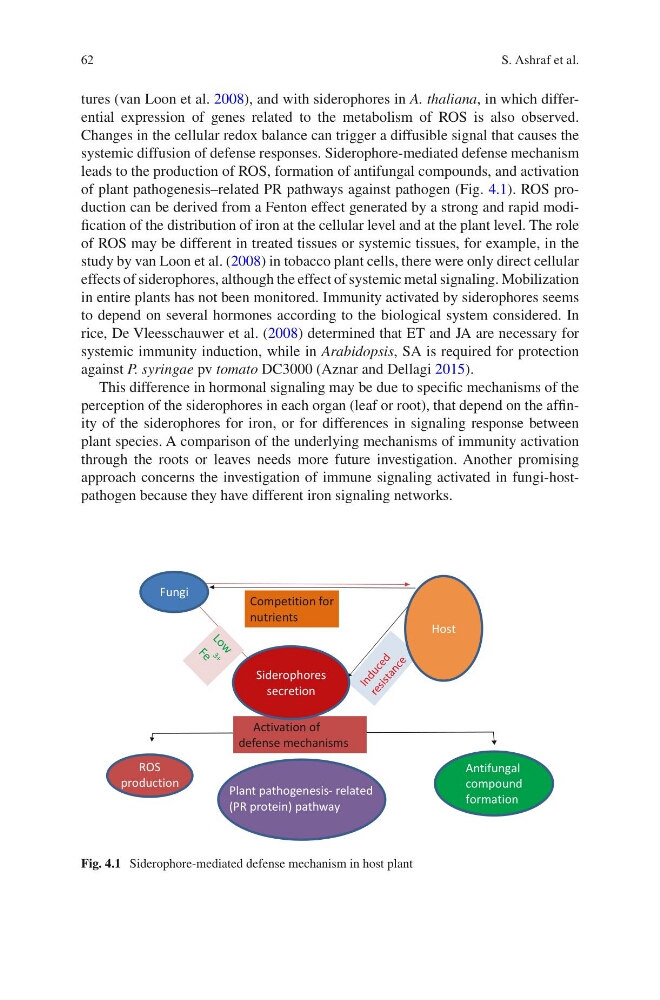
systemic diffusion of defense responses. Siderophore-mediated defense mechanism
leads to the production of ROS, formation of antifungal compounds, and activation
of plant pathogenesis–related PR pathways against pathogen (Fig. 4.1). ROS production can be derived from a Fenton effect generated by a strong and rapid modification of the distribution of iron at the cellular level and at the plant level. The role
of ROS may be different in treated tissues or systemic tissues, for example, in the
study by van Loon et al. (2008) in tobacco plant cells, there were only direct cellular
effects of siderophores, although the effect of systemic metal signaling. Mobilization
in entire plants has not been monitored. Immunity activated by siderophores seems
to depend on several hormones according to the biological system considered. In
rice, De Vleesschauwer et al. (2008) determined that ET and JA are necessary for
systemic immunity induction, while in Arabidopsis, SA is required for protection
against P. syringae pv tomato DC3000 (Aznar and Dellagi 2015).
This difference in hormonal signaling may be due to specific mechanisms of the
perception of the siderophores in each organ (leaf or root), that depend on the affinity of the siderophores for iron, or for differences in signaling response between
plant species. A comparison of the underlying mechanisms of immunity activation
through the roots or leaves needs more future investigation. Another promising
approach concerns the investigation of immune signaling activated in fungi-hostpathogen because they have different iron signaling networks.
Competition for
nutrients
Activation of
defense mechanisms
Fungi
Host
Siderophores
Antifungal
compound
formation
secretion
ROS
production
Plant pathogenesis- related
(PR protein) pathway
I n d u c e d
r e s i s t a n c e
Fig. 4.1 Siderophore-mediated defense mechanism in host plant
S. Ashraf et al.
tures (van Loon et al. 2008), and with siderophores in A. thaliana, in which differential expression of genes related to the metabolism of ROS is also observed.
Changes in the cellular redox balance can trigger a diffusible signal that causes the
systemic diffusion of defense responses. Siderophore-mediated defense mechanism
leads to the production of ROS, formation of antifungal compounds, and activation
of plant pathogenesis–related PR pathways against pathogen (Fig. 4.1). ROS production can be derived from a Fenton effect generated by a strong and rapid modification of the distribution of iron at the cellular level and at the plant level. The role
of ROS may be different in treated tissues or systemic tissues, for example, in the
study by van Loon et al. (2008) in tobacco plant cells, there were only direct cellular
effects of siderophores, although the effect of systemic metal signaling. Mobilization
in entire plants has not been monitored. Immunity activated by siderophores seems
to depend on several hormones according to the biological system considered. In
rice, De Vleesschauwer et al. (2008) determined that ET and JA are necessary for
systemic immunity induction, while in Arabidopsis, SA is required for protection
against P. syringae pv tomato DC3000 (Aznar and Dellagi 2015).
This difference in hormonal signaling may be due to specific mechanisms of the
perception of the siderophores in each organ (leaf or root), that depend on the affinity of the siderophores for iron, or for differences in signaling response between
plant species. A comparison of the underlying mechanisms of immunity activation
through the roots or leaves needs more future investigation. Another promising
approach concerns the investigation of immune signaling activated in fungi-hostpathogen because they have different iron signaling networks.
Competition for
nutrients
Activation of
defense mechanisms
Fungi
Host
Siderophores
Antifungal
compound
formation
secretion
ROS
production
Plant pathogenesis- related
(PR protein) pathway
I n d u c e d
r e s i s t a n c e
Fig. 4.1 Siderophore-mediated defense mechanism in host plant
S. Ashraf et al.