

55
for siderophore production are Aspergillus fumigatus and Aspergillus nidulans having 55 similar types of siderophore. The types of siderophores produced in plants
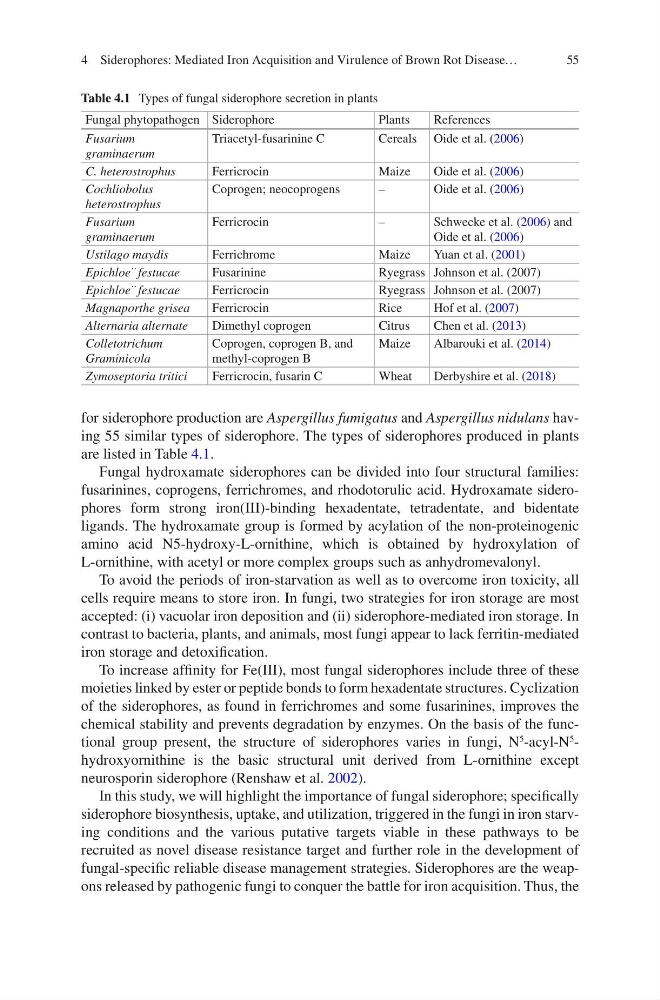
are listed in Table 4.1.
Fungal hydroxamate siderophores can be divided into four structural families:
fusarinines, coprogens, ferrichromes, and rhodotorulic acid. Hydroxamate siderophores form strong iron(III)-binding hexadentate, tetradentate, and bidentate
ligands. The hydroxamate group is formed by acylation of the non-proteinogenic
amino acid N5-hydroxy-L-ornithine, which is obtained by hydroxylation of
L-ornithine, with acetyl or more complex groups such as anhydromevalonyl.
To avoid the periods of iron-starvation as well as to overcome iron toxicity, all
cells require means to store iron. In fungi, two strategies for iron storage are most
accepted: (i) vacuolar iron deposition and (ii) siderophore-mediated iron storage. In
contrast to bacteria, plants, and animals, most fungi appear to lack ferritin-mediated
iron storage and detoxification.
To increase affinity for Fe(III), most fungal siderophores include three of these
moieties linked by ester or peptide bonds to form hexadentate structures. Cyclization
of the siderophores, as found in ferrichromes and some fusarinines, improves the
chemical stability and prevents degradation by enzymes. On the basis of the functional group present, the structure of siderophores varies in fungi, N
5
-acyl-N
5
-
hydroxyornithine is the basic structural unit derived from L-ornithine except
neurosporin siderophore (Renshaw et al. 2002).
In this study, we will highlight the importance of fungal siderophore; specifically
siderophore biosynthesis, uptake, and utilization, triggered in the fungi in iron starving conditions and the various putative targets viable in these pathways to be
recruited as novel disease resistance target and further role in the development of
fungal-specific reliable disease management strategies. Siderophores are the weapons released by pathogenic fungi to conquer the battle for iron acquisition. Thus, the
Table 4.1 Types of fungal siderophore secretion in plants
Fungal phytopathogen Siderophore
Plants
References
Fusarium
graminaerum
Triacetyl-fusarinine C
Cereals Oide et al. (2006)
C. heterostrophus
Ferricrocin
Maize
Oide et al. (2006)
Cochliobolus
heterostrophus
Coprogen; neocoprogens
–
Oide et al. (2006)
Fusarium
graminaerum
Ferricrocin
–
Schwecke et al. (2006) and
Oide et al. (2006)
Ustilago maydis
Ferrichrome
Maize
Yuan et al. (2001)
Epichloe¨ festucae
Fusarinine
Ryegrass Johnson et al. (2007)
Epichloe¨ festucae
Ferricrocin
Ryegrass Johnson et al. (2007)
Magnaporthe grisea
Ferricrocin
Rice
Hof et al. (2007)
Alternaria alternate
Dimethyl coprogen
Citrus
Chen et al. (2013)
Colletotrichum
Graminicola
Coprogen, coprogen B, and
methyl-coprogen B
Maize
Albarouki et al. (2014)
Zymoseptoria tritici
Ferricrocin, fusarin C
Wheat
Derbyshire et al. (2018)
4 Siderophores: Mediated Iron Acquisition and Virulence of Brown Rot Disease…
for siderophore production are Aspergillus fumigatus and Aspergillus nidulans having 55 similar types of siderophore. The types of siderophores produced in plants
are listed in Table 4.1.
Fungal hydroxamate siderophores can be divided into four structural families:
fusarinines, coprogens, ferrichromes, and rhodotorulic acid. Hydroxamate siderophores form strong iron(III)-binding hexadentate, tetradentate, and bidentate
ligands. The hydroxamate group is formed by acylation of the non-proteinogenic
amino acid N5-hydroxy-L-ornithine, which is obtained by hydroxylation of
L-ornithine, with acetyl or more complex groups such as anhydromevalonyl.
To avoid the periods of iron-starvation as well as to overcome iron toxicity, all
cells require means to store iron. In fungi, two strategies for iron storage are most
accepted: (i) vacuolar iron deposition and (ii) siderophore-mediated iron storage. In
contrast to bacteria, plants, and animals, most fungi appear to lack ferritin-mediated
iron storage and detoxification.
To increase affinity for Fe(III), most fungal siderophores include three of these
moieties linked by ester or peptide bonds to form hexadentate structures. Cyclization
of the siderophores, as found in ferrichromes and some fusarinines, improves the
chemical stability and prevents degradation by enzymes. On the basis of the functional group present, the structure of siderophores varies in fungi, N
5
-acyl-N
5
-
hydroxyornithine is the basic structural unit derived from L-ornithine except
neurosporin siderophore (Renshaw et al. 2002).
In this study, we will highlight the importance of fungal siderophore; specifically
siderophore biosynthesis, uptake, and utilization, triggered in the fungi in iron starving conditions and the various putative targets viable in these pathways to be
recruited as novel disease resistance target and further role in the development of
fungal-specific reliable disease management strategies. Siderophores are the weapons released by pathogenic fungi to conquer the battle for iron acquisition. Thus, the
Table 4.1 Types of fungal siderophore secretion in plants
Fungal phytopathogen Siderophore
Plants
References
Fusarium
graminaerum
Triacetyl-fusarinine C
Cereals Oide et al. (2006)
C. heterostrophus
Ferricrocin
Maize
Oide et al. (2006)
Cochliobolus
heterostrophus
Coprogen; neocoprogens
–
Oide et al. (2006)
Fusarium
graminaerum
Ferricrocin
–
Schwecke et al. (2006) and
Oide et al. (2006)
Ustilago maydis
Ferrichrome
Maize
Yuan et al. (2001)
Epichloe¨ festucae
Fusarinine
Ryegrass Johnson et al. (2007)
Epichloe¨ festucae
Ferricrocin
Ryegrass Johnson et al. (2007)
Magnaporthe grisea
Ferricrocin
Rice
Hof et al. (2007)
Alternaria alternate
Dimethyl coprogen
Citrus
Chen et al. (2013)
Colletotrichum
Graminicola
Coprogen, coprogen B, and
methyl-coprogen B
Maize
Albarouki et al. (2014)
Zymoseptoria tritici
Ferricrocin, fusarin C
Wheat
Derbyshire et al. (2018)
4 Siderophores: Mediated Iron Acquisition and Virulence of Brown Rot Disease…