

24
et al. 2014). The connection of AAP protein in interfering with siderophore biosynthetic pathway was established using mass spectrometry analysis which discloses
the structural similarity of trypsin-digested fragments of AAP with siderophore biosynthetic protein in A. fumigatus.
Similarly, Zhang et al. reported the antifungal peptide for saprolegniasis (fungal
fish disease) isolated from Pseudomonas protegens. The compound was found to be
active against Saprolegnia spore germination and hyphal growth. MIC value of the
purified protein against Saprolegnia spores was identified to be 0.0625 mg ml
−1
. The
stability of investigated peptide falls in the temperature range of 30 °C and 60 °C
with narrow working pH range of 5.0–9.0. These investigations demonstrate the
potential of P. protegens as measure for saprolegniasis in aquaculture industry.
Hence, this approach can be exploited to search for more such organisms producing antifungal proteins that can interfere with iron uptake machinery of pathogenic
microbes by interrupting the biosynthetic pathways of siderophore production.
2.4.4 Trojan Horse Approach
One effective method to circumvent the permeability-mediated drug resistance was
to utilize “Trojan horse” strategy. This concept is based on targeting the siderophores as antimicrobial weapon and killing the bacteria by either limiting the iron
uptake mechanism of pathogen or by complexing the drug with siderophore as
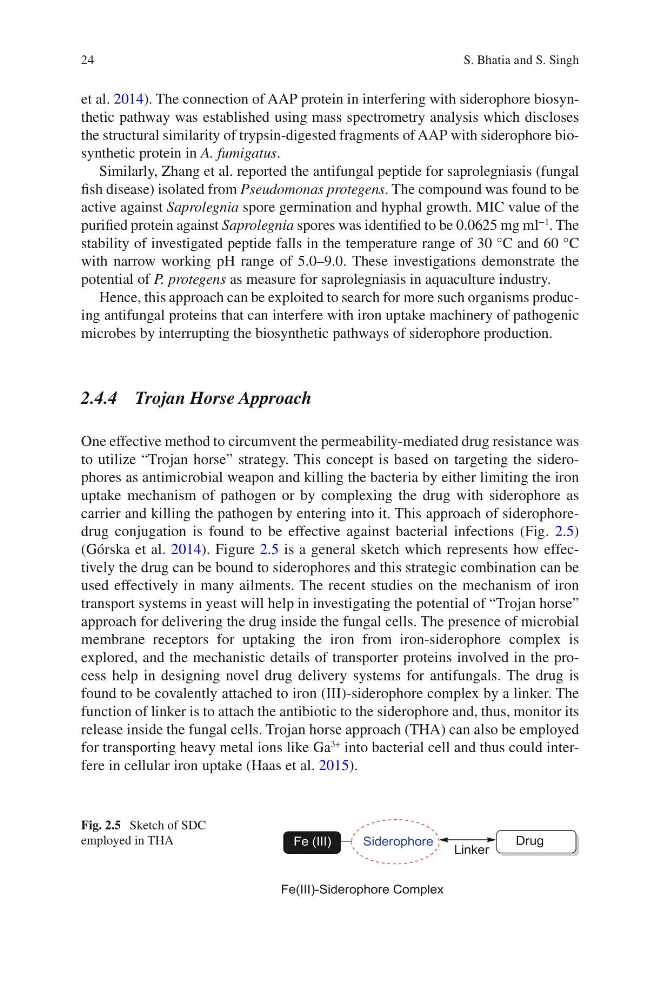
carrier and killing the pathogen by entering into it. This approach of siderophoredrug conjugation is found to be effective against bacterial infections (Fig. 2.5)
(Górska et al. 2014). Figure 2.5 is a general sketch which represents how effectively the drug can be bound to siderophores and this strategic combination can be
used effectively in many ailments. The recent studies on the mechanism of iron
transport systems in yeast will help in investigating the potential of “Trojan horse”
approach for delivering the drug inside the fungal cells. The presence of microbial
membrane receptors for uptaking the iron from iron-siderophore complex is
explored, and the mechanistic details of transporter proteins involved in the process help in designing novel drug delivery systems for antifungals. The drug is
found to be covalently attached to iron (III)-siderophore complex by a linker. The
function of linker is to attach the antibiotic to the siderophore and, thus, monitor its
release inside the fungal cells. Trojan horse approach (THA) can also be employed
for transporting heavy metal ions like Ga
3+
into bacterial cell and thus could interfere in cellular iron uptake (Haas et al. 2015).
Fig. 2.5 Sketch of SDC
employed in THA
S. Bhatia and S. Singh
et al. 2014). The connection of AAP protein in interfering with siderophore biosynthetic pathway was established using mass spectrometry analysis which discloses
the structural similarity of trypsin-digested fragments of AAP with siderophore biosynthetic protein in A. fumigatus.
Similarly, Zhang et al. reported the antifungal peptide for saprolegniasis (fungal
fish disease) isolated from Pseudomonas protegens. The compound was found to be
active against Saprolegnia spore germination and hyphal growth. MIC value of the
purified protein against Saprolegnia spores was identified to be 0.0625 mg ml
−1
. The
stability of investigated peptide falls in the temperature range of 30 °C and 60 °C
with narrow working pH range of 5.0–9.0. These investigations demonstrate the
potential of P. protegens as measure for saprolegniasis in aquaculture industry.
Hence, this approach can be exploited to search for more such organisms producing antifungal proteins that can interfere with iron uptake machinery of pathogenic
microbes by interrupting the biosynthetic pathways of siderophore production.
2.4.4 Trojan Horse Approach
One effective method to circumvent the permeability-mediated drug resistance was
to utilize “Trojan horse” strategy. This concept is based on targeting the siderophores as antimicrobial weapon and killing the bacteria by either limiting the iron
uptake mechanism of pathogen or by complexing the drug with siderophore as
carrier and killing the pathogen by entering into it. This approach of siderophoredrug conjugation is found to be effective against bacterial infections (Fig. 2.5)
(Górska et al. 2014). Figure 2.5 is a general sketch which represents how effectively the drug can be bound to siderophores and this strategic combination can be
used effectively in many ailments. The recent studies on the mechanism of iron
transport systems in yeast will help in investigating the potential of “Trojan horse”
approach for delivering the drug inside the fungal cells. The presence of microbial
membrane receptors for uptaking the iron from iron-siderophore complex is
explored, and the mechanistic details of transporter proteins involved in the process help in designing novel drug delivery systems for antifungals. The drug is
found to be covalently attached to iron (III)-siderophore complex by a linker. The
function of linker is to attach the antibiotic to the siderophore and, thus, monitor its
release inside the fungal cells. Trojan horse approach (THA) can also be employed
for transporting heavy metal ions like Ga
3+
into bacterial cell and thus could interfere in cellular iron uptake (Haas et al. 2015).
Fig. 2.5 Sketch of SDC
employed in THA
S. Bhatia and S. Singh