

21
the biosynthesis of siderophore. Similar approach was also applied for targeting
kynurenine monooxygenase (KMO) for reducing the pathogenesis of Trypanosoma
brucei among African population suffering from neurodegenerative disorders. The
high-affinity KMO inhibitor (Ro-61-8048) was recognized which was found to be
effective in manipulating the kynurenine pathway in a highly reproducible mouse
model of human African trypanosomiasis (Rodgers et al. 2009; Zwilling et al. 2011).
Hence, such site-directed inhibitors can be explored using high-throughput screening which can be a virtuous approach for targeting antifungal therapy. In contrast to
this, another approach involves the blocking of multifunctional NRPS enzymes
which synthesize macrocyclic secondary metabolites including siderophores. The
secondary metabolism and virulence is closely linked in fungal pathogens invading
plants and humans (Keller et al. 2005). A. fumigatus and C. neoformans are the
examples of human-invading fungus which produces melanin as a product of secondary metabolism which contributes in their pathogenicity by quenching reactive
oxygen species and protecting hyphae by invasion from human monocyte. This
NRPS synthesis is activated in the biological system by phosphopantetheine transferase (PptA) which catalyzed the processes of phosphopantetheinylation that
proves to be a novel target for antifungal therapy in A. fumigatus through gene-specific mutant studies (Horbach et al. 2009; Allen et al. 2011). Through FP-based
assay, the screening of potential inhibitors against PptA was carried out where the
activity of targeted enzyme can be monitored by quantifying the polarization signals. This protocol can be extended further for the determination of toxicity of
potential inhibitors for evaluating the therapeutic index of lead compounds. Another
advantage for targeting PptA was to design pathogen-specific inhibitors as the PptA
enzyme was found to differ considerably in its sequence between host (humans,
plants, animals) and pathogen (bacteria and fungi). Hence, this target is newly identified and can be explored in a logical manner for identifying pathogen-specific antifungal drugs. The diverse approaches adopted against siderophore- linked iron
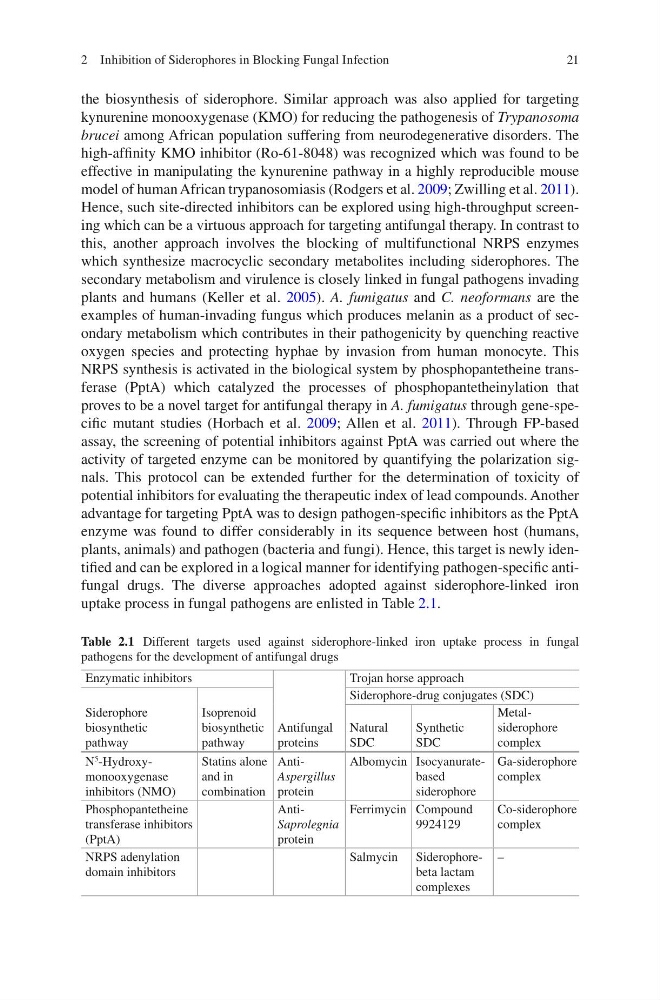
uptake process in fungal pathogens are enlisted in Table 2.1.
Table 2.1 Different targets used against siderophore-linked iron uptake process in fungal
pathogens for the development of antifungal drugs
Enzymatic inhibitors
Antifungal
proteins
Trojan horse approach
Siderophore
biosynthetic
pathway
Isoprenoid
biosynthetic
pathway
Siderophore-drug conjugates (SDC)
Natural
SDC
Synthetic
SDC
Metalsiderophore
complex
N
5
-Hydroxymonooxygenase
inhibitors (NMO)
Statins alone
and in
combination
AntiAspergillus
protein
Albomycin Isocyanuratebased
siderophore
Ga-siderophore
complex
Phosphopantetheine
transferase inhibitors
(PptA)
AntiSaprolegnia
protein
Ferrimycin Compound
9924129
Co-siderophore
complex
NRPS adenylation
domain inhibitors
Salmycin Siderophorebeta lactam
complexes
–
2 Inhibition of Siderophores in Blocking Fungal Infection
the biosynthesis of siderophore. Similar approach was also applied for targeting
kynurenine monooxygenase (KMO) for reducing the pathogenesis of Trypanosoma
brucei among African population suffering from neurodegenerative disorders. The
high-affinity KMO inhibitor (Ro-61-8048) was recognized which was found to be
effective in manipulating the kynurenine pathway in a highly reproducible mouse
model of human African trypanosomiasis (Rodgers et al. 2009; Zwilling et al. 2011).
Hence, such site-directed inhibitors can be explored using high-throughput screening which can be a virtuous approach for targeting antifungal therapy. In contrast to
this, another approach involves the blocking of multifunctional NRPS enzymes
which synthesize macrocyclic secondary metabolites including siderophores. The
secondary metabolism and virulence is closely linked in fungal pathogens invading
plants and humans (Keller et al. 2005). A. fumigatus and C. neoformans are the
examples of human-invading fungus which produces melanin as a product of secondary metabolism which contributes in their pathogenicity by quenching reactive
oxygen species and protecting hyphae by invasion from human monocyte. This
NRPS synthesis is activated in the biological system by phosphopantetheine transferase (PptA) which catalyzed the processes of phosphopantetheinylation that
proves to be a novel target for antifungal therapy in A. fumigatus through gene-specific mutant studies (Horbach et al. 2009; Allen et al. 2011). Through FP-based
assay, the screening of potential inhibitors against PptA was carried out where the
activity of targeted enzyme can be monitored by quantifying the polarization signals. This protocol can be extended further for the determination of toxicity of
potential inhibitors for evaluating the therapeutic index of lead compounds. Another
advantage for targeting PptA was to design pathogen-specific inhibitors as the PptA
enzyme was found to differ considerably in its sequence between host (humans,
plants, animals) and pathogen (bacteria and fungi). Hence, this target is newly identified and can be explored in a logical manner for identifying pathogen-specific antifungal drugs. The diverse approaches adopted against siderophore- linked iron
uptake process in fungal pathogens are enlisted in Table 2.1.
Table 2.1 Different targets used against siderophore-linked iron uptake process in fungal
pathogens for the development of antifungal drugs
Enzymatic inhibitors
Antifungal
proteins
Trojan horse approach
Siderophore
biosynthetic
pathway
Isoprenoid
biosynthetic
pathway
Siderophore-drug conjugates (SDC)
Natural
SDC
Synthetic
SDC
Metalsiderophore
complex
N
5
-Hydroxymonooxygenase
inhibitors (NMO)
Statins alone
and in
combination
AntiAspergillus
protein
Albomycin Isocyanuratebased
siderophore
Ga-siderophore
complex
Phosphopantetheine
transferase inhibitors
(PptA)
AntiSaprolegnia
protein
Ferrimycin Compound
9924129
Co-siderophore
complex
NRPS adenylation
domain inhibitors
Salmycin Siderophorebeta lactam
complexes
–
2 Inhibition of Siderophores in Blocking Fungal Infection