

193
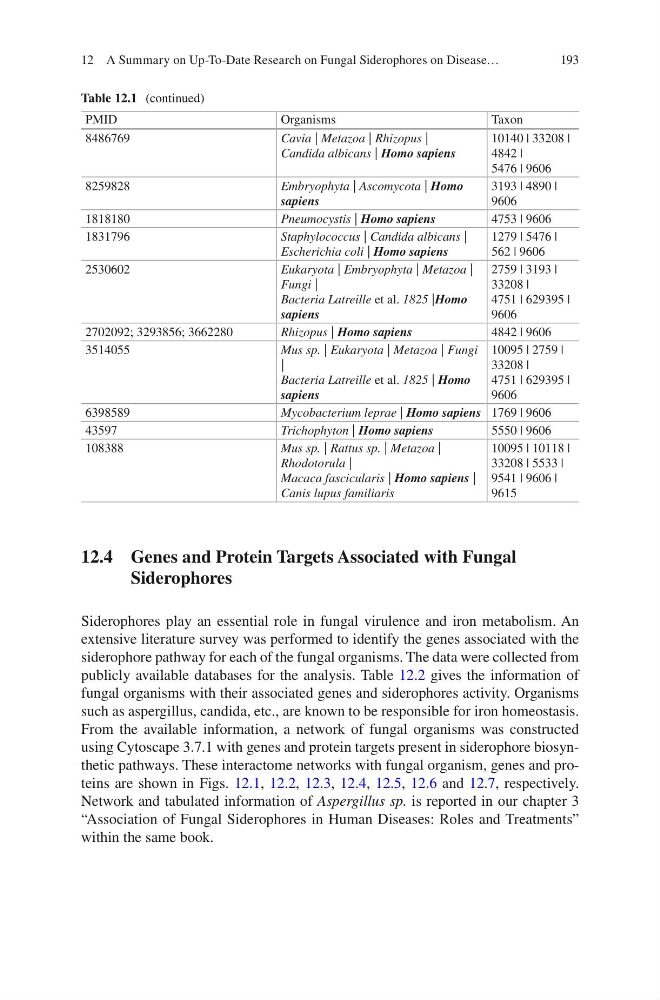
Table 12.1 (continued)
PMID
Organisms
Taxon
8486769
Cavia | Metazoa | Rhizopus |
Candida albicans | Homo sapiens
10140 | 33208 |
4842 |
5476 | 9606
8259828
Embryophyta | Ascomycota | Homo
sapiens
3193 | 4890 |
9606
1818180
Pneumocystis | Homo sapiens
4753 | 9606
1831796
Staphylococcus | Candida albicans |
Escherichia coli | Homo sapiens
1279 | 5476 |
562 | 9606
2530602
Eukaryota | Embryophyta | Metazoa |
Fungi |
Bacteria Latreille et al. 1825 |Homo
sapiens
2759 | 3193 |
33208 |
4751 | 629395 |
9606
2702092; 3293856; 3662280
Rhizopus | Homo sapiens
4842 | 9606
3514055
Mus sp. | Eukaryota | Metazoa | Fungi
|
Bacteria Latreille et al. 1825 | Homo
sapiens
10095 | 2759 |
33208 |
4751 | 629395 |
9606
6398589
Mycobacterium leprae | Homo sapiens 1769 | 9606
43597
Trichophyton | Homo sapiens
5550 | 9606
108388
Mus sp. | Rattus sp. | Metazoa |
Rhodotorula |
Macaca fascicularis | Homo sapiens |
Canis lupus familiaris
10095 | 10118 |
33208 | 5533 |
9541 | 9606 |
9615
12.4 Genes and Protein Targets Associated with Fungal
Siderophores
Siderophores play an essential role in fungal virulence and iron metabolism. An
extensive literature survey was performed to identify the genes associated with the
siderophore pathway for each of the fungal organisms. The data were collected from
publicly available databases for the analysis. Table 12.2 gives the information of
fungal organisms with their associated genes and siderophores activity. Organisms
such as aspergillus, candida, etc., are known to be responsible for iron homeostasis.
From the available information, a network of fungal organisms was constructed
using Cytoscape 3.7.1 with genes and protein targets present in siderophore biosynthetic pathways. These interactome networks with fungal organism, genes and proteins are shown in Figs. 12.1, 12.2, 12.3, 12.4, 12.5, 12.6 and 12.7, respectively.
Network and tabulated information of Aspergillus sp. is reported in our chapter 3
“Association of Fungal Siderophores in Human Diseases: Roles and Treatments”
within the same book.
12 A Summary on Up-To-Date Research on Fungal Siderophores on Disease…
Table 12.1 (continued)
PMID
Organisms
Taxon
8486769
Cavia | Metazoa | Rhizopus |
Candida albicans | Homo sapiens
10140 | 33208 |
4842 |
5476 | 9606
8259828
Embryophyta | Ascomycota | Homo
sapiens
3193 | 4890 |
9606
1818180
Pneumocystis | Homo sapiens
4753 | 9606
1831796
Staphylococcus | Candida albicans |
Escherichia coli | Homo sapiens
1279 | 5476 |
562 | 9606
2530602
Eukaryota | Embryophyta | Metazoa |
Fungi |
Bacteria Latreille et al. 1825 |Homo
sapiens
2759 | 3193 |
33208 |
4751 | 629395 |
9606
2702092; 3293856; 3662280
Rhizopus | Homo sapiens
4842 | 9606
3514055
Mus sp. | Eukaryota | Metazoa | Fungi
|
Bacteria Latreille et al. 1825 | Homo
sapiens
10095 | 2759 |
33208 |
4751 | 629395 |
9606
6398589
Mycobacterium leprae | Homo sapiens 1769 | 9606
43597
Trichophyton | Homo sapiens
5550 | 9606
108388
Mus sp. | Rattus sp. | Metazoa |
Rhodotorula |
Macaca fascicularis | Homo sapiens |
Canis lupus familiaris
10095 | 10118 |
33208 | 5533 |
9541 | 9606 |
9615
12.4 Genes and Protein Targets Associated with Fungal
Siderophores
Siderophores play an essential role in fungal virulence and iron metabolism. An
extensive literature survey was performed to identify the genes associated with the
siderophore pathway for each of the fungal organisms. The data were collected from
publicly available databases for the analysis. Table 12.2 gives the information of
fungal organisms with their associated genes and siderophores activity. Organisms
such as aspergillus, candida, etc., are known to be responsible for iron homeostasis.
From the available information, a network of fungal organisms was constructed
using Cytoscape 3.7.1 with genes and protein targets present in siderophore biosynthetic pathways. These interactome networks with fungal organism, genes and proteins are shown in Figs. 12.1, 12.2, 12.3, 12.4, 12.5, 12.6 and 12.7, respectively.
Network and tabulated information of Aspergillus sp. is reported in our chapter 3
“Association of Fungal Siderophores in Human Diseases: Roles and Treatments”
within the same book.
12 A Summary on Up-To-Date Research on Fungal Siderophores on Disease…