

9
mitochondria to the glutaredoxins (Arstol and Hohmann-Marriot 2019; Gerwien
et al. 2016). In iron-excess environment, the Fe-S clusters in mitochondria activate
the iron-responsive regulator yap 5 that targets two genes, CCC1 that codes for the
vacuolar iron importer and CUP1 that codes for the copper-binding metallothionein
(Ueta et al. 2012; Li et al. 2008, 2012; Pimentel et al. 2012).
1.9 Siderophores and Pathogenicity
In some species, production of siderophores serves as virulence component which
controls pathogenicity. The variant of Microbotryum violaceum, a plant pathogen,
produces little quantity of siderophores and it is almost devoid of pathogenic ability.
The growth of fungi that are pathogenic to plants may be controlled by the utilization of atypical siderophores produced by nonpathogenic fungi. Such fungi are
deemed to be useful for plants. The published literature confirms that the plants are
capable of acquisition of iron through siderophores to a minimum level (Renshaw
et al. 2002; Saha et al. 2012, 2015).
1.10 Applications
Fungal siderophores can either be beneficial or detrimental to our environment
based on their use in bioremediation process. The aforementioned examples clearly
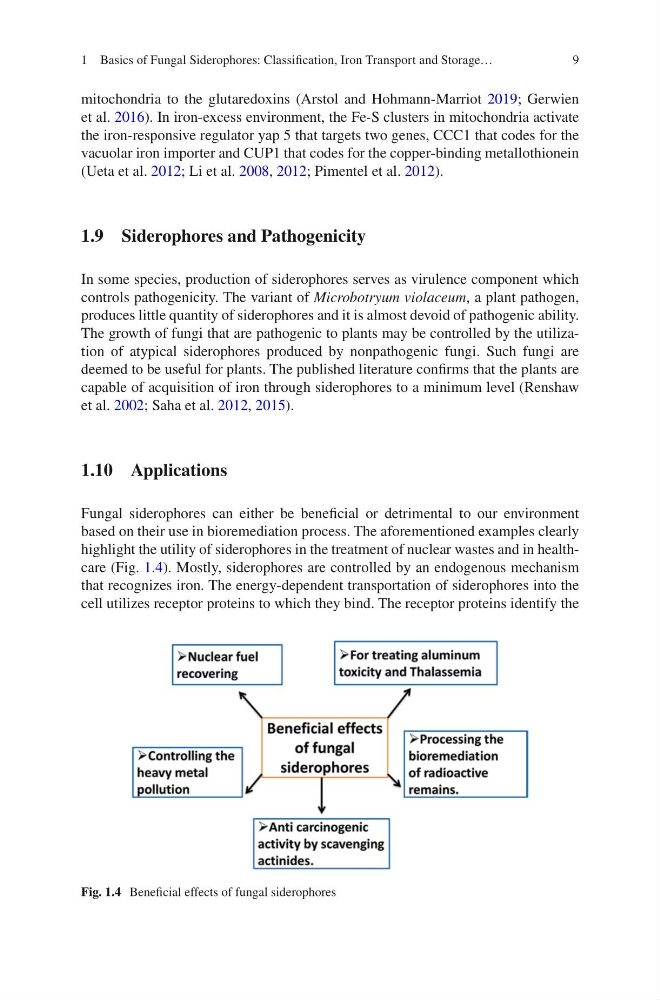
highlight the utility of siderophores in the treatment of nuclear wastes and in healthcare (Fig. 1.4). Mostly, siderophores are controlled by an endogenous mechanism
that recognizes iron. The energy-dependent transportation of siderophores into the
cell utilizes receptor proteins to which they bind. The receptor proteins identify the
Fig. 1.4 Beneficial effects of fungal siderophores
1 Basics of Fungal Siderophores: Classification, Iron Transport and Storage…
mitochondria to the glutaredoxins (Arstol and Hohmann-Marriot 2019; Gerwien
et al. 2016). In iron-excess environment, the Fe-S clusters in mitochondria activate
the iron-responsive regulator yap 5 that targets two genes, CCC1 that codes for the
vacuolar iron importer and CUP1 that codes for the copper-binding metallothionein
(Ueta et al. 2012; Li et al. 2008, 2012; Pimentel et al. 2012).
1.9 Siderophores and Pathogenicity
In some species, production of siderophores serves as virulence component which
controls pathogenicity. The variant of Microbotryum violaceum, a plant pathogen,
produces little quantity of siderophores and it is almost devoid of pathogenic ability.
The growth of fungi that are pathogenic to plants may be controlled by the utilization of atypical siderophores produced by nonpathogenic fungi. Such fungi are
deemed to be useful for plants. The published literature confirms that the plants are
capable of acquisition of iron through siderophores to a minimum level (Renshaw
et al. 2002; Saha et al. 2012, 2015).
1.10 Applications
Fungal siderophores can either be beneficial or detrimental to our environment
based on their use in bioremediation process. The aforementioned examples clearly
highlight the utility of siderophores in the treatment of nuclear wastes and in healthcare (Fig. 1.4). Mostly, siderophores are controlled by an endogenous mechanism
that recognizes iron. The energy-dependent transportation of siderophores into the
cell utilizes receptor proteins to which they bind. The receptor proteins identify the
Fig. 1.4 Beneficial effects of fungal siderophores
1 Basics of Fungal Siderophores: Classification, Iron Transport and Storage…