

177
rhodotorulic acid comprises only two such hydroxamates whereas the rest have
three hydroxamates joined together by peptide or ester bonds. In the ferrichrome
family of fungal siderophores, NRPS also incorporates three more amino acids:
glycine, serine and alanine (Haas 2014; Haas 2003; Mercier and Labbé 2010). The
genes sid2 and sidC encoding this synthetase enzyme are observed in U. maydis and
A. nidulans, respectively (Bushley et al. 2008; Eichhorn et al. 2006). Studies also
showed that the disruption of these genes blocks the siderophore biosynthesis. This
ensures their significance in the survival of the pathogen in an iron-deficit condition.
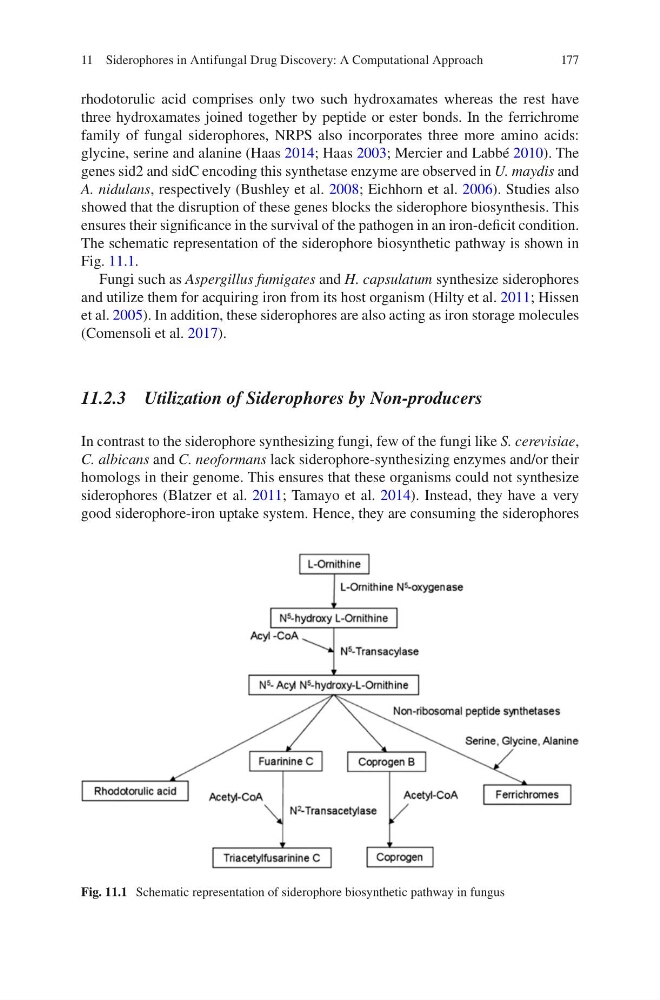
The schematic representation of the siderophore biosynthetic pathway is shown in
Fig. 11.1.
Fungi such as Aspergillus fumigates and H. capsulatum synthesize siderophores
and utilize them for acquiring iron from its host organism (Hilty et al. 2011; Hissen
et al. 2005). In addition, these siderophores are also acting as iron storage molecules
(Comensoli et al. 2017).
11.2.3 Utilization of Siderophores by Non-producers
In contrast to the siderophore synthesizing fungi, few of the fungi like S. cerevisiae,
C. albicans and C. neoformans lack siderophore-synthesizing enzymes and/or their
homologs in their genome. This ensures that these organisms could not synthesize
siderophores (Blatzer et al. 2011; Tamayo et al. 2014). Instead, they have a very
good siderophore-iron uptake system. Hence, they are consuming the siderophores
Fig. 11.1 Schematic representation of siderophore biosynthetic pathway in fungus
11 Siderophores in Antifungal Drug Discovery: A Computational Approach
rhodotorulic acid comprises only two such hydroxamates whereas the rest have
three hydroxamates joined together by peptide or ester bonds. In the ferrichrome
family of fungal siderophores, NRPS also incorporates three more amino acids:
glycine, serine and alanine (Haas 2014; Haas 2003; Mercier and Labbé 2010). The
genes sid2 and sidC encoding this synthetase enzyme are observed in U. maydis and
A. nidulans, respectively (Bushley et al. 2008; Eichhorn et al. 2006). Studies also
showed that the disruption of these genes blocks the siderophore biosynthesis. This
ensures their significance in the survival of the pathogen in an iron-deficit condition.
The schematic representation of the siderophore biosynthetic pathway is shown in
Fig. 11.1.
Fungi such as Aspergillus fumigates and H. capsulatum synthesize siderophores
and utilize them for acquiring iron from its host organism (Hilty et al. 2011; Hissen
et al. 2005). In addition, these siderophores are also acting as iron storage molecules
(Comensoli et al. 2017).
11.2.3 Utilization of Siderophores by Non-producers
In contrast to the siderophore synthesizing fungi, few of the fungi like S. cerevisiae,
C. albicans and C. neoformans lack siderophore-synthesizing enzymes and/or their
homologs in their genome. This ensures that these organisms could not synthesize
siderophores (Blatzer et al. 2011; Tamayo et al. 2014). Instead, they have a very
good siderophore-iron uptake system. Hence, they are consuming the siderophores
Fig. 11.1 Schematic representation of siderophore biosynthetic pathway in fungus
11 Siderophores in Antifungal Drug Discovery: A Computational Approach