

142
nonpathogenic organisms employ different strategies to ensure iron supply as well
as in avoiding iron toxicity (Haas 2014).
9.1.1 Iron Acquisition in Fungi
Fungi employ different strategies to access iron; they are (1) a reductive iron acquisition (RIA) pathway, (2) siderophore transporters for endogenous or exogenous
siderophores, (3) secreted cell surface reductants, and (4) endocytic pathway for
haem internalization. However, all the four pathways are not involved in the iron
acquisition of individual fungal species; instead, any one of the strategy would be
utilized (Potrykus et al. 2014). For example, Aspergillus fumigatus utilize endogenous siderophores, RIA system, as well as low-affinity iron uptake (Hissen et al.
2005). The different strategies of sequestering iron employed by different fungal
types are reported for Candida albicans, Cryptococcus neoformans, and Histoplasma
capsulatum (Potrykus et al. 2014). Fungi store the iron in the form of vacuolar iron
deposition and siderophore-mediated iron storage (Haas et al. 2008).
9.2 Fungal Siderophores
Siderophores are low molecular weight polyketide/polypeptide compounds and
non-ribosomally synthesized, secreted molecules in a wide variety of organisms
which help the organism to survive in both iron-deficit and iron-excess conditions.
It works by sequestering the environmental iron as well as iron chelators (Condon
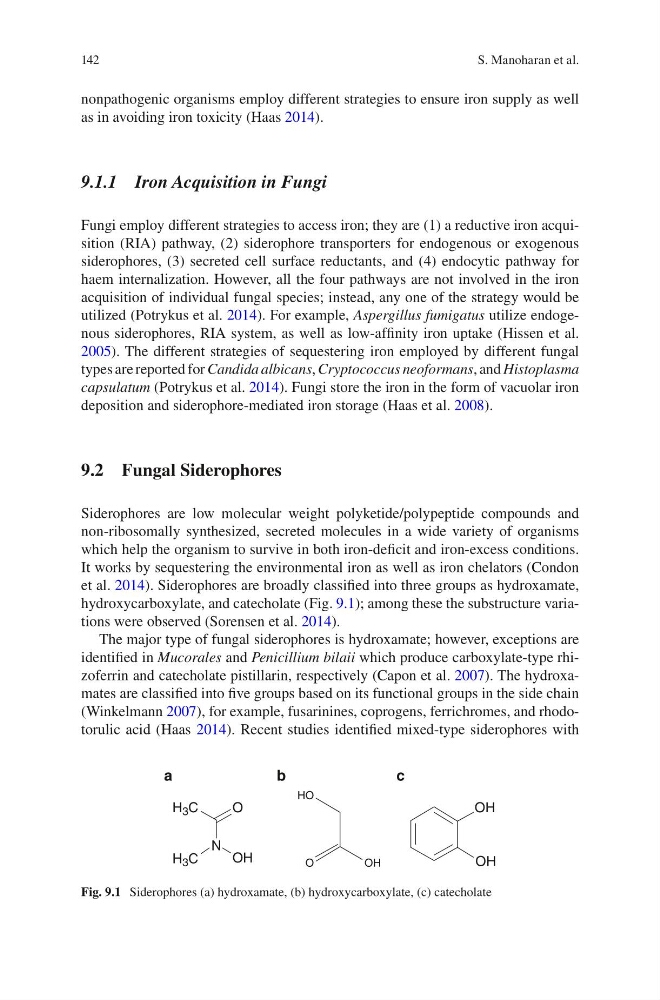
et al. 2014). Siderophores are broadly classified into three groups as hydroxamate,
hydroxycarboxylate, and catecholate (Fig. 9.1); among these the substructure variations were observed (Sorensen et al. 2014).
The major type of fungal siderophores is hydroxamate; however, exceptions are
identified in Mucorales and Penicillium bilaii which produce carboxylate-type rhizoferrin and catecholate pistillarin, respectively (Capon et al. 2007). The hydroxamates are classified into five groups based on its functional groups in the side chain
(Winkelmann 2007), for example, fusarinines, coprogens, ferrichromes, and rhodotorulic acid (Haas 2014). Recent studies identified mixed-type siderophores with
O
O
HO
N OH
OH
OH
OH
H 3 C
H 3 C
a
b
c
Fig. 9.1 Siderophores (a) hydroxamate, (b) hydroxycarboxylate, (c) catecholate
S. Manoharan et al.
nonpathogenic organisms employ different strategies to ensure iron supply as well
as in avoiding iron toxicity (Haas 2014).
9.1.1 Iron Acquisition in Fungi
Fungi employ different strategies to access iron; they are (1) a reductive iron acquisition (RIA) pathway, (2) siderophore transporters for endogenous or exogenous
siderophores, (3) secreted cell surface reductants, and (4) endocytic pathway for
haem internalization. However, all the four pathways are not involved in the iron
acquisition of individual fungal species; instead, any one of the strategy would be
utilized (Potrykus et al. 2014). For example, Aspergillus fumigatus utilize endogenous siderophores, RIA system, as well as low-affinity iron uptake (Hissen et al.
2005). The different strategies of sequestering iron employed by different fungal
types are reported for Candida albicans, Cryptococcus neoformans, and Histoplasma
capsulatum (Potrykus et al. 2014). Fungi store the iron in the form of vacuolar iron
deposition and siderophore-mediated iron storage (Haas et al. 2008).
9.2 Fungal Siderophores
Siderophores are low molecular weight polyketide/polypeptide compounds and
non-ribosomally synthesized, secreted molecules in a wide variety of organisms
which help the organism to survive in both iron-deficit and iron-excess conditions.
It works by sequestering the environmental iron as well as iron chelators (Condon
et al. 2014). Siderophores are broadly classified into three groups as hydroxamate,
hydroxycarboxylate, and catecholate (Fig. 9.1); among these the substructure variations were observed (Sorensen et al. 2014).
The major type of fungal siderophores is hydroxamate; however, exceptions are
identified in Mucorales and Penicillium bilaii which produce carboxylate-type rhizoferrin and catecholate pistillarin, respectively (Capon et al. 2007). The hydroxamates are classified into five groups based on its functional groups in the side chain
(Winkelmann 2007), for example, fusarinines, coprogens, ferrichromes, and rhodotorulic acid (Haas 2014). Recent studies identified mixed-type siderophores with
O
O
HO
N OH
OH
OH
OH
H 3 C
H 3 C
a
b
c
Fig. 9.1 Siderophores (a) hydroxamate, (b) hydroxycarboxylate, (c) catecholate
S. Manoharan et al.