

128
(Ser 1 -Ser 2 -Gly-Orn 1 -Orn 2 -Orn 3 ) forming a stable Fe
3+
octahedral complex with
three dissimilar ornithyl δ-N-acyl groups (Tables 8.2 and 8.3).
Asperchrome Bl, B2 and B3 (19–21) (Fig. 8.12, Tables 8.3 and 8.4) are functional isomers with two long ornithyl N-acyl groups and a short N-acetyl group with
difference in the position of N-acyl group on the three ornithines present on the
hexapeptide ring.
Structurally, the substitution of the acyl group in ferrichrome C (32) by malonic
acid results in malonichrome (36) (Fig. 8.12, Tables 8.3 and 8.4) found in Fusurium
roseum (Emery 1980).
The efficiency of iron transport by the siderophore in fungal systems increase
when the 3-methyl-5-hydroxy-2-pentenyl residues in the ornithines are gradually
replaced by the acetyl residues (17 > 23–25 > 19 > 35) (Fig. 8.12, Tables 8.3 and
8.4). The efficiency also depends on (i) the position of the odd acyl group when the
compounds are isomeric (19 > 20) (Fig. 8.12, Tables 8.3 and 8.4) and (ii) the
hydrophobicity of the acyl groups (asperchromes >35) and of the peptide ring
(18 > 35) (Fig. 8.12, Tables 8.3 and 8.4). Thus, the efficiency of the ferrichromes
depends on minor structural variations, the acyl part, and also the peptide ring of the
siderophore which is involved in hydrophobic interactions with the siderophorebinding protein and possibly with the outer lipid membrane (Jalal et al. 1984).
Deml et al. isolated tetraglycyl ferrichrome (38) (Fig. 8.10), the first heptapeptide ferrichrome, from Neovossia indica. Although it contained increased ring size
and conformational flexibility when compared with its hexapeptide analogues, there
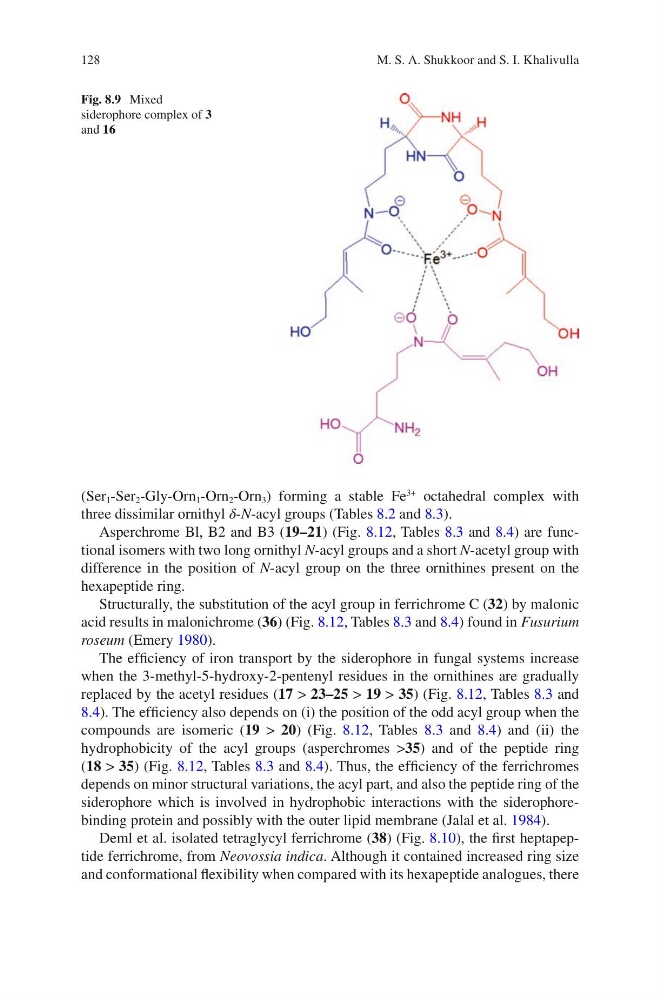
Fig. 8.9 Mixed
siderophore complex of 3
and 16
M. S. A. Shukkoor and S. I. Khalivulla
(Ser 1 -Ser 2 -Gly-Orn 1 -Orn 2 -Orn 3 ) forming a stable Fe
3+
octahedral complex with
three dissimilar ornithyl δ-N-acyl groups (Tables 8.2 and 8.3).
Asperchrome Bl, B2 and B3 (19–21) (Fig. 8.12, Tables 8.3 and 8.4) are functional isomers with two long ornithyl N-acyl groups and a short N-acetyl group with
difference in the position of N-acyl group on the three ornithines present on the
hexapeptide ring.
Structurally, the substitution of the acyl group in ferrichrome C (32) by malonic
acid results in malonichrome (36) (Fig. 8.12, Tables 8.3 and 8.4) found in Fusurium
roseum (Emery 1980).
The efficiency of iron transport by the siderophore in fungal systems increase
when the 3-methyl-5-hydroxy-2-pentenyl residues in the ornithines are gradually
replaced by the acetyl residues (17 > 23–25 > 19 > 35) (Fig. 8.12, Tables 8.3 and
8.4). The efficiency also depends on (i) the position of the odd acyl group when the
compounds are isomeric (19 > 20) (Fig. 8.12, Tables 8.3 and 8.4) and (ii) the
hydrophobicity of the acyl groups (asperchromes >35) and of the peptide ring
(18 > 35) (Fig. 8.12, Tables 8.3 and 8.4). Thus, the efficiency of the ferrichromes
depends on minor structural variations, the acyl part, and also the peptide ring of the
siderophore which is involved in hydrophobic interactions with the siderophorebinding protein and possibly with the outer lipid membrane (Jalal et al. 1984).
Deml et al. isolated tetraglycyl ferrichrome (38) (Fig. 8.10), the first heptapeptide ferrichrome, from Neovossia indica. Although it contained increased ring size
and conformational flexibility when compared with its hexapeptide analogues, there
Fig. 8.9 Mixed
siderophore complex of 3
and 16
M. S. A. Shukkoor and S. I. Khalivulla