

123
8.2.1 Coprogens
Coprogens (Table 8.1) are connected by a head-to-head dipeptide bond of two N
5
-
hydroxy- N
5
-acyl-l-ornithine monomers to form a cyclic dipeptide or diketopiperazine unit in the middle and hydroxamate members towards the end with different
substituents. Dihydroxamate members (2, 3) (Fig. 8.5) of the coprogen family (also
called Rhodotorulic acid family) are rhodotorulic acid and dimerum acid. In the
trihydroxamate members of the coprogen family, the additional monomer of substituted N
5
-hydroxy-N
5
-acyl-l-ornithine is linked either side by an ester bond (4–15)
(Figs. 8.6 and 8.7).
8.2.1.1 Dihydroxamate Coprogens
Rhodotorulic acid (2), containing two acetyl groups, was first isolated from the
yeast Rhodotorula pilimanae in 1967 by Atkin et al. (Atkin and Neilands 1968), and
from fungus Ustilago inflorescentiae by Muller et al. (Muller et al. 1985). The
dimerum acid (3) formed by a head-to-head peptide bond of trans-fusarinine moiety
was first isolated from the fungus Fusarium dimerum (Diekmann 1970) and connected with two trans-anhydromevalonoyl residues.
8.2.1.2 Trihydroxamate Coprogens
In the trihydroxamate coprogen members, a N
5
-hydroxy-N
5
-acyl-l-ornithine (or
trans-fusarinine) and trans-fusarinine form a head-to-head dipeptide bond, and an
additional substituted N
5
-hydroxy-N
5
-acyl-l-ornithine (or substituted transfusarinine) moieties laterally attaches to the trans-fusarinine side chain to form an
ester bond. In these compounds, the common chemical groups are ornithyl residues
and the middle N
δ
-trans-anhydromevalonoyl groups. In coprogen (4), the third
trans-fusarinine, the free amine (N
2
) group hydrogen is replaced with acyl group.
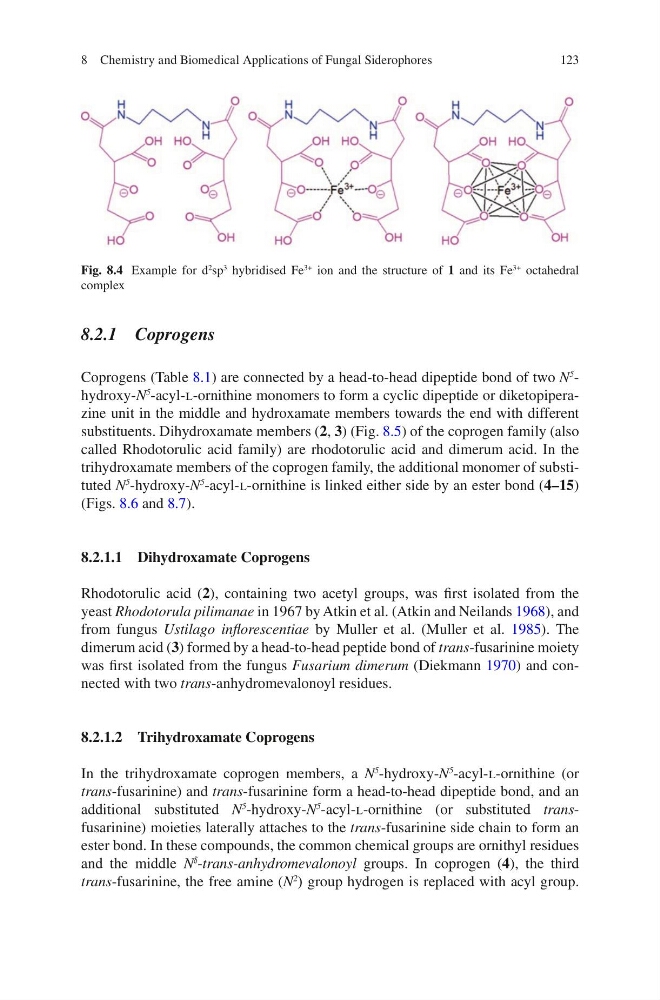
Fig. 8.4 Example for d
2 sp
3 hybridised Fe
3+ ion and the structure of 1 and its Fe
3+ octahedral
complex
8 Chemistry and Biomedical Applications of Fungal Siderophores
8.2.1 Coprogens
Coprogens (Table 8.1) are connected by a head-to-head dipeptide bond of two N
5
-
hydroxy- N
5
-acyl-l-ornithine monomers to form a cyclic dipeptide or diketopiperazine unit in the middle and hydroxamate members towards the end with different
substituents. Dihydroxamate members (2, 3) (Fig. 8.5) of the coprogen family (also
called Rhodotorulic acid family) are rhodotorulic acid and dimerum acid. In the
trihydroxamate members of the coprogen family, the additional monomer of substituted N
5
-hydroxy-N
5
-acyl-l-ornithine is linked either side by an ester bond (4–15)
(Figs. 8.6 and 8.7).
8.2.1.1 Dihydroxamate Coprogens
Rhodotorulic acid (2), containing two acetyl groups, was first isolated from the
yeast Rhodotorula pilimanae in 1967 by Atkin et al. (Atkin and Neilands 1968), and
from fungus Ustilago inflorescentiae by Muller et al. (Muller et al. 1985). The
dimerum acid (3) formed by a head-to-head peptide bond of trans-fusarinine moiety
was first isolated from the fungus Fusarium dimerum (Diekmann 1970) and connected with two trans-anhydromevalonoyl residues.
8.2.1.2 Trihydroxamate Coprogens
In the trihydroxamate coprogen members, a N
5
-hydroxy-N
5
-acyl-l-ornithine (or
trans-fusarinine) and trans-fusarinine form a head-to-head dipeptide bond, and an
additional substituted N
5
-hydroxy-N
5
-acyl-l-ornithine (or substituted transfusarinine) moieties laterally attaches to the trans-fusarinine side chain to form an
ester bond. In these compounds, the common chemical groups are ornithyl residues
and the middle N
δ
-trans-anhydromevalonoyl groups. In coprogen (4), the third
trans-fusarinine, the free amine (N
2
) group hydrogen is replaced with acyl group.
Fig. 8.4 Example for d
2 sp
3 hybridised Fe
3+ ion and the structure of 1 and its Fe
3+ octahedral
complex
8 Chemistry and Biomedical Applications of Fungal Siderophores