

2
1.1 Introduction
Siderophores are the low molecular weight organic compound produced by most of
the microorganisms, especially bacteria and fungi. The primary role of siderophores
is to chelate and transport iron across the cell membrane through an energydependent process (Renshaw et al. 2002). The ferric form of iron, Fe
3+
, is insoluble
at physiological pH of 7.35–7.40 (Bou-Abdallah 2010). Under such environmental
conditions, the microorganisms produce siderophores that exhibit high affinity for
Fe
3+
ion and form siderophore – Fe
3+
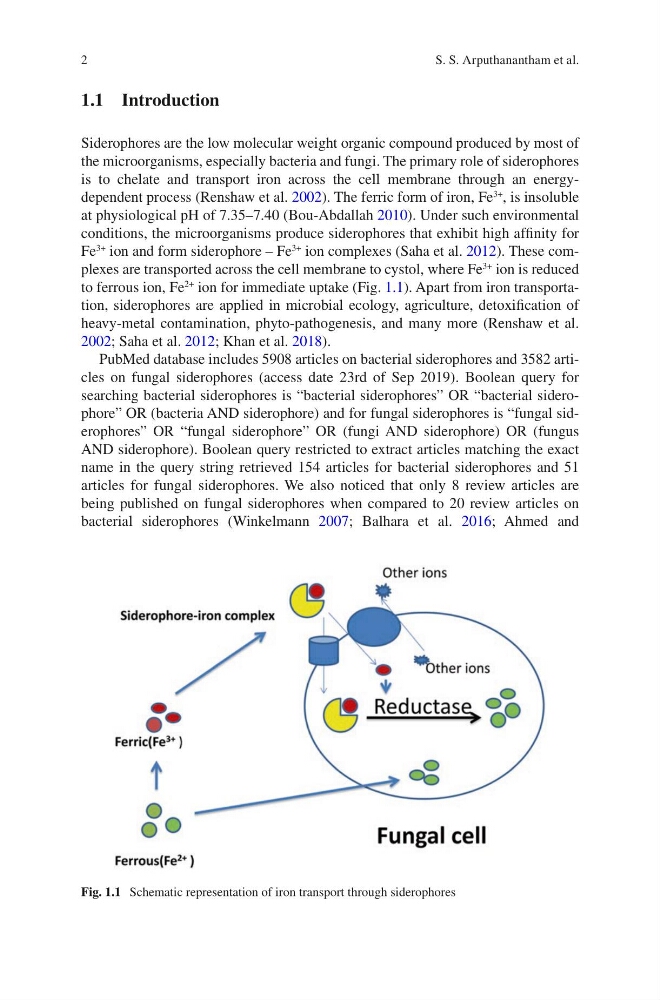
ion complexes (Saha et al. 2012). These complexes are transported across the cell membrane to cystol, where Fe
3+
ion is reduced
to ferrous ion, Fe
2+
ion for immediate uptake (Fig. 1.1). Apart from iron transportation, siderophores are applied in microbial ecology, agriculture, detoxification of
heavy-metal contamination, phyto-pathogenesis, and many more (Renshaw et al.
2002; Saha et al. 2012; Khan et al. 2018).
PubMed database includes 5908 articles on bacterial siderophores and 3582 articles on fungal siderophores (access date 23rd of Sep 2019). Boolean query for
searching bacterial siderophores is “bacterial siderophores” OR “bacterial siderophore” OR (bacteria AND siderophore) and for fungal siderophores is “fungal siderophores” OR “fungal siderophore” OR (fungi AND siderophore) OR (fungus
AND siderophore). Boolean query restricted to extract articles matching the exact
name in the query string retrieved 154 articles for bacterial siderophores and 51
articles for fungal siderophores. We also noticed that only 8 review articles are
being published on fungal siderophores when compared to 20 review articles on
bacterial siderophores (Winkelmann 2007; Balhara et al. 2016; Ahmed and
Fig. 1.1 Schematic representation of iron transport through siderophores
S. S. Arputhanantham et al.
1.1 Introduction
Siderophores are the low molecular weight organic compound produced by most of
the microorganisms, especially bacteria and fungi. The primary role of siderophores
is to chelate and transport iron across the cell membrane through an energydependent process (Renshaw et al. 2002). The ferric form of iron, Fe
3+
, is insoluble
at physiological pH of 7.35–7.40 (Bou-Abdallah 2010). Under such environmental
conditions, the microorganisms produce siderophores that exhibit high affinity for
Fe
3+
ion and form siderophore – Fe
3+
ion complexes (Saha et al. 2012). These complexes are transported across the cell membrane to cystol, where Fe
3+
ion is reduced
to ferrous ion, Fe
2+
ion for immediate uptake (Fig. 1.1). Apart from iron transportation, siderophores are applied in microbial ecology, agriculture, detoxification of
heavy-metal contamination, phyto-pathogenesis, and many more (Renshaw et al.
2002; Saha et al. 2012; Khan et al. 2018).
PubMed database includes 5908 articles on bacterial siderophores and 3582 articles on fungal siderophores (access date 23rd of Sep 2019). Boolean query for
searching bacterial siderophores is “bacterial siderophores” OR “bacterial siderophore” OR (bacteria AND siderophore) and for fungal siderophores is “fungal siderophores” OR “fungal siderophore” OR (fungi AND siderophore) OR (fungus
AND siderophore). Boolean query restricted to extract articles matching the exact
name in the query string retrieved 154 articles for bacterial siderophores and 51
articles for fungal siderophores. We also noticed that only 8 review articles are
being published on fungal siderophores when compared to 20 review articles on
bacterial siderophores (Winkelmann 2007; Balhara et al. 2016; Ahmed and
Fig. 1.1 Schematic representation of iron transport through siderophores
S. S. Arputhanantham et al.