

101
whereas Neurospora crassa represents different recognition sites for coprogen- and
ferrichrome-type siderophore system (Howard 1999).
In fungal species, majority of literature suggested that Saccharomyces cerevisiae
has two high-affinity iron transport mechanism. In first reductive mechanism, ferric
iron (Fe
3+
) is identified to be reduced by a number of inducible membrane-bound
reductase, namely, Fre1p–4p, usually present at cell surface. Across plasma membrane, the reduced iron (Fe
2+
) is then transported by involvement of permeaseoxidase, namely, Ftr1p and Fet3p. This mechanism is utilized by variety of
Fe
3+
-siderophore complexes such as ferrichrome, triacetyl fusarinine C and rhodotorulic acid for their transportation after being reduced by cell-surface-bound reductase. On the other hand, the second mechanism involves the uptake of iron
(Fe
3+
)-siderophore complex as an intact form into the cell. All the proteins that are
involved in the transport of so far identified complexes by this type of mechanism
belong to major facilitator superfamily, namely, Sit1p (also known as Arn3p which
helps in transporting ferrioxamine B, ferrichrome and ferrichrome A), Arn1p (helps
in transporting ferrirubin, ferrirhodin and ferrichrome A), Taf1 (also known as
Arn2p, which helps in transporting triacetyl fusarinine C) and Enb1p (helps in
transporting enterobactin). The uptake specificity may vary among receptors as well
as among strains (Renshaw et al. 2002). For instance, Arn1p specifically transports
ferrichrome-type siderophores around the iron centre which have branched-chain
ornithine-N5-acyl residues but does not support the short-chain acetyl hydroxamic
residues present in siderophore such as ferrirubin and ferrichrome. Likewise, Arn2p
is found to specifically transport triacetyl fusarinine C, whereas Sit1p has been
found to be less specific. Arn1p and Sit1p transport the complex via cell surface and
are then rapidly internalized as both are localized in intracellular vesicle layers
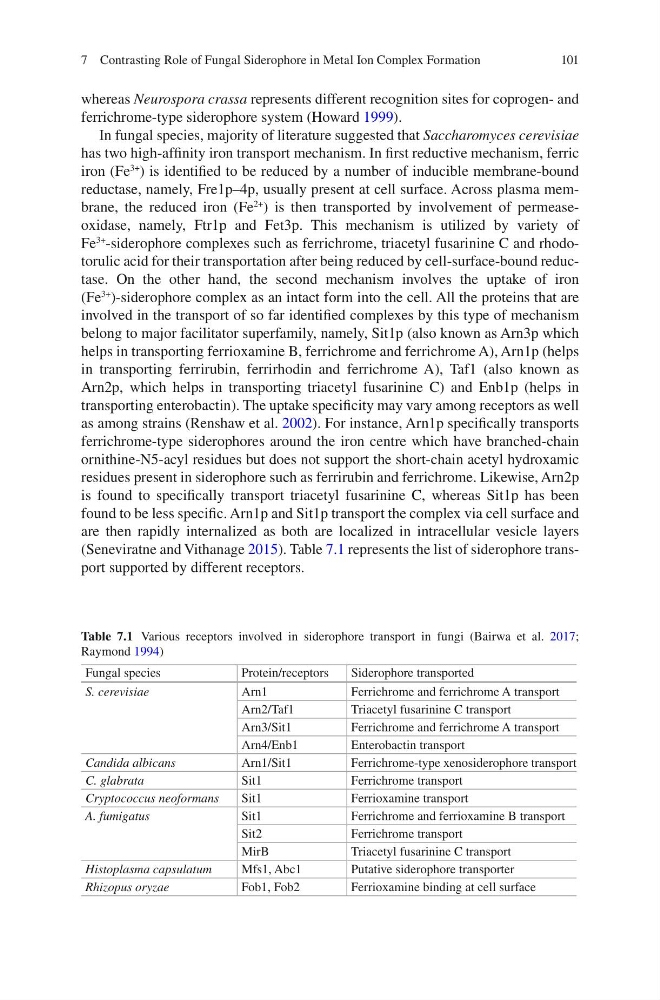
(Seneviratne and Vithanage 2015). Table 7.1 represents the list of siderophore transport supported by different receptors.
Table 7.1 Various receptors involved in siderophore transport in fungi (Bairwa et al. 2017;
Raymond 1994)
Fungal species
Protein/receptors
Siderophore transported
S. cerevisiae
Arn1
Ferrichrome and ferrichrome A transport
Arn2/Taf1
Triacetyl fusarinine C transport
Arn3/Sit1
Ferrichrome and ferrichrome A transport
Arn4/Enb1
Enterobactin transport
Candida albicans
Arn1/Sit1
Ferrichrome-type xenosiderophore transport
C. glabrata
Sit1
Ferrichrome transport
Cryptococcus neoformans
Sit1
Ferrioxamine transport
A. fumigatus
Sit1
Ferrichrome and ferrioxamine B transport
Sit2
Ferrichrome transport
MirB
Triacetyl fusarinine C transport
Histoplasma capsulatum
Mfs1, Abc1
Putative siderophore transporter
Rhizopus oryzae
Fob1, Fob2
Ferrioxamine binding at cell surface
7 Contrasting Role of Fungal Siderophore in Metal Ion Complex Formation
whereas Neurospora crassa represents different recognition sites for coprogen- and
ferrichrome-type siderophore system (Howard 1999).
In fungal species, majority of literature suggested that Saccharomyces cerevisiae
has two high-affinity iron transport mechanism. In first reductive mechanism, ferric
iron (Fe
3+
) is identified to be reduced by a number of inducible membrane-bound
reductase, namely, Fre1p–4p, usually present at cell surface. Across plasma membrane, the reduced iron (Fe
2+
) is then transported by involvement of permeaseoxidase, namely, Ftr1p and Fet3p. This mechanism is utilized by variety of
Fe
3+
-siderophore complexes such as ferrichrome, triacetyl fusarinine C and rhodotorulic acid for their transportation after being reduced by cell-surface-bound reductase. On the other hand, the second mechanism involves the uptake of iron
(Fe
3+
)-siderophore complex as an intact form into the cell. All the proteins that are
involved in the transport of so far identified complexes by this type of mechanism
belong to major facilitator superfamily, namely, Sit1p (also known as Arn3p which
helps in transporting ferrioxamine B, ferrichrome and ferrichrome A), Arn1p (helps
in transporting ferrirubin, ferrirhodin and ferrichrome A), Taf1 (also known as
Arn2p, which helps in transporting triacetyl fusarinine C) and Enb1p (helps in
transporting enterobactin). The uptake specificity may vary among receptors as well
as among strains (Renshaw et al. 2002). For instance, Arn1p specifically transports
ferrichrome-type siderophores around the iron centre which have branched-chain
ornithine-N5-acyl residues but does not support the short-chain acetyl hydroxamic
residues present in siderophore such as ferrirubin and ferrichrome. Likewise, Arn2p
is found to specifically transport triacetyl fusarinine C, whereas Sit1p has been
found to be less specific. Arn1p and Sit1p transport the complex via cell surface and
are then rapidly internalized as both are localized in intracellular vesicle layers
(Seneviratne and Vithanage 2015). Table 7.1 represents the list of siderophore transport supported by different receptors.
Table 7.1 Various receptors involved in siderophore transport in fungi (Bairwa et al. 2017;
Raymond 1994)
Fungal species
Protein/receptors
Siderophore transported
S. cerevisiae
Arn1
Ferrichrome and ferrichrome A transport
Arn2/Taf1
Triacetyl fusarinine C transport
Arn3/Sit1
Ferrichrome and ferrichrome A transport
Arn4/Enb1
Enterobactin transport
Candida albicans
Arn1/Sit1
Ferrichrome-type xenosiderophore transport
C. glabrata
Sit1
Ferrichrome transport
Cryptococcus neoformans
Sit1
Ferrioxamine transport
A. fumigatus
Sit1
Ferrichrome and ferrioxamine B transport
Sit2
Ferrichrome transport
MirB
Triacetyl fusarinine C transport
Histoplasma capsulatum
Mfs1, Abc1
Putative siderophore transporter
Rhizopus oryzae
Fob1, Fob2
Ferrioxamine binding at cell surface
7 Contrasting Role of Fungal Siderophore in Metal Ion Complex Formation