

68
3
industrial companies and their home countries in the North. The losers are smallscale farmers, indigenous peoples and traditional healers who are duped into giving away valuable natural resources and associated knowledge with no more than
chicken feed as payment.
Biopiracy refers to the monopolization of genetic resources such as seeds and
genes taken from peoples or farming communities that have nurtured those
resources through generations. It also refers to the theft of traditional knowledge
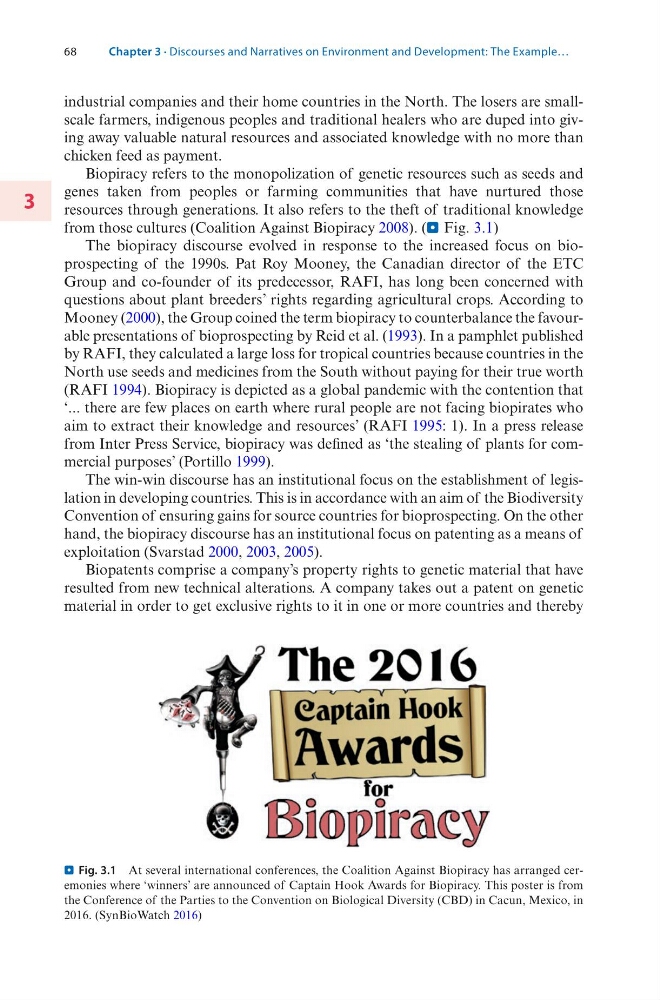
from those cultures (Coalition Against Biopiracy 2008). (. Fig. 3.1)
The biopiracy discourse evolved in response to the increased focus on bioprospecting of the 1990s. Pat Roy Mooney, the Canadian director of the ETC
Group and co-founder of its predecessor, RAFI, has long been concerned with
questions about plant breeders’ rights regarding agricultural crops. According to
Mooney (2000), the Group coined the term biopiracy to counterbalance the favourable presentations of bioprospecting by Reid et al. (1993). In a pamphlet published
by RAFI, they calculated a large loss for tropical countries because countries in the
North use seeds and medicines from the South without paying for their true worth
(RAFI 1994). Biopiracy is depicted as a global pandemic with the contention that
‘... there are few places on earth where rural people are not facing biopirates who
aim to extract their knowledge and resources’ (RAFI 1995: 1). In a press release
from Inter Press Service, biopiracy was defined as ‘the stealing of plants for commercial purposes’ (Portillo 1999).
The win-win discourse has an institutional focus on the establishment of legislation in developing countries. This is in accordance with an aim of the Biodiversity
Convention of ensuring gains for source countries for bioprospecting. On the other
hand, the biopiracy discourse has an institutional focus on patenting as a means of
exploitation (Svarstad 2000, 2003, 2005).
Biopatents comprise a company’s property rights to genetic material that have
resulted from new technical alterations. A company takes out a patent on genetic
material in order to get exclusive rights to it in one or more countries and thereby
. Fig. 3.1 At several international conferences, the Coalition Against Biopiracy has arranged ceremonies where ‘winners’ are announced of Captain Hook Awards for Biopiracy. This poster is from
the Conference of the Parties to the Convention on Biological Diversity (CBD) in Cacun, Mexico, in
2016. (SynBioWatch 2016)
Chapter 3 · Discourses and Narratives on Environment and Development: The Example…
3
industrial companies and their home countries in the North. The losers are smallscale farmers, indigenous peoples and traditional healers who are duped into giving away valuable natural resources and associated knowledge with no more than
chicken feed as payment.
Biopiracy refers to the monopolization of genetic resources such as seeds and
genes taken from peoples or farming communities that have nurtured those
resources through generations. It also refers to the theft of traditional knowledge
from those cultures (Coalition Against Biopiracy 2008). (. Fig. 3.1)
The biopiracy discourse evolved in response to the increased focus on bioprospecting of the 1990s. Pat Roy Mooney, the Canadian director of the ETC
Group and co-founder of its predecessor, RAFI, has long been concerned with
questions about plant breeders’ rights regarding agricultural crops. According to
Mooney (2000), the Group coined the term biopiracy to counterbalance the favourable presentations of bioprospecting by Reid et al. (1993). In a pamphlet published
by RAFI, they calculated a large loss for tropical countries because countries in the
North use seeds and medicines from the South without paying for their true worth
(RAFI 1994). Biopiracy is depicted as a global pandemic with the contention that
‘... there are few places on earth where rural people are not facing biopirates who
aim to extract their knowledge and resources’ (RAFI 1995: 1). In a press release
from Inter Press Service, biopiracy was defined as ‘the stealing of plants for commercial purposes’ (Portillo 1999).
The win-win discourse has an institutional focus on the establishment of legislation in developing countries. This is in accordance with an aim of the Biodiversity
Convention of ensuring gains for source countries for bioprospecting. On the other
hand, the biopiracy discourse has an institutional focus on patenting as a means of
exploitation (Svarstad 2000, 2003, 2005).
Biopatents comprise a company’s property rights to genetic material that have
resulted from new technical alterations. A company takes out a patent on genetic
material in order to get exclusive rights to it in one or more countries and thereby
. Fig. 3.1 At several international conferences, the Coalition Against Biopiracy has arranged ceremonies where ‘winners’ are announced of Captain Hook Awards for Biopiracy. This poster is from
the Conference of the Parties to the Convention on Biological Diversity (CBD) in Cacun, Mexico, in
2016. (SynBioWatch 2016)
Chapter 3 · Discourses and Narratives on Environment and Development: The Example…