

38
2
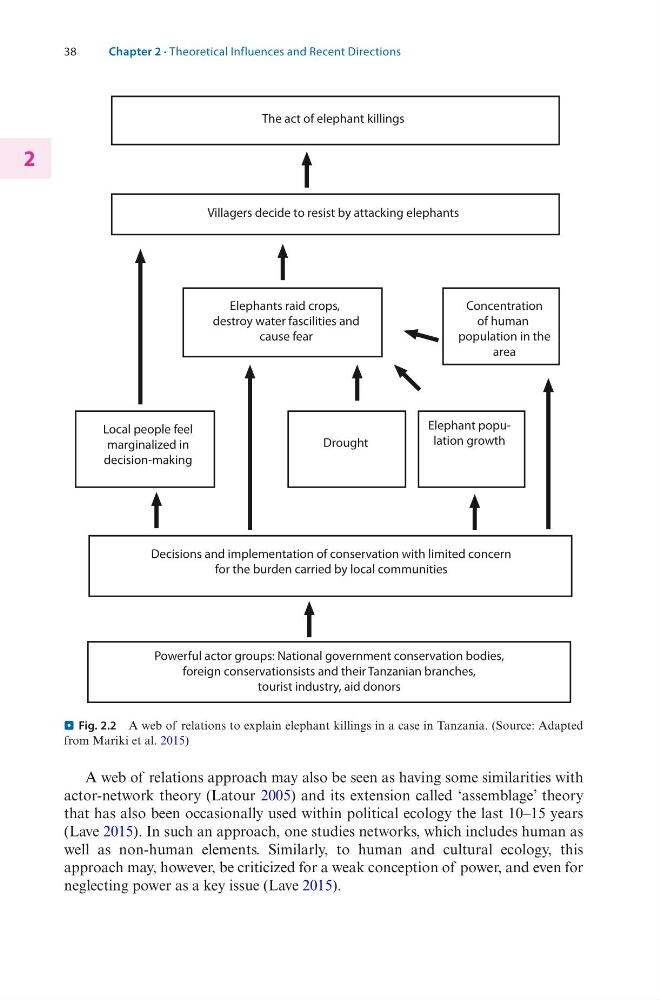
A web of relations approach may also be seen as having some similarities with
actor-network theory (Latour 2005) and its extension called ‘assemblage’ theory
that has also been occasionally used within political ecology the last 10–15 years
(Lave 2015). In such an approach, one studies networks, which includes human as
well as non-human elements. Similarly, to human and cultural ecology, this
approach may, however, be criticized for a weak conception of power, and even for
neglecting power as a key issue (Lave 2015).
The act of elephant killings
Villagers decide to resist by attacking elephants
Elephants raid crops,
destroy water fascilities and
cause fear
Concentration
of human
population in the
area
Drought
Decisions and implementation of conservation with limited concern
for the burden carried by local communities
Powerful actor groups: National government conservation bodies,
foreign conservationsists and their Tanzanian branches,
tourist industry, aid donors
Local people feel
marginalized in
decision-making
Elephant population growth
. Fig. 2.2 A web of relations to explain elephant killings in a case in Tanzania. (Source: Adapted
from Mariki et al. 2015)
Chapter 2 · Theoretical Influences and Recent Directions
2
A web of relations approach may also be seen as having some similarities with
actor-network theory (Latour 2005) and its extension called ‘assemblage’ theory
that has also been occasionally used within political ecology the last 10–15 years
(Lave 2015). In such an approach, one studies networks, which includes human as
well as non-human elements. Similarly, to human and cultural ecology, this
approach may, however, be criticized for a weak conception of power, and even for
neglecting power as a key issue (Lave 2015).
The act of elephant killings
Villagers decide to resist by attacking elephants
Elephants raid crops,
destroy water fascilities and
cause fear
Concentration
of human
population in the
area
Drought
Decisions and implementation of conservation with limited concern
for the burden carried by local communities
Powerful actor groups: National government conservation bodies,
foreign conservationsists and their Tanzanian branches,
tourist industry, aid donors
Local people feel
marginalized in
decision-making
Elephant population growth
. Fig. 2.2 A web of relations to explain elephant killings in a case in Tanzania. (Source: Adapted
from Mariki et al. 2015)
Chapter 2 · Theoretical Influences and Recent Directions