

217
9
imported farm inputs (e.g. inorganic fertilizers) increased, cotton also became more
valuable. In the first years after the devaluation, inorganic fertilizers had never been
so cheap, if measured in cotton prices. In addition, in the late 1990s, an agreement
between the CMDT and the cotton farmers union reintroduced subsidized fertilizers. This again led to a dramatic rise in fertilizer use. However, the area under cotton
cultivation expanded even faster. . Figure 9.4 demonstrates the effect of devaluation on area under cotton cultivation in particular for the core area of the cotton
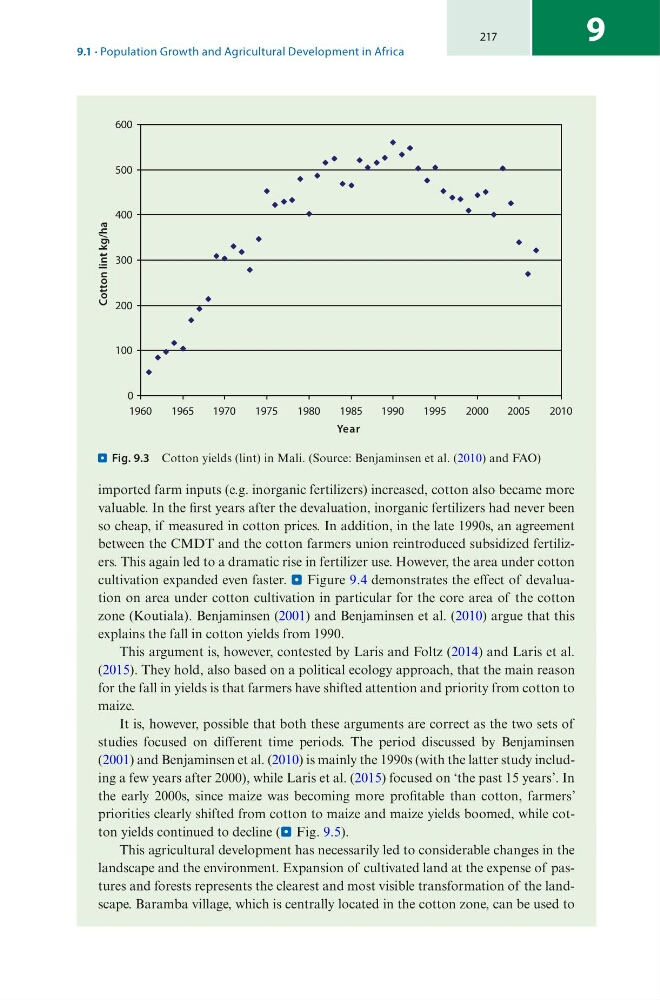
zone (Koutiala). Benjaminsen (2001) and Benjaminsen et al. (2010) argue that this
explains the fall in cotton yields from 1990.
This argument is, however, contested by Laris and Foltz (2014) and Laris et al.
(2015). They hold, also based on a political ecology approach, that the main reason
for the fall in yields is that farmers have shifted attention and priority from cotton to
maize.
It is, however, possible that both these arguments are correct as the two sets of
studies focused on different time periods. The period discussed by Benjaminsen
(2001) and Benjaminsen et al. (2010) is mainly the 1990s (with the latter study including a few years after 2000), while Laris et al. (2015) focused on ‘the past 15 years’. In
the early 2000s, since maize was becoming more profitable than cotton, farmers’
priorities clearly shifted from cotton to maize and maize yields boomed, while cotton yields continued to decline (. Fig. 9.5).
This agricultural development has necessarily led to considerable changes in the
landscape and the environment. Expansion of cultivated land at the expense of pastures and forests represents the clearest and most visible transformation of the landscape. Baramba village, which is centrally located in the cotton zone, can be used to
0
100
200
300
400
500
600
1960
1965
1970
1975
1980
1985
1990
1995
2000
2005
2010
Year
Cotton lint kg/ha
. Fig. 9.3 Cotton yields (lint) in Mali. (Source: Benjaminsen et al. (2010) and FAO)
9.1 · Population Growth and Agricultural Development in Africa
9
imported farm inputs (e.g. inorganic fertilizers) increased, cotton also became more
valuable. In the first years after the devaluation, inorganic fertilizers had never been
so cheap, if measured in cotton prices. In addition, in the late 1990s, an agreement
between the CMDT and the cotton farmers union reintroduced subsidized fertilizers. This again led to a dramatic rise in fertilizer use. However, the area under cotton
cultivation expanded even faster. . Figure 9.4 demonstrates the effect of devaluation on area under cotton cultivation in particular for the core area of the cotton
zone (Koutiala). Benjaminsen (2001) and Benjaminsen et al. (2010) argue that this
explains the fall in cotton yields from 1990.
This argument is, however, contested by Laris and Foltz (2014) and Laris et al.
(2015). They hold, also based on a political ecology approach, that the main reason
for the fall in yields is that farmers have shifted attention and priority from cotton to
maize.
It is, however, possible that both these arguments are correct as the two sets of
studies focused on different time periods. The period discussed by Benjaminsen
(2001) and Benjaminsen et al. (2010) is mainly the 1990s (with the latter study including a few years after 2000), while Laris et al. (2015) focused on ‘the past 15 years’. In
the early 2000s, since maize was becoming more profitable than cotton, farmers’
priorities clearly shifted from cotton to maize and maize yields boomed, while cotton yields continued to decline (. Fig. 9.5).
This agricultural development has necessarily led to considerable changes in the
landscape and the environment. Expansion of cultivated land at the expense of pastures and forests represents the clearest and most visible transformation of the landscape. Baramba village, which is centrally located in the cotton zone, can be used to
0
100
200
300
400
500
600
1960
1965
1970
1975
1980
1985
1990
1995
2000
2005
2010
Year
Cotton lint kg/ha
. Fig. 9.3 Cotton yields (lint) in Mali. (Source: Benjaminsen et al. (2010) and FAO)
9.1 · Population Growth and Agricultural Development in Africa