

175
7
subsist in such marginal environments. The alternative to this system is privatization of large areas for ranching for a few, such as in South Africa. This would lead
to the marginalization of large groups of people who may be excluded and end up
in urban areas as slum-dwellers.
For pastoralists, maximizing the number of animals is also a strategy to buffer the fluctuations in access to pasture and food. While farmers store grain from
one harvest to the next, it is too cumbersome for herders to transport grain or
fodder. Therefore, they save by having larger herds than they strictly need in the
short term in order to sell or exchange animals for grain from farmers during
periods of scarcity (Benjaminsen and Berge 2004). This is usually the time of the
year when livestock prices are low. But for pastoralists, it is more important that
the animals can move themselves, than receiving a maximum price at an unfavourable time. In African drylands, the rainy season is an unfavourable time of
year to sell animals. This is primarily because this time is when the animals produce the milk that is the most important source of carbohydrates and proteins,
and because during the rainy season, livestock often reside far from the markets.
In addition, investments in livestock in normal and good years bring a large
return, even though such investments also involve the risk that one may have
large losses during droughts.
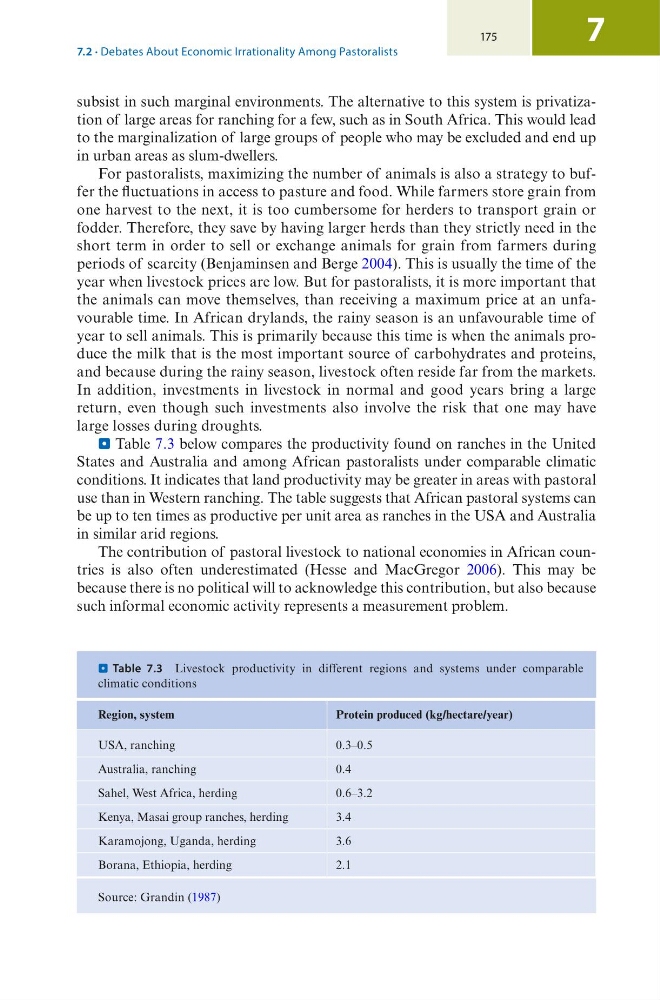
. Table 7.3 below compares the productivity found on ranches in the United
States and Australia and among African pastoralists under comparable climatic
conditions. It indicates that land productivity may be greater in areas with pastoral
use than in Western ranching. The table suggests that African pastoral systems can
be up to ten times as productive per unit area as ranches in the USA and Australia
in similar arid regions.
The contribution of pastoral livestock to national economies in African countries is also often underestimated (Hesse and MacGregor 2006). This may be
because there is no political will to acknowledge this contribution, but also because
such informal economic activity represents a measurement problem.
. Table 7.3 Livestock productivity in different regions and systems under comparable
climatic conditions
Region, system
Protein produced (kg/hectare/year)
USA, ranching
0.3–0.5
Australia, ranching
0.4
Sahel, West Africa, herding
0.6–3.2
Kenya, Masai group ranches, herding
3.4
Karamojong, Uganda, herding
3.6
Borana, Ethiopia, herding
2.1
Source: Grandin (1987)
7.2 · Debates About Economic Irrationality Among Pastoralists
7
subsist in such marginal environments. The alternative to this system is privatization of large areas for ranching for a few, such as in South Africa. This would lead
to the marginalization of large groups of people who may be excluded and end up
in urban areas as slum-dwellers.
For pastoralists, maximizing the number of animals is also a strategy to buffer the fluctuations in access to pasture and food. While farmers store grain from
one harvest to the next, it is too cumbersome for herders to transport grain or
fodder. Therefore, they save by having larger herds than they strictly need in the
short term in order to sell or exchange animals for grain from farmers during
periods of scarcity (Benjaminsen and Berge 2004). This is usually the time of the
year when livestock prices are low. But for pastoralists, it is more important that
the animals can move themselves, than receiving a maximum price at an unfavourable time. In African drylands, the rainy season is an unfavourable time of
year to sell animals. This is primarily because this time is when the animals produce the milk that is the most important source of carbohydrates and proteins,
and because during the rainy season, livestock often reside far from the markets.
In addition, investments in livestock in normal and good years bring a large
return, even though such investments also involve the risk that one may have
large losses during droughts.
. Table 7.3 below compares the productivity found on ranches in the United
States and Australia and among African pastoralists under comparable climatic
conditions. It indicates that land productivity may be greater in areas with pastoral
use than in Western ranching. The table suggests that African pastoral systems can
be up to ten times as productive per unit area as ranches in the USA and Australia
in similar arid regions.
The contribution of pastoral livestock to national economies in African countries is also often underestimated (Hesse and MacGregor 2006). This may be
because there is no political will to acknowledge this contribution, but also because
such informal economic activity represents a measurement problem.
. Table 7.3 Livestock productivity in different regions and systems under comparable
climatic conditions
Region, system
Protein produced (kg/hectare/year)
USA, ranching
0.3–0.5
Australia, ranching
0.4
Sahel, West Africa, herding
0.6–3.2
Kenya, Masai group ranches, herding
3.4
Karamojong, Uganda, herding
3.6
Borana, Ethiopia, herding
2.1
Source: Grandin (1987)
7.2 · Debates About Economic Irrationality Among Pastoralists