

162
7
In today’s debate on the management of communal areas in South Africa, the
idea of the ‘tragedy of the commons’ (Hardin 1968) holds a strong position.
Communal areas are particularly among politicians and government officials associated with overstocking and the small-scale farmers’ use of these areas is seen as
outdated. They are told to learn from white large-scale ‘commercial’ farmers and
adopt their methods. The densities of people and livestock are naturally far greater
(at least 10 times as high) in communal areas compared to the private large-scale
farms, and this naturally has consequences for vegetation and landscape. But the
question is whether an intensively used landscape is necessarily overgrazed and
degraded.
Landscape or aerial photographs of so-called fence-line contrasts are often used
as evidence of overgrazing and degradation on the communal side. These are photos
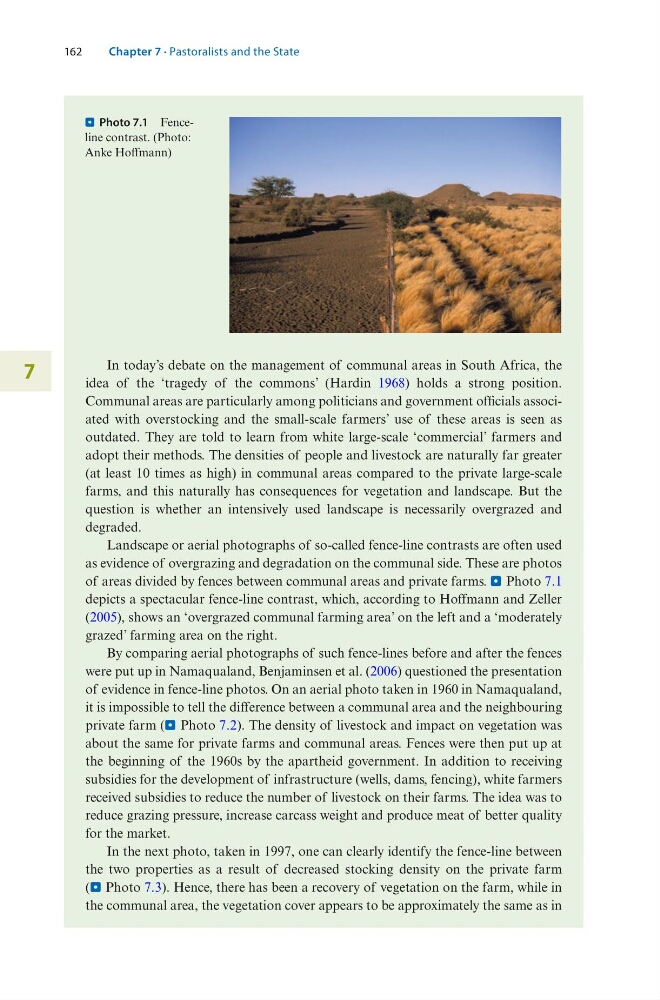
of areas divided by fences between communal areas and private farms. . Photo 7.1
depicts a spectacular fence-line contrast, which, according to Hoffmann and Zeller
(2005), shows an ‘overgrazed communal farming area’ on the left and a ‘moderately
grazed’ farming area on the right.
By comparing aerial photographs of such fence-lines before and after the fences
were put up in Namaqualand, Benjaminsen et al. (2006) questioned the presentation
of evidence in fence-line photos. On an aerial photo taken in 1960 in Namaqualand,
it is impossible to tell the difference between a communal area and the neighbouring
private farm (. Photo 7.2). The density of livestock and impact on vegetation was
about the same for private farms and communal areas. Fences were then put up at
the beginning of the 1960s by the apartheid government. In addition to receiving
subsidies for the development of infrastructure (wells, dams, fencing), white farmers
received subsidies to reduce the number of livestock on their farms. The idea was to
reduce grazing pressure, increase carcass weight and produce meat of better quality
for the market.
In the next photo, taken in 1997, one can clearly identify the fence-line between
the two properties as a result of decreased stocking density on the private farm
(. Photo 7.3). Hence, there has been a recovery of vegetation on the farm, while in
the communal area, the vegetation cover appears to be approximately the same as in
. Photo 7.1 Fenceline contrast. (Photo:
Anke Hoffmann)
Chapter 7 · Pastoralists and the State
7
In today’s debate on the management of communal areas in South Africa, the
idea of the ‘tragedy of the commons’ (Hardin 1968) holds a strong position.
Communal areas are particularly among politicians and government officials associated with overstocking and the small-scale farmers’ use of these areas is seen as
outdated. They are told to learn from white large-scale ‘commercial’ farmers and
adopt their methods. The densities of people and livestock are naturally far greater
(at least 10 times as high) in communal areas compared to the private large-scale
farms, and this naturally has consequences for vegetation and landscape. But the
question is whether an intensively used landscape is necessarily overgrazed and
degraded.
Landscape or aerial photographs of so-called fence-line contrasts are often used
as evidence of overgrazing and degradation on the communal side. These are photos
of areas divided by fences between communal areas and private farms. . Photo 7.1
depicts a spectacular fence-line contrast, which, according to Hoffmann and Zeller
(2005), shows an ‘overgrazed communal farming area’ on the left and a ‘moderately
grazed’ farming area on the right.
By comparing aerial photographs of such fence-lines before and after the fences
were put up in Namaqualand, Benjaminsen et al. (2006) questioned the presentation
of evidence in fence-line photos. On an aerial photo taken in 1960 in Namaqualand,
it is impossible to tell the difference between a communal area and the neighbouring
private farm (. Photo 7.2). The density of livestock and impact on vegetation was
about the same for private farms and communal areas. Fences were then put up at
the beginning of the 1960s by the apartheid government. In addition to receiving
subsidies for the development of infrastructure (wells, dams, fencing), white farmers
received subsidies to reduce the number of livestock on their farms. The idea was to
reduce grazing pressure, increase carcass weight and produce meat of better quality
for the market.
In the next photo, taken in 1997, one can clearly identify the fence-line between
the two properties as a result of decreased stocking density on the private farm
(. Photo 7.3). Hence, there has been a recovery of vegetation on the farm, while in
the communal area, the vegetation cover appears to be approximately the same as in
. Photo 7.1 Fenceline contrast. (Photo:
Anke Hoffmann)
Chapter 7 · Pastoralists and the State