

156
7
Trailer
In 2016, the Sámi reindeer owner Jovsset Ánte Sara from Finnmark in the far north of
Norway took the Norwegian state to court. As a young and newly established
livestock- keeper, Sara aims to build up a sizeable herd that can sustain him economically. But the Norwegian state’s policy of bringing down overall reindeer numbers tries
to force him to reduce his herd to 75 animals from the 116 he previously had. He
claims this is a decision that in practice means the end of his activities as a pastoralist,
since it is impossible to make a living from 75 reindeer. He therefore went to court in
order not to lose his livelihood.
In March 2016, Sara won the first round in the Primary Court, but the state
appealed to the Secondary Court in Tromsø where Sara also won. The state, however,
appealed again and in December 2017, the Supreme Court in Oslo ruled against Sara.
While he appealed to the United Nations Human Rights Committee in Geneva, the
state immediately started to implement its destocking policy through administrating
heavy fines for not following the court’s ruling combined with plans for forced slaughter of Sara’s reindeer.
This case illustrates how Sámi reindeer-keepers in Norway are squeezed by a policy
to reduce both the numbers of reindeer and their owners. It is also an example that demonstrates the marginalization that Sámi reindeer-owners have been subject to in
Norwegian society for a couple of centuries. But such marginalization is not unique to
reindeer- keepers. It is found in most countries where there are pastoralists. We will in this
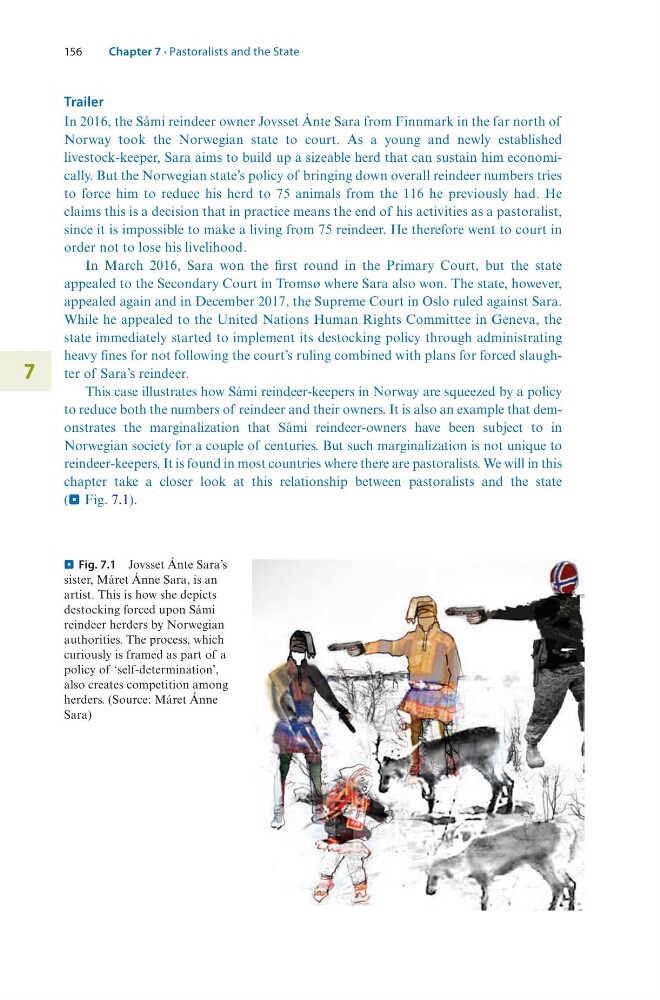
chapter take a closer look at this relationship between pastoralists and the state
(. Fig. 7.1).
. Fig. 7.1 Jovsset Ánte Sara’s
sister, Máret Ánne Sara, is an
artist. This is how she depicts
destocking forced upon Sámi
reindeer herders by Norwegian
authorities. The process, which
curiously is framed as part of a
policy of ‘self-determination’,
also creates competition among
herders. (Source: Máret Ánne
Sara)
Chapter 7 · Pastoralists and the State
7
Trailer
In 2016, the Sámi reindeer owner Jovsset Ánte Sara from Finnmark in the far north of
Norway took the Norwegian state to court. As a young and newly established
livestock- keeper, Sara aims to build up a sizeable herd that can sustain him economically. But the Norwegian state’s policy of bringing down overall reindeer numbers tries
to force him to reduce his herd to 75 animals from the 116 he previously had. He
claims this is a decision that in practice means the end of his activities as a pastoralist,
since it is impossible to make a living from 75 reindeer. He therefore went to court in
order not to lose his livelihood.
In March 2016, Sara won the first round in the Primary Court, but the state
appealed to the Secondary Court in Tromsø where Sara also won. The state, however,
appealed again and in December 2017, the Supreme Court in Oslo ruled against Sara.
While he appealed to the United Nations Human Rights Committee in Geneva, the
state immediately started to implement its destocking policy through administrating
heavy fines for not following the court’s ruling combined with plans for forced slaughter of Sara’s reindeer.
This case illustrates how Sámi reindeer-keepers in Norway are squeezed by a policy
to reduce both the numbers of reindeer and their owners. It is also an example that demonstrates the marginalization that Sámi reindeer-owners have been subject to in
Norwegian society for a couple of centuries. But such marginalization is not unique to
reindeer- keepers. It is found in most countries where there are pastoralists. We will in this
chapter take a closer look at this relationship between pastoralists and the state
(. Fig. 7.1).
. Fig. 7.1 Jovsset Ánte Sara’s
sister, Máret Ánne Sara, is an
artist. This is how she depicts
destocking forced upon Sámi
reindeer herders by Norwegian
authorities. The process, which
curiously is framed as part of a
policy of ‘self-determination’,
also creates competition among
herders. (Source: Máret Ánne
Sara)
Chapter 7 · Pastoralists and the State