

134
6
ises made by the funding agency and the implementing NGO that the project
would provide a reliable source of income for the villagers in the future through
sales of carbon credits.
This was one of nine pilot projects financed by the Norwegian government to
use forest conservation to mitigate climate change, while also conserving tropical
forests. It was part of Norway’s International Climate and Forest Initiative
(NICFI), and NICFI is an important element of international efforts of Reducing
Emissions from Deforestation and forest Degradation (REDD). Proposed at the
climate conference in Montreal in 2005, REDD was adopted at the climate conference in Bali 2 years later. A plus sign has been added (REDD+) to indicate additional targets, such as community benefits. However, what is actually added in each
case remains unclear, with the plus sign serving a rhetorical purpose rather than
reflecting a practice, we therefore prefer to use REDD without the +.
At the climate conference in Bali, Norway’s prime minister at the time, Jens
Stoltenberg (Labour Party), announced NICFI as a world-leading REDD initiative, and when a conservative government took over in 2013, NICFI continued
with the same high level of funding and prioritization within Norway’s climate
policy. At the Bali conference, Stoltenberg promised an annual funding of 3 billion
NOK (about 300 million US dollars). By the end of 2017, Norway had in total
spent 22.4 billion NOK (2.24 billion US dollars) on NICFI (Government of
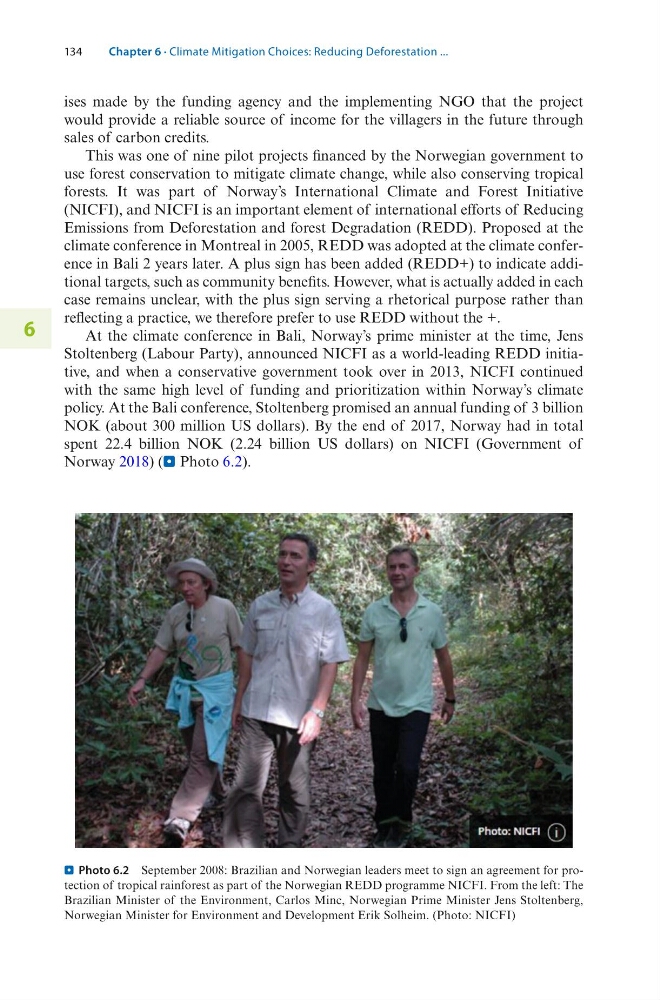
Norway 2018) (. Photo 6.2).
. Photo 6.2 September 2008: Brazilian and Norwegian leaders meet to sign an agreement for protection of tropical rainforest as part of the Norwegian REDD programme NICFI. From the left: The
Brazilian Minister of the Environment, Carlos Minc, Norwegian Prime Minister Jens Stoltenberg,
Norwegian Minister for Environment and Development Erik Solheim. (Photo: NICFI)
Chapter 6 · Climate Mitigation Choices: Reducing Deforestation ...
6
ises made by the funding agency and the implementing NGO that the project
would provide a reliable source of income for the villagers in the future through
sales of carbon credits.
This was one of nine pilot projects financed by the Norwegian government to
use forest conservation to mitigate climate change, while also conserving tropical
forests. It was part of Norway’s International Climate and Forest Initiative
(NICFI), and NICFI is an important element of international efforts of Reducing
Emissions from Deforestation and forest Degradation (REDD). Proposed at the
climate conference in Montreal in 2005, REDD was adopted at the climate conference in Bali 2 years later. A plus sign has been added (REDD+) to indicate additional targets, such as community benefits. However, what is actually added in each
case remains unclear, with the plus sign serving a rhetorical purpose rather than
reflecting a practice, we therefore prefer to use REDD without the +.
At the climate conference in Bali, Norway’s prime minister at the time, Jens
Stoltenberg (Labour Party), announced NICFI as a world-leading REDD initiative, and when a conservative government took over in 2013, NICFI continued
with the same high level of funding and prioritization within Norway’s climate
policy. At the Bali conference, Stoltenberg promised an annual funding of 3 billion
NOK (about 300 million US dollars). By the end of 2017, Norway had in total
spent 22.4 billion NOK (2.24 billion US dollars) on NICFI (Government of
Norway 2018) (. Photo 6.2).
. Photo 6.2 September 2008: Brazilian and Norwegian leaders meet to sign an agreement for protection of tropical rainforest as part of the Norwegian REDD programme NICFI. From the left: The
Brazilian Minister of the Environment, Carlos Minc, Norwegian Prime Minister Jens Stoltenberg,
Norwegian Minister for Environment and Development Erik Solheim. (Photo: NICFI)
Chapter 6 · Climate Mitigation Choices: Reducing Deforestation ...