

131
6
the needs of the present without compromising the ability of future generations to
meet their needs. Contrary to much of the decision-making about climate change
thus far, these are basic principles that would make it possible to establish more
democratic processes on climate choices than those which are often seen today. So
far, even in countries assumed to have advanced democracies, climate alternatives
have often been presented in ways that make it almost impossible for citizens to
grasp the most important consequences of each alternative, so that they can make
informed choices. Climate justice in time and space are two basic and relatively
simple principles that we argue should be fundamental for democratic decisionmaking on climate mitigation in each country. The principles are similar to what
Caney (2014) calls harm avoidance (to avoid harm for future generations) and
burden-sharing justice (among countries today).
Temporal climate justice implies that a country’s climate policy reduces climate
emissions sufficiently and fast enough to avoid the most serious consequences for
future generations. Spatial climate justice means that climate mitigation takes place
in ways that distribute burden among people today in ways that can be seen as just.
This concurs with Caney’s principle of burden-sharing justice by putting the
responsibility for mitigation on those who have caused the problem, on those who
have benefitted from activities causing climate change, as well as on those who have
the ability to pay for mitigation. Moreover, as an element of the principle of spatial
climate justice, we include the imperative of not placing a mitigation burden on
people who are currently vulnerable and who struggle to fulfil their basic needs
(Svarstad 2021).
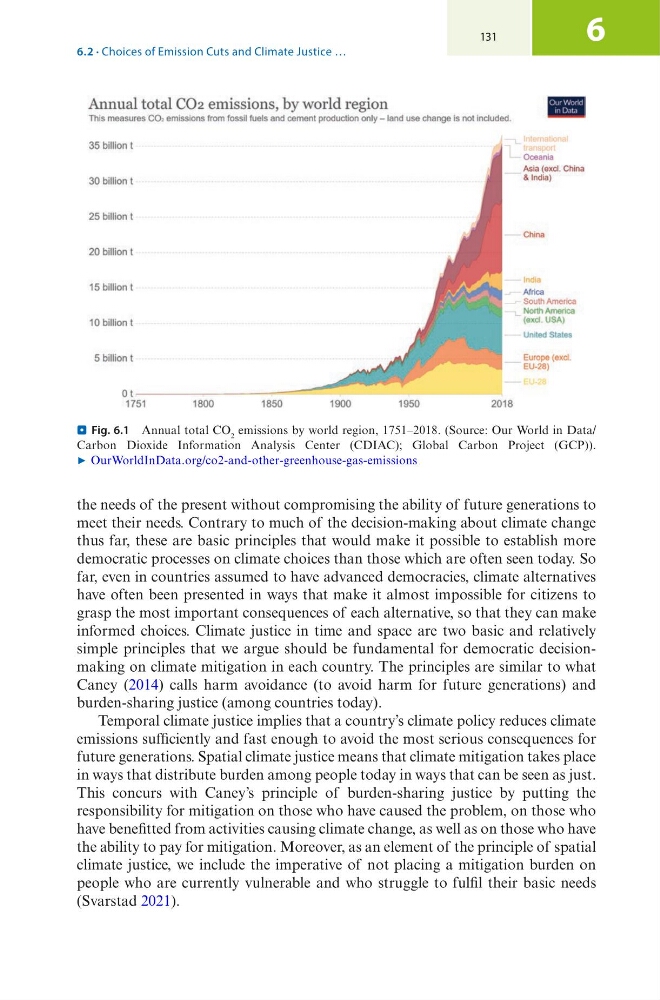
. Fig. 6.1 Annual total CO 2 emissions by world region, 1751–2018. (Source: Our World in Data/
Carbon Dioxide Information Analysis Center (CDIAC); Global Carbon Project (GCP)).
7 OurWorldInData. org/co2-and-other-greenhouse-gas-emissions
6.2 · Choices of Emission Cuts and Climate Justice …
6
the needs of the present without compromising the ability of future generations to
meet their needs. Contrary to much of the decision-making about climate change
thus far, these are basic principles that would make it possible to establish more
democratic processes on climate choices than those which are often seen today. So
far, even in countries assumed to have advanced democracies, climate alternatives
have often been presented in ways that make it almost impossible for citizens to
grasp the most important consequences of each alternative, so that they can make
informed choices. Climate justice in time and space are two basic and relatively
simple principles that we argue should be fundamental for democratic decisionmaking on climate mitigation in each country. The principles are similar to what
Caney (2014) calls harm avoidance (to avoid harm for future generations) and
burden-sharing justice (among countries today).
Temporal climate justice implies that a country’s climate policy reduces climate
emissions sufficiently and fast enough to avoid the most serious consequences for
future generations. Spatial climate justice means that climate mitigation takes place
in ways that distribute burden among people today in ways that can be seen as just.
This concurs with Caney’s principle of burden-sharing justice by putting the
responsibility for mitigation on those who have caused the problem, on those who
have benefitted from activities causing climate change, as well as on those who have
the ability to pay for mitigation. Moreover, as an element of the principle of spatial
climate justice, we include the imperative of not placing a mitigation burden on
people who are currently vulnerable and who struggle to fulfil their basic needs
(Svarstad 2021).
. Fig. 6.1 Annual total CO 2 emissions by world region, 1751–2018. (Source: Our World in Data/
Carbon Dioxide Information Analysis Center (CDIAC); Global Carbon Project (GCP)).
7 OurWorldInData. org/co2-and-other-greenhouse-gas-emissions
6.2 · Choices of Emission Cuts and Climate Justice …