

57
ability observed in reflectance spectra (Figs. 3.1 and 3.4). Thus, the underlying
variation in plant canopy structure, function, and leaf traits in turn drives the optical
properties and spectral signatures detected by RS platforms (Ollinger 2011). As
such, the capacity to infer plant health, status, stress, and leaf and plant functional
traits with optical RS observations is tied to the physical principle that plant physiological properties, structure, and distribution of foliage within plant canopies are
reflected in the RS signatures of leaves within a canopy (Curran 1989; Kokaly et al.
2009; Ollinger 2011).
3.2.1 Spectroscopy and Plant Functional Traits
With the advent of laboratory and field spectrometer instrumentation, the leaf to
landscape-scale RS of vegetation traits and functional properties began in earnest in
the early 1980s (Sect. 3.1.3). As stated in Sect. 3.1.4, there are a host of important
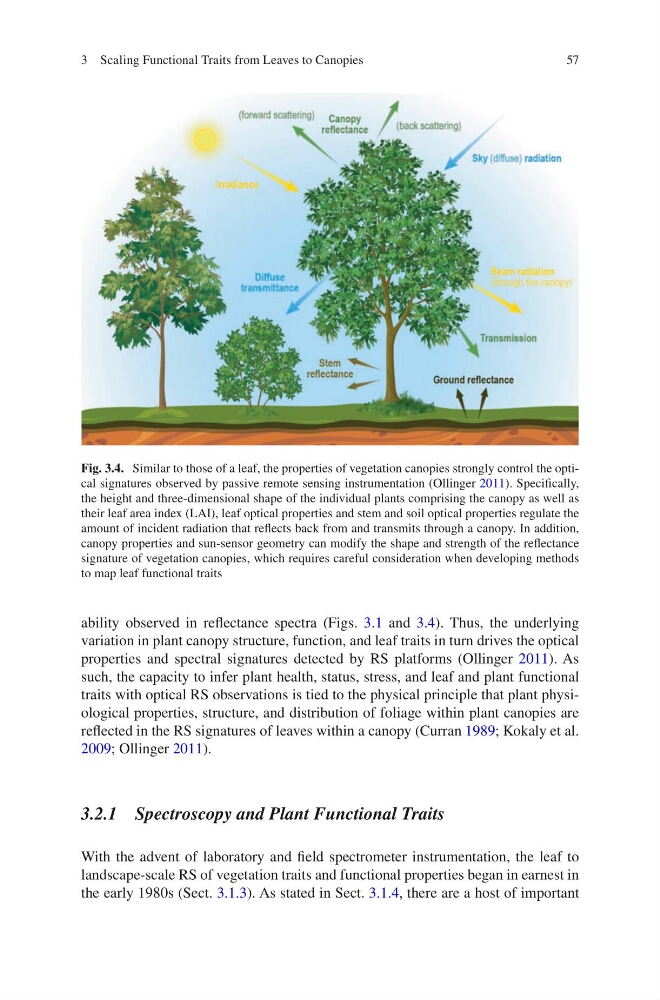
Fig. 3.4. Similar to those of a leaf, the properties of vegetation canopies strongly control the optical signatures observed by passive remote sensing instrumentation (Ollinger 2011). Specifically,
the height and three-dimensional shape of the individual plants comprising the canopy as well as
their leaf area index (LAI), leaf optical properties and stem and soil optical properties regulate the
amount of incident radiation that reflects back from and transmits through a canopy. In addition,
canopy properties and sun-sensor geometry can modify the shape and strength of the reflectance
signature of vegetation canopies, which requires careful consideration when developing methods
to map leaf functional traits
3 Scaling Functional Traits from Leaves to Canopies
ability observed in reflectance spectra (Figs. 3.1 and 3.4). Thus, the underlying
variation in plant canopy structure, function, and leaf traits in turn drives the optical
properties and spectral signatures detected by RS platforms (Ollinger 2011). As
such, the capacity to infer plant health, status, stress, and leaf and plant functional
traits with optical RS observations is tied to the physical principle that plant physiological properties, structure, and distribution of foliage within plant canopies are
reflected in the RS signatures of leaves within a canopy (Curran 1989; Kokaly et al.
2009; Ollinger 2011).
3.2.1 Spectroscopy and Plant Functional Traits
With the advent of laboratory and field spectrometer instrumentation, the leaf to
landscape-scale RS of vegetation traits and functional properties began in earnest in
the early 1980s (Sect. 3.1.3). As stated in Sect. 3.1.4, there are a host of important
Fig. 3.4. Similar to those of a leaf, the properties of vegetation canopies strongly control the optical signatures observed by passive remote sensing instrumentation (Ollinger 2011). Specifically,
the height and three-dimensional shape of the individual plants comprising the canopy as well as
their leaf area index (LAI), leaf optical properties and stem and soil optical properties regulate the
amount of incident radiation that reflects back from and transmits through a canopy. In addition,
canopy properties and sun-sensor geometry can modify the shape and strength of the reflectance
signature of vegetation canopies, which requires careful consideration when developing methods
to map leaf functional traits
3 Scaling Functional Traits from Leaves to Canopies