

53
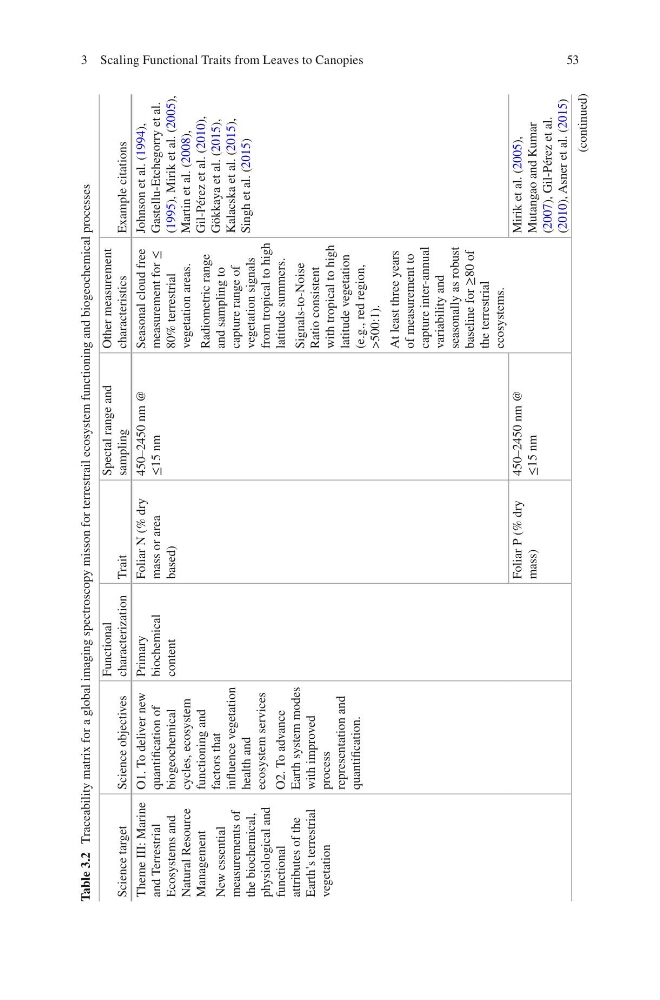
Table 3.2 Traceability matrix for a global imaging spectroscopy misson for terrestrail ecosystem functioning and biogeochemical processes
Science target
Science objectives
Functional
characterization Trait
Spectal range and
sampling
Other measurement
characteristics
Example citations
Theme III: Marine
and Terrestrial
Ecosystems and
Natural Resource
Management
New essential
measurements of
the biochemical,
physiological and
functional
attributes of the
Earth’s terrestrial
vegetation
O1. To deliver new
quantification of
biogeochemical
cycles, ecosystem
functioning and
factors that
influence vegetation
health and
ecosystem services
O2. To advance
Earth system modes
with improved
process
representation and
quantification.
Primary
biochemical
content
Foliar N (% dry
mass or area
based)
450–2450 nm @
≤15 nm
Seasonal cloud free
measurement for
≤
80% terrestrial
vegetation areas.
Radiometric range
and sampling to
capture range of
vegetation signals
from tropical to high
latitude summers.
Signals-to-Noise
Ratio consistent
with tropical to high
latitude vegetation
(e.g., red region,
>500:1).
At least three years
of measurement to
capture inter-annual
variability and
seasonally as robust
baseline for
≥80 of
the terrestrial
ecosystems.
Johnson et al. (1994),
Gastellu-Etchegorry et al.
(1995), Mirik et al. (2005),
Martin et al. (2008),
Gil-Pérez et al. (2010),
Gökkaya et al. (2015),
Kalacska et al. (2015),
Singh et al. (2015)
Foliar P (% dry
mass)
450–2450 nm @
≤15 nm
Mirik et al. (2005),
Mutangao and Kumar
(2007), Gil- Pérez et al.
(2010), Asner et al. (2015)
(continued)
3 Scaling Functional Traits from Leaves to Canopies
Table 3.2 Traceability matrix for a global imaging spectroscopy misson for terrestrail ecosystem functioning and biogeochemical processes
Science target
Science objectives
Functional
characterization Trait
Spectal range and
sampling
Other measurement
characteristics
Example citations
Theme III: Marine
and Terrestrial
Ecosystems and
Natural Resource
Management
New essential
measurements of
the biochemical,
physiological and
functional
attributes of the
Earth’s terrestrial
vegetation
O1. To deliver new
quantification of
biogeochemical
cycles, ecosystem
functioning and
factors that
influence vegetation
health and
ecosystem services
O2. To advance
Earth system modes
with improved
process
representation and
quantification.
Primary
biochemical
content
Foliar N (% dry
mass or area
based)
450–2450 nm @
≤15 nm
Seasonal cloud free
measurement for
≤
80% terrestrial
vegetation areas.
Radiometric range
and sampling to
capture range of
vegetation signals
from tropical to high
latitude summers.
Signals-to-Noise
Ratio consistent
with tropical to high
latitude vegetation
(e.g., red region,
>500:1).
At least three years
of measurement to
capture inter-annual
variability and
seasonally as robust
baseline for
≥80 of
the terrestrial
ecosystems.
Johnson et al. (1994),
Gastellu-Etchegorry et al.
(1995), Mirik et al. (2005),
Martin et al. (2008),
Gil-Pérez et al. (2010),
Gökkaya et al. (2015),
Kalacska et al. (2015),
Singh et al. (2015)
Foliar P (% dry
mass)
450–2450 nm @
≤15 nm
Mirik et al. (2005),
Mutangao and Kumar
(2007), Gil- Pérez et al.
(2010), Asner et al. (2015)
(continued)
3 Scaling Functional Traits from Leaves to Canopies