

46
(Wu et al. 2016). Given the role plant traits play in community assembly, characterizing the distribution, spatial patterns, and seasonality of traits is crucial for improved
prediction of biodiversity change and ecosystem responses to global change.
Numerous plant trait databases have been developed to store information on the
variation in functional traits across space and time (e.g., Wright et al. 2004; Kattge
et al. 2011; LeBauer et al. 2018) needed to inform biodiversity and ecological modeling research. However, repeated direct measurement of plant traits is logistically
challenging, which limits the geographic and temporal coverage of trait variation in
these databases. Moreover, capturing plant trait variation through time is critical,
but currently lacking from most observations (but with notable exceptions, e.g.,
Stylinski et al. 2002; Yang et al. 2016) given a host of additional technical and monetary challenges. In particular, efforts to collect direct, repeat samples of functional
traits in remote areas, such as high-latitude ecosystems and the remote tropics, can
be severely hindered by access and other logistical considerations.
On the other hand, RS can provide the critical unifying observations to link
in-situ measurements of plant traits to the larger spatial and temporal scales needed
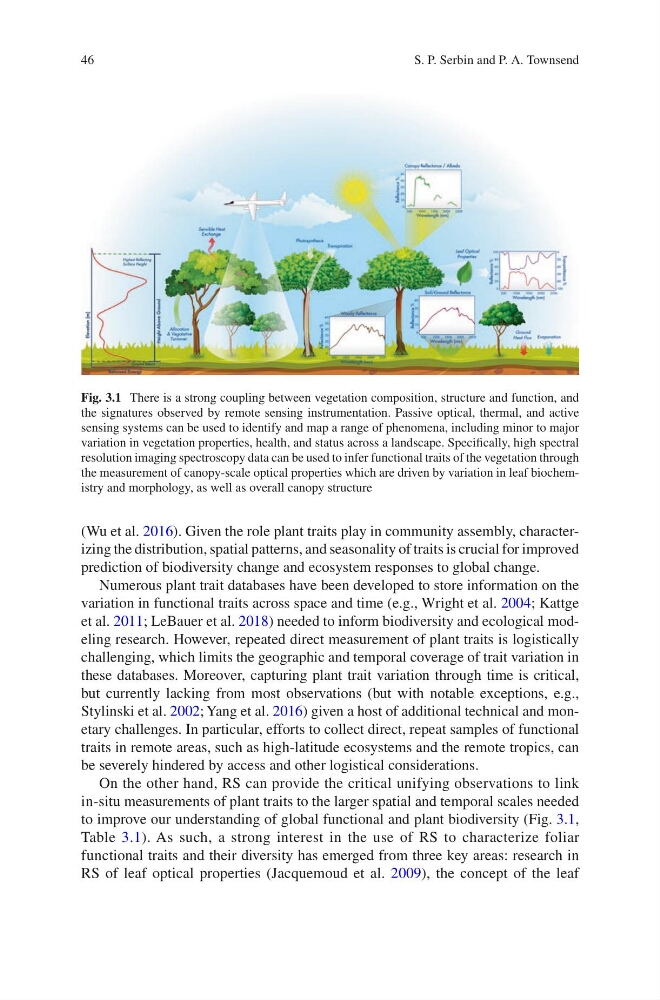
to improve our understanding of global functional and plant biodiversity (Fig. 3.1,
Table 3.1). As such, a strong interest in the use of RS to characterize foliar
functional traits and their diversity has emerged from three key areas: research in
RS of leaf optical properties (Jacquemoud et al. 2009), the concept of the leaf
Fig. 3.1 There is a strong coupling between vegetation composition, structure and function, and
the signatures observed by remote sensing instrumentation. Passive optical, thermal, and active
sensing systems can be used to identify and map a range of phenomena, including minor to major
variation in vegetation properties, health, and status across a landscape. Specifically, high spectral
resolution imaging spectroscopy data can be used to infer functional traits of the vegetation through
the measurement of canopy-scale optical properties which are driven by variation in leaf biochemistry and morphology, as well as overall canopy structure
S. P. Serbin and P. A. Townsend
(Wu et al. 2016). Given the role plant traits play in community assembly, characterizing the distribution, spatial patterns, and seasonality of traits is crucial for improved
prediction of biodiversity change and ecosystem responses to global change.
Numerous plant trait databases have been developed to store information on the
variation in functional traits across space and time (e.g., Wright et al. 2004; Kattge
et al. 2011; LeBauer et al. 2018) needed to inform biodiversity and ecological modeling research. However, repeated direct measurement of plant traits is logistically
challenging, which limits the geographic and temporal coverage of trait variation in
these databases. Moreover, capturing plant trait variation through time is critical,
but currently lacking from most observations (but with notable exceptions, e.g.,
Stylinski et al. 2002; Yang et al. 2016) given a host of additional technical and monetary challenges. In particular, efforts to collect direct, repeat samples of functional
traits in remote areas, such as high-latitude ecosystems and the remote tropics, can
be severely hindered by access and other logistical considerations.
On the other hand, RS can provide the critical unifying observations to link
in-situ measurements of plant traits to the larger spatial and temporal scales needed
to improve our understanding of global functional and plant biodiversity (Fig. 3.1,
Table 3.1). As such, a strong interest in the use of RS to characterize foliar
functional traits and their diversity has emerged from three key areas: research in
RS of leaf optical properties (Jacquemoud et al. 2009), the concept of the leaf
Fig. 3.1 There is a strong coupling between vegetation composition, structure and function, and
the signatures observed by remote sensing instrumentation. Passive optical, thermal, and active
sensing systems can be used to identify and map a range of phenomena, including minor to major
variation in vegetation properties, health, and status across a landscape. Specifically, high spectral
resolution imaging spectroscopy data can be used to infer functional traits of the vegetation through
the measurement of canopy-scale optical properties which are driven by variation in leaf biochemistry and morphology, as well as overall canopy structure
S. P. Serbin and P. A. Townsend