

522
chapters. Importantly, the architecture is inherently flexible, providing a suite of
basic capabilities that can be utilized in a variety of ways; for example, which algorithms are developed and how they are assessed and published depends upon the
data the system hosts and how the system is governed. Box 20.2 summarizes some
Box 20.1 System Concept Overview
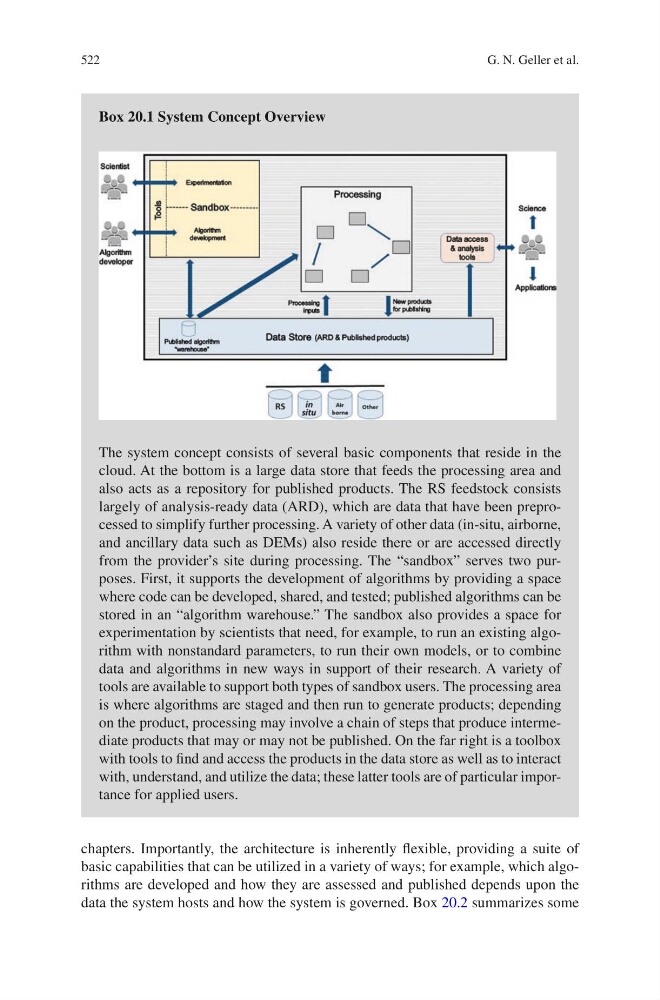
The system concept consists of several basic components that reside in the
cloud. At the bottom is a large data store that feeds the processing area and
also acts as a repository for published products. The RS feedstock consists
largely of analysis-ready data (ARD), which are data that have been preprocessed to simplify further processing. A variety of other data (in-situ, airborne,
and ancillary data such as DEMs) also reside there or are accessed directly
from the provider’s site during processing. The “sandbox” serves two purposes. First, it supports the development of algorithms by providing a space
where code can be developed, shared, and tested; published algorithms can be
stored in an “algorithm warehouse.” The sandbox also provides a space for
experimentation by scientists that need, for example, to run an existing algorithm with nonstandard parameters, to run their own models, or to combine
data and algorithms in new ways in support of their research. A variety of
tools are available to support both types of sandbox users. The processing area
is where algorithms are staged and then run to generate products; depending
on the product, processing may involve a chain of steps that produce intermediate products that may or may not be published. On the far right is a toolbox
with tools to find and access the products in the data store as well as to interact
with, understand, and utilize the data; these latter tools are of particular importance for applied users.
G. N. Geller et al.
chapters. Importantly, the architecture is inherently flexible, providing a suite of
basic capabilities that can be utilized in a variety of ways; for example, which algorithms are developed and how they are assessed and published depends upon the
data the system hosts and how the system is governed. Box 20.2 summarizes some
Box 20.1 System Concept Overview
The system concept consists of several basic components that reside in the
cloud. At the bottom is a large data store that feeds the processing area and
also acts as a repository for published products. The RS feedstock consists
largely of analysis-ready data (ARD), which are data that have been preprocessed to simplify further processing. A variety of other data (in-situ, airborne,
and ancillary data such as DEMs) also reside there or are accessed directly
from the provider’s site during processing. The “sandbox” serves two purposes. First, it supports the development of algorithms by providing a space
where code can be developed, shared, and tested; published algorithms can be
stored in an “algorithm warehouse.” The sandbox also provides a space for
experimentation by scientists that need, for example, to run an existing algorithm with nonstandard parameters, to run their own models, or to combine
data and algorithms in new ways in support of their research. A variety of
tools are available to support both types of sandbox users. The processing area
is where algorithms are staged and then run to generate products; depending
on the product, processing may involve a chain of steps that produce intermediate products that may or may not be published. On the far right is a toolbox
with tools to find and access the products in the data store as well as to interact
with, understand, and utilize the data; these latter tools are of particular importance for applied users.
G. N. Geller et al.