

512
forests may not be fully informative compared to lower stature canopies. This can
be mitigated in seasonal vegetation by imaging prior to leaf emergence or following
canopy senescence, but this could be challenging given cloud cover and timing of
15-day repeat cycles. This forms a critical area for new research.
Canopy height and its variation are related confounding factors, as shadowing
within canopies creates significant effects. Leaf physiognomy and shadowing add
further complexity (e.g., consider the contrast between herbaceous vegetation with
only vertically distributed graminoids and those with mixed grasses and broadleaf
forbs). Likewise, broadleaf and conifer foliage in forests exhibit contrasting spectral
characteristics at the leaf and canopy levels due to shading caused by angular distribution of needles. At a basic level, a structurally continuous canopy will exhibit
lower diversity than a heterogeneous one; while this effect can be leveraged to characterize diversity, it is important to understand that the resulting spectral diversity is
a consequence of the combination of biological, chemical, and physical characteristics of vegetation.
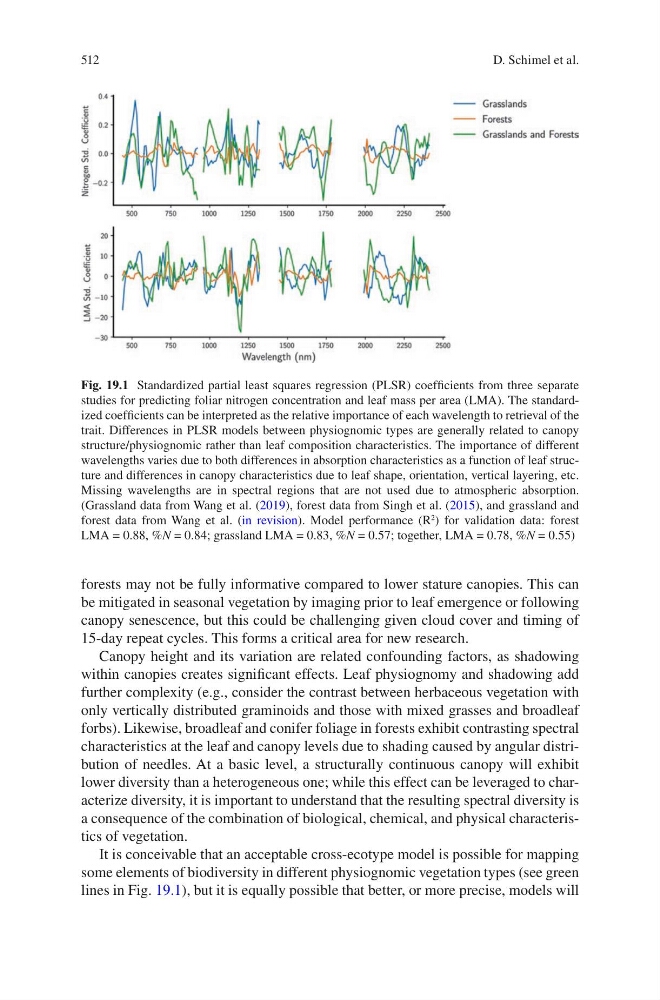
It is conceivable that an acceptable cross-ecotype model is possible for mapping
some elements of biodiversity in different physiognomic vegetation types (see green
lines in Fig. 19.1), but it is equally possible that better, or more precise, models will
Fig. 19.1 Standardized partial least squares regression (PLSR) coefficients from three separate
studies for predicting foliar nitrogen concentration and leaf mass per area (LMA). The standardized coefficients can be interpreted as the relative importance of each wavelength to retrieval of the
trait. Differences in PLSR models between physiognomic types are generally related to canopy
structure/physiognomic rather than leaf composition characteristics. The importance of different
wavelengths varies due to both differences in absorption characteristics as a function of leaf structure and differences in canopy characteristics due to leaf shape, orientation, vertical layering, etc.
Missing wavelengths are in spectral regions that are not used due to atmospheric absorption.
(Grassland data from Wang et al. (2019), forest data from Singh et al. (2015), and grassland and
forest data from Wang et al. (in revision). Model performance (R
2
) for validation data: forest
LMA = 0.88, %N = 0.84; grassland LMA = 0.83, %N = 0.57; together, LMA = 0.78, %N = 0.55)
D. Schimel et al.
forests may not be fully informative compared to lower stature canopies. This can
be mitigated in seasonal vegetation by imaging prior to leaf emergence or following
canopy senescence, but this could be challenging given cloud cover and timing of
15-day repeat cycles. This forms a critical area for new research.
Canopy height and its variation are related confounding factors, as shadowing
within canopies creates significant effects. Leaf physiognomy and shadowing add
further complexity (e.g., consider the contrast between herbaceous vegetation with
only vertically distributed graminoids and those with mixed grasses and broadleaf
forbs). Likewise, broadleaf and conifer foliage in forests exhibit contrasting spectral
characteristics at the leaf and canopy levels due to shading caused by angular distribution of needles. At a basic level, a structurally continuous canopy will exhibit
lower diversity than a heterogeneous one; while this effect can be leveraged to characterize diversity, it is important to understand that the resulting spectral diversity is
a consequence of the combination of biological, chemical, and physical characteristics of vegetation.
It is conceivable that an acceptable cross-ecotype model is possible for mapping
some elements of biodiversity in different physiognomic vegetation types (see green
lines in Fig. 19.1), but it is equally possible that better, or more precise, models will
Fig. 19.1 Standardized partial least squares regression (PLSR) coefficients from three separate
studies for predicting foliar nitrogen concentration and leaf mass per area (LMA). The standardized coefficients can be interpreted as the relative importance of each wavelength to retrieval of the
trait. Differences in PLSR models between physiognomic types are generally related to canopy
structure/physiognomic rather than leaf composition characteristics. The importance of different
wavelengths varies due to both differences in absorption characteristics as a function of leaf structure and differences in canopy characteristics due to leaf shape, orientation, vertical layering, etc.
Missing wavelengths are in spectral regions that are not used due to atmospheric absorption.
(Grassland data from Wang et al. (2019), forest data from Singh et al. (2015), and grassland and
forest data from Wang et al. (in revision). Model performance (R
2
) for validation data: forest
LMA = 0.88, %N = 0.84; grassland LMA = 0.83, %N = 0.57; together, LMA = 0.78, %N = 0.55)
D. Schimel et al.