

505
taxonomic composition. Traits, types, and taxonomic composition, as well as their
variability and how they are changing, are poorly understood globally. Nor is there
a comprehensive understanding of how they feed back to the climate system via
altered biogeochemical fluxes.”
The report notes that physiological, chemical and morphological traits influence
the functioning of ecosystems with respect to matter and energy fluxes and emphasizes that environmental change can change the distributions of the functional characteristics of organisms, thereby potentially feeding back to the climate system and
other drivers of environmental change.
The concept that the unique characteristics of organisms mediate the functioning
of ecosystems, and that changes to the distribution of functional traits can feed back
to the environment and even the planetary climate, leads to a key question in
the report:
• What are the structures, functions, and biodiversity of Earth’s ecosystems, and
how and why are they changing in time and space (National Academies of
Sciences, Engineering, and Medicine 2018)?
and an objective
• Quantify the distribution of the functional traits, functional types, and composition of terrestrial and shallow aquatic vegetation … spatially and over time
(National Academies 2018).
The report identifies imaging spectroscopy (IS) as “the only technology that can
provide the detailed spectral data to allow identification and quantification of major
biochemical and structural components of plant canopies” and calls for an instrument in orbit optimized for the retrieval of a set of plant functional traits globally
and able to track their changes over time. The report identifies a set of traits for terrestrial vegetation that are priorities and that are known to be observable based on
the current literature, reflecting extensive field, lab, and airborne research. These
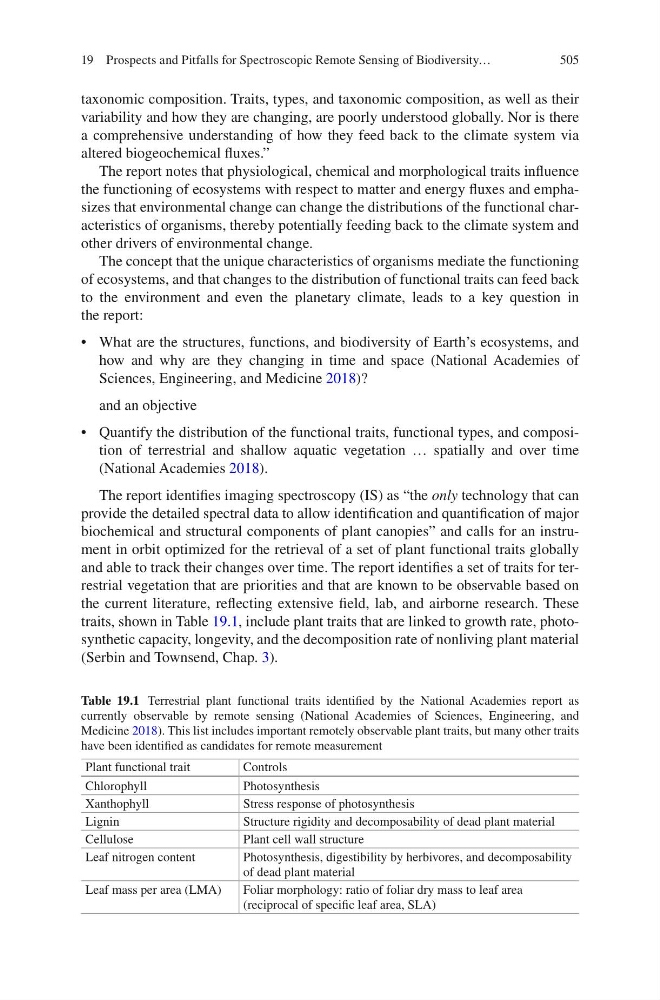
traits, shown in Table 19.1, include plant traits that are linked to growth rate, photosynthetic capacity, longevity, and the decomposition rate of nonliving plant material
(Serbin and Townsend, Chap. 3).
Table 19.1 Terrestrial plant functional traits identified by the National Academies report as
currently observable by remote sensing (National Academies of Sciences, Engineering, and
Medicine 2018). This list includes important remotely observable plant traits, but many other traits
have been identified as candidates for remote measurement
Plant functional trait
Controls
Chlorophyll
Photosynthesis
Xanthophyll
Stress response of photosynthesis
Lignin
Structure rigidity and decomposability of dead plant material
Cellulose
Plant cell wall structure
Leaf nitrogen content
Photosynthesis, digestibility by herbivores, and decomposability
of dead plant material
Leaf mass per area (LMA)
Foliar morphology: ratio of foliar dry mass to leaf area
(reciprocal of specific leaf area, SLA)
19 Prospects and Pitfalls for Spectroscopic Remote Sensing of Biodiversity…
taxonomic composition. Traits, types, and taxonomic composition, as well as their
variability and how they are changing, are poorly understood globally. Nor is there
a comprehensive understanding of how they feed back to the climate system via
altered biogeochemical fluxes.”
The report notes that physiological, chemical and morphological traits influence
the functioning of ecosystems with respect to matter and energy fluxes and emphasizes that environmental change can change the distributions of the functional characteristics of organisms, thereby potentially feeding back to the climate system and
other drivers of environmental change.
The concept that the unique characteristics of organisms mediate the functioning
of ecosystems, and that changes to the distribution of functional traits can feed back
to the environment and even the planetary climate, leads to a key question in
the report:
• What are the structures, functions, and biodiversity of Earth’s ecosystems, and
how and why are they changing in time and space (National Academies of
Sciences, Engineering, and Medicine 2018)?
and an objective
• Quantify the distribution of the functional traits, functional types, and composition of terrestrial and shallow aquatic vegetation … spatially and over time
(National Academies 2018).
The report identifies imaging spectroscopy (IS) as “the only technology that can
provide the detailed spectral data to allow identification and quantification of major
biochemical and structural components of plant canopies” and calls for an instrument in orbit optimized for the retrieval of a set of plant functional traits globally
and able to track their changes over time. The report identifies a set of traits for terrestrial vegetation that are priorities and that are known to be observable based on
the current literature, reflecting extensive field, lab, and airborne research. These
traits, shown in Table 19.1, include plant traits that are linked to growth rate, photosynthetic capacity, longevity, and the decomposition rate of nonliving plant material
(Serbin and Townsend, Chap. 3).
Table 19.1 Terrestrial plant functional traits identified by the National Academies report as
currently observable by remote sensing (National Academies of Sciences, Engineering, and
Medicine 2018). This list includes important remotely observable plant traits, but many other traits
have been identified as candidates for remote measurement
Plant functional trait
Controls
Chlorophyll
Photosynthesis
Xanthophyll
Stress response of photosynthesis
Lignin
Structure rigidity and decomposability of dead plant material
Cellulose
Plant cell wall structure
Leaf nitrogen content
Photosynthesis, digestibility by herbivores, and decomposability
of dead plant material
Leaf mass per area (LMA)
Foliar morphology: ratio of foliar dry mass to leaf area
(reciprocal of specific leaf area, SLA)
19 Prospects and Pitfalls for Spectroscopic Remote Sensing of Biodiversity…