

31
The distribution of plant traits within communities influences resource availability
for other trophic levels above- and belowground, which affects community assembly
and population dynamics across trophic levels. Diversity of neighbors surrounding
focal trees can both increase and decrease pathogen and herbivore pressure on them
(Grossman et al. 2019). Thus, while we know that plant diversity impacts other trophic levels, consistent rules across the globe that explain how and why these impacts
occur remain elusive. An increasing number of studies reveal that plant diversity
influences belowground microbial diversity and composition (Madritch et al. 2014;
Cline et al. 2018). While these relationships are significant, they may explain limited
variation given the number of other factors that influence microbial diversity and
potentially due to a mismatch in sampling scales. Ultimately, it appears that chemical
composition and productivity of aboveground components of ecosystems that can be
remotely sensed are critical drivers of belowground processes, including microbial
diversity (Madritch et al., Chap. 8).
Biodiversity loss is known to substantially decrease ecosystem functioning and
ecosystem stability (Cardinale et al. 2011; O’Connor et al. 2017). Yet, the nature
and scale of biodiversity-ecosystem function relationships remains a central question in biodiversity science. The issue is one that is ready to be tackled across scales
using RS technology. The long-term biodiversity experiment at Cedar Creek
Ecosystem Science Reserve (Tilman 1997) (Fig. 2.6), for example, has revealed the
increasing effects of biodiversity on productivity over time (Reich et al. 2012) and
that phylogenetic and functional diversity are highly predictive of productivity
(Cadotte et al. 2008; Cadotte et al. 2009). Remotely sensed spectral diversity also
predicts productivity (Sect. 2.9). Increased stability has also been linked to both
higher plant richness (Tilman et al. 2006) and phylogenetic diversity (Cadotte et al.
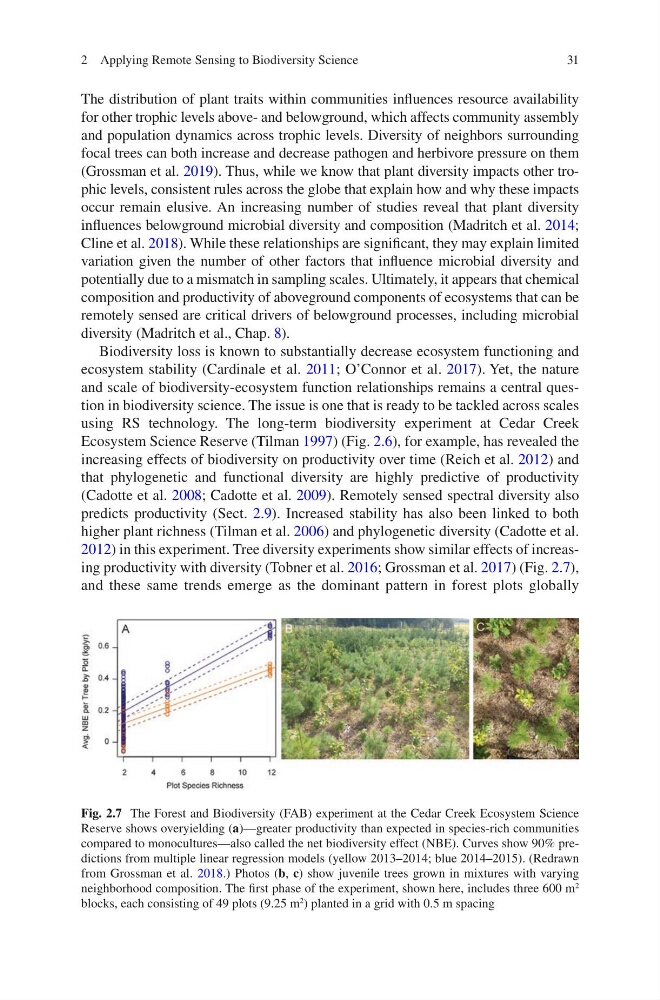
2012) in this experiment. Tree diversity experiments show similar effects of increasing productivity with diversity (Tobner et al. 2016; Grossman et al. 2017) (Fig. 2.7),
and these same trends emerge as the dominant pattern in forest plots globally
Fig. 2.7 The Forest and Biodiversity (FAB) experiment at the Cedar Creek Ecosystem Science
Reserve shows overyielding (a)—greater productivity than expected in species-rich communities
compared to monocultures—also called the net biodiversity effect (NBE). Curves show 90% predictions from multiple linear regression models (yellow 2013–2014; blue 2014–2015). (Redrawn
from Grossman et al. 2018.) Photos (b, c) show juvenile trees grown in mixtures with varying
neighborhood composition. The first phase of the experiment, shown here, includes three 600 m
2
blocks, each consisting of 49 plots (9.25 m
2
) planted in a grid with 0.5 m spacing
2 Applying Remote Sensing to Biodiversity Science
The distribution of plant traits within communities influences resource availability
for other trophic levels above- and belowground, which affects community assembly
and population dynamics across trophic levels. Diversity of neighbors surrounding
focal trees can both increase and decrease pathogen and herbivore pressure on them
(Grossman et al. 2019). Thus, while we know that plant diversity impacts other trophic levels, consistent rules across the globe that explain how and why these impacts
occur remain elusive. An increasing number of studies reveal that plant diversity
influences belowground microbial diversity and composition (Madritch et al. 2014;
Cline et al. 2018). While these relationships are significant, they may explain limited
variation given the number of other factors that influence microbial diversity and
potentially due to a mismatch in sampling scales. Ultimately, it appears that chemical
composition and productivity of aboveground components of ecosystems that can be
remotely sensed are critical drivers of belowground processes, including microbial
diversity (Madritch et al., Chap. 8).
Biodiversity loss is known to substantially decrease ecosystem functioning and
ecosystem stability (Cardinale et al. 2011; O’Connor et al. 2017). Yet, the nature
and scale of biodiversity-ecosystem function relationships remains a central question in biodiversity science. The issue is one that is ready to be tackled across scales
using RS technology. The long-term biodiversity experiment at Cedar Creek
Ecosystem Science Reserve (Tilman 1997) (Fig. 2.6), for example, has revealed the
increasing effects of biodiversity on productivity over time (Reich et al. 2012) and
that phylogenetic and functional diversity are highly predictive of productivity
(Cadotte et al. 2008; Cadotte et al. 2009). Remotely sensed spectral diversity also
predicts productivity (Sect. 2.9). Increased stability has also been linked to both
higher plant richness (Tilman et al. 2006) and phylogenetic diversity (Cadotte et al.
2012) in this experiment. Tree diversity experiments show similar effects of increasing productivity with diversity (Tobner et al. 2016; Grossman et al. 2017) (Fig. 2.7),
and these same trends emerge as the dominant pattern in forest plots globally
Fig. 2.7 The Forest and Biodiversity (FAB) experiment at the Cedar Creek Ecosystem Science
Reserve shows overyielding (a)—greater productivity than expected in species-rich communities
compared to monocultures—also called the net biodiversity effect (NBE). Curves show 90% predictions from multiple linear regression models (yellow 2013–2014; blue 2014–2015). (Redrawn
from Grossman et al. 2018.) Photos (b, c) show juvenile trees grown in mixtures with varying
neighborhood composition. The first phase of the experiment, shown here, includes three 600 m
2
blocks, each consisting of 49 plots (9.25 m
2
) planted in a grid with 0.5 m spacing
2 Applying Remote Sensing to Biodiversity Science