

408
sampling combined with species identification can also be used as an alternative to
detailed botanical inventories because species frequencies approximate fractional
cover when a sufficiently large number of points are sampled within a plot. For
approximating fractional cover, it is good practice to choose random points (e.g.,
using the point frame method; Heady and Rader 1958; Jonasson 1988) and not random individuals within plots, to avoid overrepresenting species with more lateral
growth. When botanical inventories are available, stratified random sampling within
plots with plant species as strata followed by abundance weighting based on species
fractional cover or biomass is a good way for capturing vegetation composition and
for scaling traits of individuals to plot-level estimates. In plant communities where
species abundances are unequally distributed, it is important to think about the pros
and cons of sampling all species vs. sampling the most abundant species and of
sampling all species at the same frequency vs. sampling more abundant species at
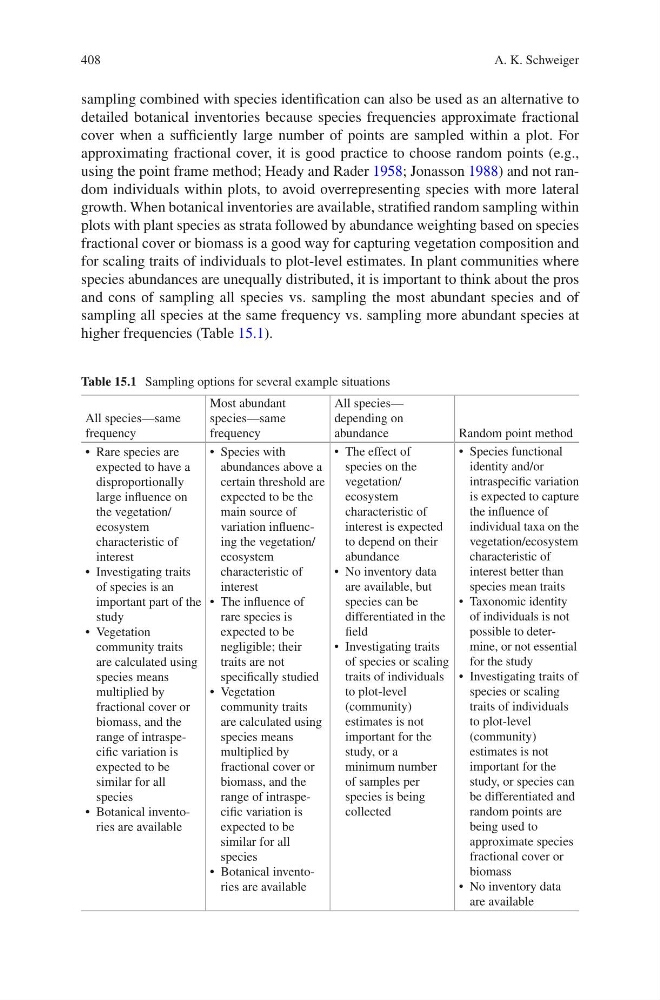
higher frequencies (Table 15.1).
Table 15.1 Sampling options for several example situations
All species—same
frequency
Most abundant
species—same
frequency
All species—
depending on
abundance
Random point method
• Rare species are
expected to have a
disproportionally
large influence on
the vegetation/
ecosystem
characteristic of
interest
• Investigating traits
of species is an
important part of the
study
• Vegetation
community traits
are calculated using
species means
multiplied by
fractional cover or
biomass, and the
range of intraspecific variation is
expected to be
similar for all
species
• Botanical inventories are available
• Species with
abundances above a
certain threshold are
expected to be the
main source of
variation influencing the vegetation/
ecosystem
characteristic of
interest
• The influence of
rare species is
expected to be
negligible; their
traits are not
specifically studied
• Vegetation
community traits
are calculated using
species means
multiplied by
fractional cover or
biomass, and the
range of intraspecific variation is
expected to be
similar for all
species
• Botanical inventories are available
• The effect of
species on the
vegetation/
ecosystem
characteristic of
interest is expected
to depend on their
abundance
• No inventory data
are available, but
species can be
differentiated in the
field
• Investigating traits
of species or scaling
traits of individuals
to plot-level
(community)
estimates is not
important for the
study, or a
minimum number
of samples per
species is being
collected
• Species functional
identity and/or
intraspecific variation
is expected to capture
the influence of
individual taxa on the
vegetation/ecosystem
characteristic of
interest better than
species mean traits
• Taxonomic identity
of individuals is not
possible to determine, or not essential
for the study
• Investigating traits of
species or scaling
traits of individuals
to plot-level
(community)
estimates is not
important for the
study, or species can
be differentiated and
random points are
being used to
approximate species
fractional cover or
biomass
• No inventory data
are available
A. K. Schweiger
sampling combined with species identification can also be used as an alternative to
detailed botanical inventories because species frequencies approximate fractional
cover when a sufficiently large number of points are sampled within a plot. For
approximating fractional cover, it is good practice to choose random points (e.g.,
using the point frame method; Heady and Rader 1958; Jonasson 1988) and not random individuals within plots, to avoid overrepresenting species with more lateral
growth. When botanical inventories are available, stratified random sampling within
plots with plant species as strata followed by abundance weighting based on species
fractional cover or biomass is a good way for capturing vegetation composition and
for scaling traits of individuals to plot-level estimates. In plant communities where
species abundances are unequally distributed, it is important to think about the pros
and cons of sampling all species vs. sampling the most abundant species and of
sampling all species at the same frequency vs. sampling more abundant species at
higher frequencies (Table 15.1).
Table 15.1 Sampling options for several example situations
All species—same
frequency
Most abundant
species—same
frequency
All species—
depending on
abundance
Random point method
• Rare species are
expected to have a
disproportionally
large influence on
the vegetation/
ecosystem
characteristic of
interest
• Investigating traits
of species is an
important part of the
study
• Vegetation
community traits
are calculated using
species means
multiplied by
fractional cover or
biomass, and the
range of intraspecific variation is
expected to be
similar for all
species
• Botanical inventories are available
• Species with
abundances above a
certain threshold are
expected to be the
main source of
variation influencing the vegetation/
ecosystem
characteristic of
interest
• The influence of
rare species is
expected to be
negligible; their
traits are not
specifically studied
• Vegetation
community traits
are calculated using
species means
multiplied by
fractional cover or
biomass, and the
range of intraspecific variation is
expected to be
similar for all
species
• Botanical inventories are available
• The effect of
species on the
vegetation/
ecosystem
characteristic of
interest is expected
to depend on their
abundance
• No inventory data
are available, but
species can be
differentiated in the
field
• Investigating traits
of species or scaling
traits of individuals
to plot-level
(community)
estimates is not
important for the
study, or a
minimum number
of samples per
species is being
collected
• Species functional
identity and/or
intraspecific variation
is expected to capture
the influence of
individual taxa on the
vegetation/ecosystem
characteristic of
interest better than
species mean traits
• Taxonomic identity
of individuals is not
possible to determine, or not essential
for the study
• Investigating traits of
species or scaling
traits of individuals
to plot-level
(community)
estimates is not
important for the
study, or species can
be differentiated and
random points are
being used to
approximate species
fractional cover or
biomass
• No inventory data
are available
A. K. Schweiger