

405
schemes are useful, for example, to find at a defined accuracy the optimal sampling
grid orientation and spacing for kriging methods (see, e.g., Papritz and Stein 1999)
and to define ideal locations for additional sampling points when some sampling
points are predefined or spatially fixed. Moreover, model-based sampling encompasses methods such as convenience sampling (sampling at locations that are easy
to reach) and purposive sampling (sampling sites chosen subjectively to represent
“typical” conditions). Although no formal statement of representativeness can be
made for these methods (Justice and Townshend 1981), and they are not appropriate
for accuracy assessments (Stehman and Foody 2009), they can provide valuable
information in a geostatistical context (for an introduction to geostatistics, see, e.g.,
Atkinson 1999, Chun and Griffith 2013).
Design-based sampling is based on classic sampling theory. It evaluates uncertainty by varying the sample points while the underlying values are unknown but
fixed (De Gruijter 1999). Statistical inferences from design-based sampling are
valid, regardless of spatial variation and patterns of spatial autocorrelation, because
no assumptions about spatial structure are being made. Design-based sampling
schemes can be classified depending on how randomizations are restricted. Two or
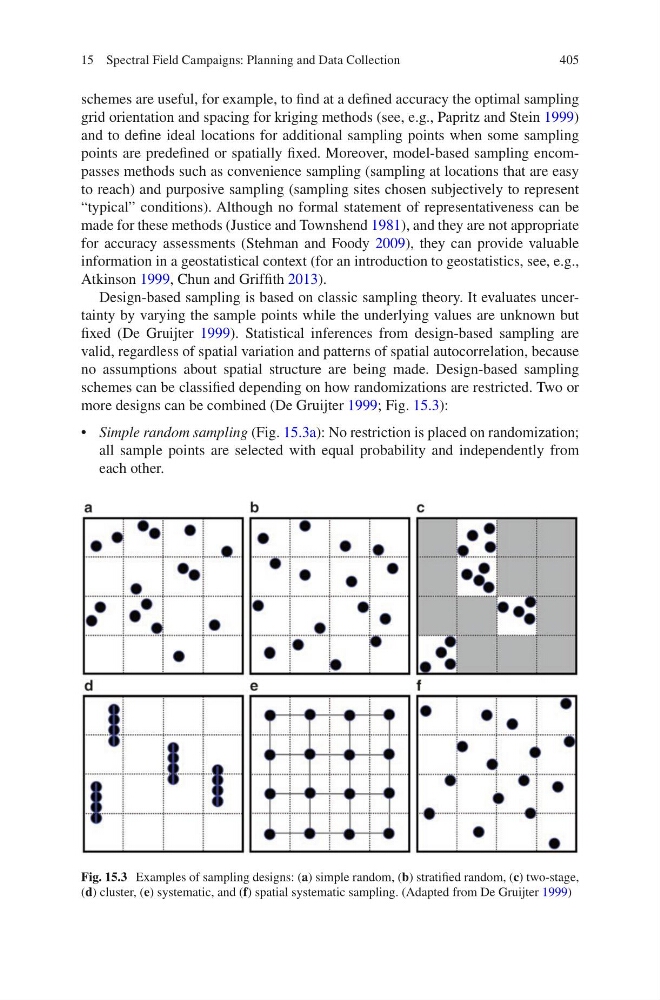
more designs can be combined (De Gruijter 1999; Fig. 15.3):
• Simple random sampling (Fig. 15.3a): No restriction is placed on randomization;
all sample points are selected with equal probability and independently from
each other.
Fig. 15.3 Examples of sampling designs: (a) simple random, (b) stratified random, (c) two-stage,
(d) cluster, (e) systematic, and (f) spatial systematic sampling. (Adapted from De Gruijter 1999)
15 Spectral Field Campaigns: Planning and Data Collection
schemes are useful, for example, to find at a defined accuracy the optimal sampling
grid orientation and spacing for kriging methods (see, e.g., Papritz and Stein 1999)
and to define ideal locations for additional sampling points when some sampling
points are predefined or spatially fixed. Moreover, model-based sampling encompasses methods such as convenience sampling (sampling at locations that are easy
to reach) and purposive sampling (sampling sites chosen subjectively to represent
“typical” conditions). Although no formal statement of representativeness can be
made for these methods (Justice and Townshend 1981), and they are not appropriate
for accuracy assessments (Stehman and Foody 2009), they can provide valuable
information in a geostatistical context (for an introduction to geostatistics, see, e.g.,
Atkinson 1999, Chun and Griffith 2013).
Design-based sampling is based on classic sampling theory. It evaluates uncertainty by varying the sample points while the underlying values are unknown but
fixed (De Gruijter 1999). Statistical inferences from design-based sampling are
valid, regardless of spatial variation and patterns of spatial autocorrelation, because
no assumptions about spatial structure are being made. Design-based sampling
schemes can be classified depending on how randomizations are restricted. Two or
more designs can be combined (De Gruijter 1999; Fig. 15.3):
• Simple random sampling (Fig. 15.3a): No restriction is placed on randomization;
all sample points are selected with equal probability and independently from
each other.
Fig. 15.3 Examples of sampling designs: (a) simple random, (b) stratified random, (c) two-stage,
(d) cluster, (e) systematic, and (f) spatial systematic sampling. (Adapted from De Gruijter 1999)
15 Spectral Field Campaigns: Planning and Data Collection