

401
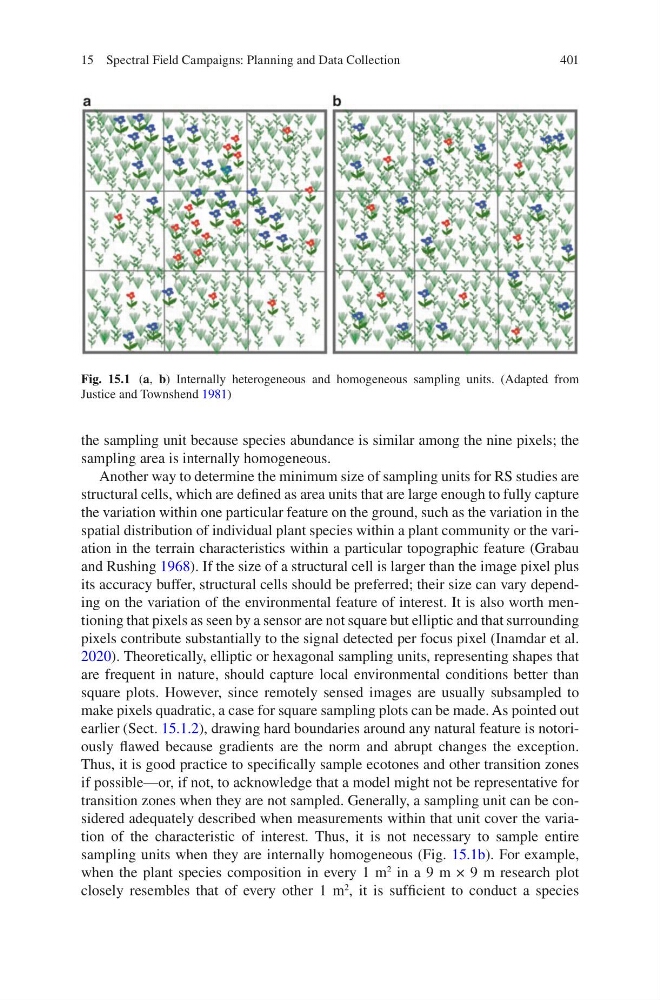
the sampling unit because species abundance is similar among the nine pixels; the
sampling area is internally homogeneous.
Another way to determine the minimum size of sampling units for RS studies are
structural cells, which are defined as area units that are large enough to fully capture
the variation within one particular feature on the ground, such as the variation in the
spatial distribution of individual plant species within a plant community or the variation in the terrain characteristics within a particular topographic feature (Grabau
and Rushing 1968). If the size of a structural cell is larger than the image pixel plus
its accuracy buffer, structural cells should be preferred; their size can vary depending on the variation of the environmental feature of interest. It is also worth mentioning that pixels as seen by a sensor are not square but elliptic and that surrounding
pixels contribute substantially to the signal detected per focus pixel (Inamdar et al.
2020). Theoretically, elliptic or hexagonal sampling units, representing shapes that
are frequent in nature, should capture local environmental conditions better than
square plots. However, since remotely sensed images are usually subsampled to
make pixels quadratic, a case for square sampling plots can be made. As pointed out
earlier (Sect. 15.1.2), drawing hard boundaries around any natural feature is notoriously flawed because gradients are the norm and abrupt changes the exception.
Thus, it is good practice to specifically sample ecotones and other transition zones
if possible—or, if not, to acknowledge that a model might not be representative for
transition zones when they are not sampled. Generally, a sampling unit can be considered adequately described when measurements within that unit cover the variation of the characteristic of interest. Thus, it is not necessary to sample entire
sampling units when they are internally homogeneous (Fig. 15.1b). For example,
when the plant species composition in every 1 m
2
in a 9 m × 9 m research plot
closely resembles that of every other 1 m
2
, it is sufficient to conduct a species
Fig. 15.1 (a, b) Internally heterogeneous and homogeneous sampling units. (Adapted from
Justice and Townshend 1981)
15 Spectral Field Campaigns: Planning and Data Collection
the sampling unit because species abundance is similar among the nine pixels; the
sampling area is internally homogeneous.
Another way to determine the minimum size of sampling units for RS studies are
structural cells, which are defined as area units that are large enough to fully capture
the variation within one particular feature on the ground, such as the variation in the
spatial distribution of individual plant species within a plant community or the variation in the terrain characteristics within a particular topographic feature (Grabau
and Rushing 1968). If the size of a structural cell is larger than the image pixel plus
its accuracy buffer, structural cells should be preferred; their size can vary depending on the variation of the environmental feature of interest. It is also worth mentioning that pixels as seen by a sensor are not square but elliptic and that surrounding
pixels contribute substantially to the signal detected per focus pixel (Inamdar et al.
2020). Theoretically, elliptic or hexagonal sampling units, representing shapes that
are frequent in nature, should capture local environmental conditions better than
square plots. However, since remotely sensed images are usually subsampled to
make pixels quadratic, a case for square sampling plots can be made. As pointed out
earlier (Sect. 15.1.2), drawing hard boundaries around any natural feature is notoriously flawed because gradients are the norm and abrupt changes the exception.
Thus, it is good practice to specifically sample ecotones and other transition zones
if possible—or, if not, to acknowledge that a model might not be representative for
transition zones when they are not sampled. Generally, a sampling unit can be considered adequately described when measurements within that unit cover the variation of the characteristic of interest. Thus, it is not necessary to sample entire
sampling units when they are internally homogeneous (Fig. 15.1b). For example,
when the plant species composition in every 1 m
2
in a 9 m × 9 m research plot
closely resembles that of every other 1 m
2
, it is sufficient to conduct a species
Fig. 15.1 (a, b) Internally heterogeneous and homogeneous sampling units. (Adapted from
Justice and Townshend 1981)
15 Spectral Field Campaigns: Planning and Data Collection