

364
excited P680
∗
complex and from there to plastoquinol, the first step in the electron
transport chain. The energy is passed to the cytochrome b6f complex and to plastocyanin in the path to the reaction center at photosystem I (PS I) and, from there,
ultimately to NADP+ and ADP. In their reduced state, they provide energy to reduce
CO 2 to a 3-C sugar in the Calvin cycle. The enzyme catalyzing the CO 2 reduction
reaction is RuBisCO, which is the most abundant protein on Earth (Ellis 1979;
Cooper 2000; Raven 2013).
14.8.3 Leaf Biochemistry and Energy Absorption
in the Solar Spectrum
The chemistry of plant species may be highly variable in terms of secondary compounds, but essential physiological functions are similar. Because seed plants share
a common ancestry and face common requirements to survive, younger species
retain structures based on their genetic heritage to capture and use sunlight. For a
species to survive in a particular environment, the suite of leaf traits must be consistent with long-term patterns of environmental resources, and investments in plant
tissues and biochemical composition are determined by metabolic activities, as
illustrated by correlations among environmental conditions, leaf chemistry, and
Singlet States
Increasing Energy
Electronic Ground State
T 1
T 2
S 1
S 2
S n
Triplet States
Photon Absorption
Fluorescence
Intersystem Crossing
Internal Conversion
IC
IC
Phosphorescence
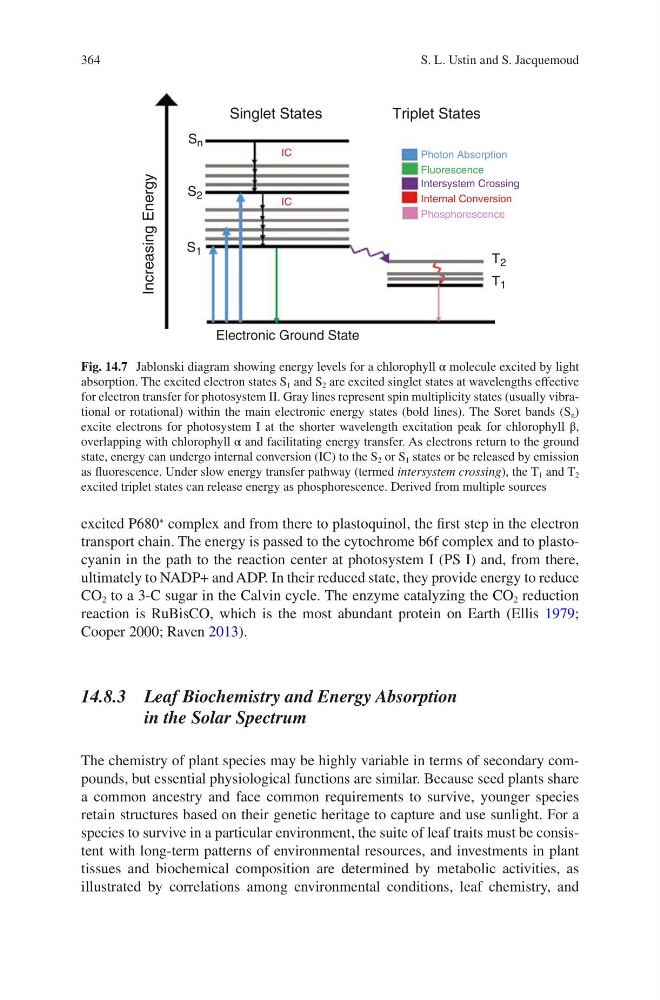
Fig. 14.7 Jablonski diagram showing energy levels for a chlorophyll α molecule excited by light
absorption. The excited electron states S 1 and S 2 are excited singlet states at wavelengths effective
for electron transfer for photosystem II. Gray lines represent spin multiplicity states (usually vibrational or rotational) within the main electronic energy states (bold lines). The Soret bands (S n )
excite electrons for photosystem I at the shorter wavelength excitation peak for chlorophyll β,
overlapping with chlorophyll α and facilitating energy transfer. As electrons return to the ground
state, energy can undergo internal conversion (IC) to the S 2 or S 1 states or be released by emission
as fluorescence. Under slow energy transfer pathway (termed intersystem crossing), the T 1 and T 2
excited triplet states can release energy as phosphorescence. Derived from multiple sources
S. L. Ustin and S. Jacquemoud
excited P680
∗
complex and from there to plastoquinol, the first step in the electron
transport chain. The energy is passed to the cytochrome b6f complex and to plastocyanin in the path to the reaction center at photosystem I (PS I) and, from there,
ultimately to NADP+ and ADP. In their reduced state, they provide energy to reduce
CO 2 to a 3-C sugar in the Calvin cycle. The enzyme catalyzing the CO 2 reduction
reaction is RuBisCO, which is the most abundant protein on Earth (Ellis 1979;
Cooper 2000; Raven 2013).
14.8.3 Leaf Biochemistry and Energy Absorption
in the Solar Spectrum
The chemistry of plant species may be highly variable in terms of secondary compounds, but essential physiological functions are similar. Because seed plants share
a common ancestry and face common requirements to survive, younger species
retain structures based on their genetic heritage to capture and use sunlight. For a
species to survive in a particular environment, the suite of leaf traits must be consistent with long-term patterns of environmental resources, and investments in plant
tissues and biochemical composition are determined by metabolic activities, as
illustrated by correlations among environmental conditions, leaf chemistry, and
Singlet States
Increasing Energy
Electronic Ground State
T 1
T 2
S 1
S 2
S n
Triplet States
Photon Absorption
Fluorescence
Intersystem Crossing
Internal Conversion
IC
IC
Phosphorescence
Fig. 14.7 Jablonski diagram showing energy levels for a chlorophyll α molecule excited by light
absorption. The excited electron states S 1 and S 2 are excited singlet states at wavelengths effective
for electron transfer for photosystem II. Gray lines represent spin multiplicity states (usually vibrational or rotational) within the main electronic energy states (bold lines). The Soret bands (S n )
excite electrons for photosystem I at the shorter wavelength excitation peak for chlorophyll β,
overlapping with chlorophyll α and facilitating energy transfer. As electrons return to the ground
state, energy can undergo internal conversion (IC) to the S 2 or S 1 states or be released by emission
as fluorescence. Under slow energy transfer pathway (termed intersystem crossing), the T 1 and T 2
excited triplet states can release energy as phosphorescence. Derived from multiple sources
S. L. Ustin and S. Jacquemoud