

362
14.8 The Mesophyll
The leaf mesophyll includes all cells between the two epidermal layers and consists
of one or more types of ground parenchyma, depending on the cellular specialization. Because these tissues are arranged differently in dicots, monocots, and conifers, spectral responses frequently differ among the three groups. Other taxa,
including mosses and ferns, also have different characteristic foliar anatomy and
biochemistry that allows them to be distinguished from higher plants by their spectral characteristics (Vogelmann and Moss 1993: Bubier et al. 2007; Van Gaalen
et al. 2007). Monocots and conifers generally have one type of ground tissue, called
chlorenchyma, which are chloroplast-containing parenchyma cells, while dicot
leaves typically have two types of parenchyma cells: elongated densely packed cells
that are oriented perpendicular to the upper leaf surface and termed palisade parenchyma and irregular-shaped cells with a high proportion of air spaces in the tissue,
called spongy mesophyll (Fig. 14.3). The mesophyll tissue also includes the vascular tissue that transports water and nutrients into the leaf and carbohydrates out of
the leaf. These cells are generally within a larger tissue termed the vascular bundle,
which includes xylem and phloem cells that conduct fluids and fiber cells and tracheids that provide structural support for the leaf and the conducting tissue. The
conducting cells are connected throughout the leaf in a network of veins.
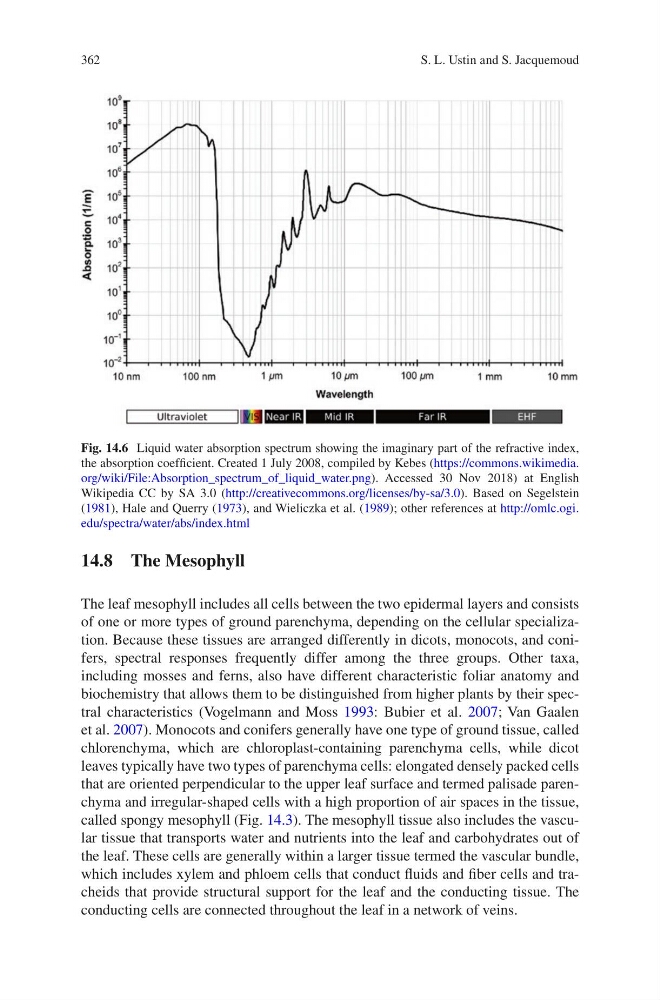
Fig. 14.6 Liquid water absorption spectrum showing the imaginary part of the refractive index,
the absorption coefficient. Created 1 July 2008, compiled by Kebes (https://commons.wikimedia.
org/wiki/File:Absorption_spectrum_of_liquid_water.png). Accessed 30 Nov 2018) at English
Wikipedia CC by SA 3.0 (http://creativecommons.org/licenses/by-sa/3.0). Based on Segelstein
(1981), Hale and Querry (1973), and Wieliczka et al. (1989); other references at http://omlc.ogi.
edu/spectra/water/abs/index.html
S. L. Ustin and S. Jacquemoud
14.8 The Mesophyll
The leaf mesophyll includes all cells between the two epidermal layers and consists
of one or more types of ground parenchyma, depending on the cellular specialization. Because these tissues are arranged differently in dicots, monocots, and conifers, spectral responses frequently differ among the three groups. Other taxa,
including mosses and ferns, also have different characteristic foliar anatomy and
biochemistry that allows them to be distinguished from higher plants by their spectral characteristics (Vogelmann and Moss 1993: Bubier et al. 2007; Van Gaalen
et al. 2007). Monocots and conifers generally have one type of ground tissue, called
chlorenchyma, which are chloroplast-containing parenchyma cells, while dicot
leaves typically have two types of parenchyma cells: elongated densely packed cells
that are oriented perpendicular to the upper leaf surface and termed palisade parenchyma and irregular-shaped cells with a high proportion of air spaces in the tissue,
called spongy mesophyll (Fig. 14.3). The mesophyll tissue also includes the vascular tissue that transports water and nutrients into the leaf and carbohydrates out of
the leaf. These cells are generally within a larger tissue termed the vascular bundle,
which includes xylem and phloem cells that conduct fluids and fiber cells and tracheids that provide structural support for the leaf and the conducting tissue. The
conducting cells are connected throughout the leaf in a network of veins.
Fig. 14.6 Liquid water absorption spectrum showing the imaginary part of the refractive index,
the absorption coefficient. Created 1 July 2008, compiled by Kebes (https://commons.wikimedia.
org/wiki/File:Absorption_spectrum_of_liquid_water.png). Accessed 30 Nov 2018) at English
Wikipedia CC by SA 3.0 (http://creativecommons.org/licenses/by-sa/3.0). Based on Segelstein
(1981), Hale and Querry (1973), and Wieliczka et al. (1989); other references at http://omlc.ogi.
edu/spectra/water/abs/index.html
S. L. Ustin and S. Jacquemoud