

360
conifer species like the blue Colorado spruce, Picea pungens. These plants are often
found in high light or drought-stressed environments, or at high elevations, where
they may be exposed to high UV radiation.
14.7.2 Epidermal Cell Shape and Function
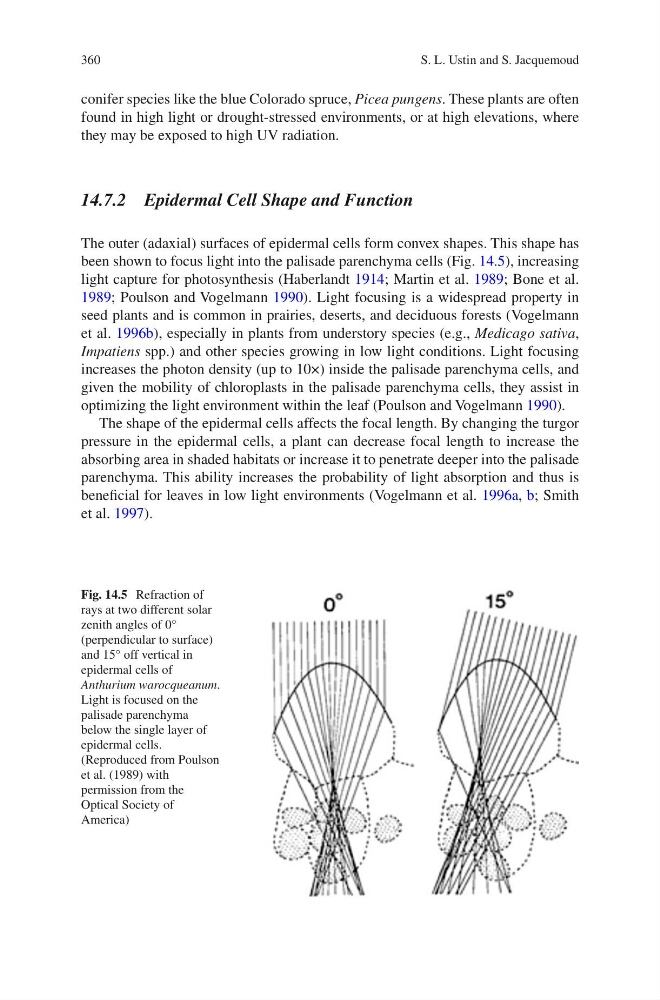
The outer (adaxial) surfaces of epidermal cells form convex shapes. This shape has
been shown to focus light into the palisade parenchyma cells (Fig. 14.5), increasing
light capture for photosynthesis (Haberlandt 1914; Martin et al. 1989; Bone et al.
1989; Poulson and Vogelmann 1990). Light focusing is a widespread property in
seed plants and is common in prairies, deserts, and deciduous forests (Vogelmann
et al. 1996b), especially in plants from understory species (e.g., Medicago sativa,
Impatiens spp.) and other species growing in low light conditions. Light focusing
increases the photon density (up to 10×) inside the palisade parenchyma cells, and
given the mobility of chloroplasts in the palisade parenchyma cells, they assist in
optimizing the light environment within the leaf (Poulson and Vogelmann 1990).
The shape of the epidermal cells affects the focal length. By changing the turgor
pressure in the epidermal cells, a plant can decrease focal length to increase the
absorbing area in shaded habitats or increase it to penetrate deeper into the palisade
parenchyma. This ability increases the probability of light absorption and thus is
beneficial for leaves in low light environments (Vogelmann et al. 1996a, b; Smith
et al. 1997).
Fig. 14.5 Refraction of
rays at two different solar
zenith angles of 0°
(perpendicular to surface)
and 15° off vertical in
epidermal cells of
Anthurium warocqueanum.
Light is focused on the
palisade parenchyma
below the single layer of
epidermal cells.
(Reproduced from Poulson
et al. (1989) with
permission from the
Optical Society of
America)
S. L. Ustin and S. Jacquemoud
conifer species like the blue Colorado spruce, Picea pungens. These plants are often
found in high light or drought-stressed environments, or at high elevations, where
they may be exposed to high UV radiation.
14.7.2 Epidermal Cell Shape and Function
The outer (adaxial) surfaces of epidermal cells form convex shapes. This shape has
been shown to focus light into the palisade parenchyma cells (Fig. 14.5), increasing
light capture for photosynthesis (Haberlandt 1914; Martin et al. 1989; Bone et al.
1989; Poulson and Vogelmann 1990). Light focusing is a widespread property in
seed plants and is common in prairies, deserts, and deciduous forests (Vogelmann
et al. 1996b), especially in plants from understory species (e.g., Medicago sativa,
Impatiens spp.) and other species growing in low light conditions. Light focusing
increases the photon density (up to 10×) inside the palisade parenchyma cells, and
given the mobility of chloroplasts in the palisade parenchyma cells, they assist in
optimizing the light environment within the leaf (Poulson and Vogelmann 1990).
The shape of the epidermal cells affects the focal length. By changing the turgor
pressure in the epidermal cells, a plant can decrease focal length to increase the
absorbing area in shaded habitats or increase it to penetrate deeper into the palisade
parenchyma. This ability increases the probability of light absorption and thus is
beneficial for leaves in low light environments (Vogelmann et al. 1996a, b; Smith
et al. 1997).
Fig. 14.5 Refraction of
rays at two different solar
zenith angles of 0°
(perpendicular to surface)
and 15° off vertical in
epidermal cells of
Anthurium warocqueanum.
Light is focused on the
palisade parenchyma
below the single layer of
epidermal cells.
(Reproduced from Poulson
et al. (1989) with
permission from the
Optical Society of
America)
S. L. Ustin and S. Jacquemoud