

354
or lesser than reflectance (Knipling 1970; Wooley 1971; Jacquemoud and Ustin
2008), depending on leaf thickness, number of leaves light passes through, and their
optical properties. Thus, transmittance spectra carry information about leaf traits
and biodiversity but are seldom used in remote sensing (RS) except in field-based or
laboratory studies.
14.5 Leaf Absorptance Patterns
The absorption of light is determined by the absorbing molecules in the leaf balanced by the structural properties that scatter light, such as air spaces and water–air
interfaces. In the visible spectrum, it is photosynthetic pigments, primarily chlorophylls and carotenoids that strongly absorb light. Other non-photosynthetic pigments also absorb in this wavelength region, such as anthocyanins (a large and
diverse group of flavonoids that are involved with leaf color but also colors of flowers and fruit). Anthocyanins (and more generally flavonoids) provide photoprotection from UV light (Stapleton 1992; Steyn et al. 2002)), such as in alpine
environments or during early leaf development (Chalker-Scott 1999; Karageorgou
and Manetas 2006) when the photosynthetic machinery is not fully developed.
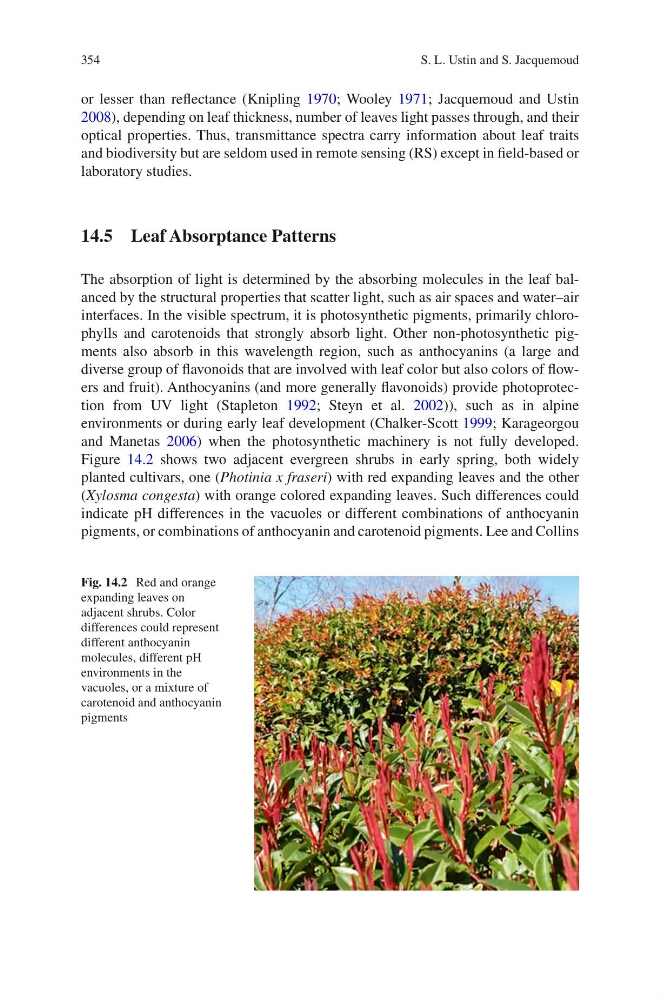
Figure 14.2 shows two adjacent evergreen shrubs in early spring, both widely
planted cultivars, one (Photinia x fraseri) with red expanding leaves and the other
(Xylosma congesta) with orange colored expanding leaves. Such differences could
indicate pH differences in the vacuoles or different combinations of anthocyanin
pigments, or combinations of anthocyanin and carotenoid pigments. Lee and Collins
Fig. 14.2 Red and orange
expanding leaves on
adjacent shrubs. Color
differences could represent
different anthocyanin
molecules, different pH
environments in the
vacuoles, or a mixture of
carotenoid and anthocyanin
pigments
S. L. Ustin and S. Jacquemoud
or lesser than reflectance (Knipling 1970; Wooley 1971; Jacquemoud and Ustin
2008), depending on leaf thickness, number of leaves light passes through, and their
optical properties. Thus, transmittance spectra carry information about leaf traits
and biodiversity but are seldom used in remote sensing (RS) except in field-based or
laboratory studies.
14.5 Leaf Absorptance Patterns
The absorption of light is determined by the absorbing molecules in the leaf balanced by the structural properties that scatter light, such as air spaces and water–air
interfaces. In the visible spectrum, it is photosynthetic pigments, primarily chlorophylls and carotenoids that strongly absorb light. Other non-photosynthetic pigments also absorb in this wavelength region, such as anthocyanins (a large and
diverse group of flavonoids that are involved with leaf color but also colors of flowers and fruit). Anthocyanins (and more generally flavonoids) provide photoprotection from UV light (Stapleton 1992; Steyn et al. 2002)), such as in alpine
environments or during early leaf development (Chalker-Scott 1999; Karageorgou
and Manetas 2006) when the photosynthetic machinery is not fully developed.
Figure 14.2 shows two adjacent evergreen shrubs in early spring, both widely
planted cultivars, one (Photinia x fraseri) with red expanding leaves and the other
(Xylosma congesta) with orange colored expanding leaves. Such differences could
indicate pH differences in the vacuoles or different combinations of anthocyanin
pigments, or combinations of anthocyanin and carotenoid pigments. Lee and Collins
Fig. 14.2 Red and orange
expanding leaves on
adjacent shrubs. Color
differences could represent
different anthocyanin
molecules, different pH
environments in the
vacuoles, or a mixture of
carotenoid and anthocyanin
pigments
S. L. Ustin and S. Jacquemoud