

351
characteristic of the NIR, where generally 10% or less of radiation is absorbed
(Jacquemoud and Ustin 2008); intermediate reflectance is characteristic of the
SWIR region (1500–2500 nm), where energy is primarily absorbed by water in
leaves (Carter 1991) or by plant residues when leaves are dry. Cell wall compounds
such as cellulose and lignin or other biochemicals found in the cytoplasm such as
proteins and sugars account for many overlapping absorption features in the SWIR.
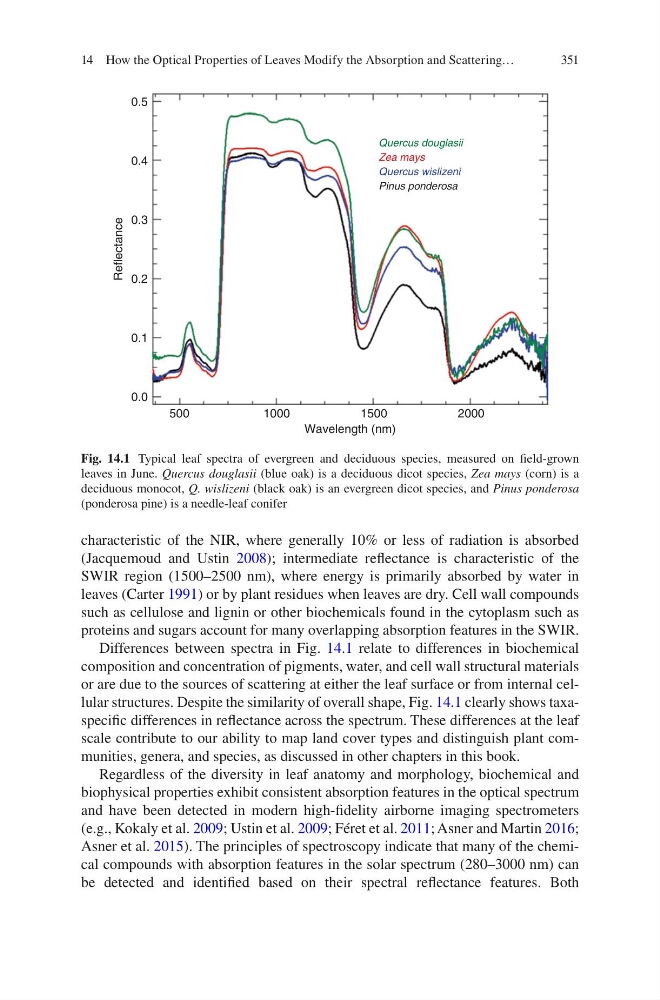
Differences between spectra in Fig. 14.1 relate to differences in biochemical
composition and concentration of pigments, water, and cell wall structural materials
or are due to the sources of scattering at either the leaf surface or from internal cellular structures. Despite the similarity of overall shape, Fig. 14.1 clearly shows taxaspecific differences in reflectance across the spectrum. These differences at the leaf
scale contribute to our ability to map land cover types and distinguish plant communities, genera, and species, as discussed in other chapters in this book.
Regardless of the diversity in leaf anatomy and morphology, biochemical and
biophysical properties exhibit consistent absorption features in the optical spectrum
and have been detected in modern high-fidelity airborne imaging spectrometers
(e.g., Kokaly et al. 2009; Ustin et al. 2009; Féret et al. 2011; Asner and Martin 2016;
Asner et al. 2015). The principles of spectroscopy indicate that many of the chemical compounds with absorption features in the solar spectrum (280–3000 nm) can
be detected and identified based on their spectral reflectance features. Both
500
0.0
0.1
0.2
0.3
Reflectance
0.4
0.5
1000
1500
Quercus douglasii
Zea mays
Quercus wislizeni
Pinus ponderosa
2000
Wavelength (nm)
Fig. 14.1 Typical leaf spectra of evergreen and deciduous species, measured on field-grown
leaves in June. Quercus douglasii (blue oak) is a deciduous dicot species, Zea mays (corn) is a
deciduous monocot, Q. wislizeni (black oak) is an evergreen dicot species, and Pinus ponderosa
(ponderosa pine) is a needle-leaf conifer
14 How the Optical Properties of Leaves Modify the Absorption and Scattering…
characteristic of the NIR, where generally 10% or less of radiation is absorbed
(Jacquemoud and Ustin 2008); intermediate reflectance is characteristic of the
SWIR region (1500–2500 nm), where energy is primarily absorbed by water in
leaves (Carter 1991) or by plant residues when leaves are dry. Cell wall compounds
such as cellulose and lignin or other biochemicals found in the cytoplasm such as
proteins and sugars account for many overlapping absorption features in the SWIR.
Differences between spectra in Fig. 14.1 relate to differences in biochemical
composition and concentration of pigments, water, and cell wall structural materials
or are due to the sources of scattering at either the leaf surface or from internal cellular structures. Despite the similarity of overall shape, Fig. 14.1 clearly shows taxaspecific differences in reflectance across the spectrum. These differences at the leaf
scale contribute to our ability to map land cover types and distinguish plant communities, genera, and species, as discussed in other chapters in this book.
Regardless of the diversity in leaf anatomy and morphology, biochemical and
biophysical properties exhibit consistent absorption features in the optical spectrum
and have been detected in modern high-fidelity airborne imaging spectrometers
(e.g., Kokaly et al. 2009; Ustin et al. 2009; Féret et al. 2011; Asner and Martin 2016;
Asner et al. 2015). The principles of spectroscopy indicate that many of the chemical compounds with absorption features in the solar spectrum (280–3000 nm) can
be detected and identified based on their spectral reflectance features. Both
500
0.0
0.1
0.2
0.3
Reflectance
0.4
0.5
1000
1500
Quercus douglasii
Zea mays
Quercus wislizeni
Pinus ponderosa
2000
Wavelength (nm)
Fig. 14.1 Typical leaf spectra of evergreen and deciduous species, measured on field-grown
leaves in June. Quercus douglasii (blue oak) is a deciduous dicot species, Zea mays (corn) is a
deciduous monocot, Q. wislizeni (black oak) is an evergreen dicot species, and Pinus ponderosa
(ponderosa pine) is a needle-leaf conifer
14 How the Optical Properties of Leaves Modify the Absorption and Scattering…