

14
2.1 What Is Biodiversity?
Biodiversity encompasses the totality of variation in life on Earth, including its
ecosystems, the species generated through evolutionary history across the tree of
life, the genetic variation within them, and the vast variety of functions that each
organism, species, and ecosystem possess to access and create resources for life to
persist. Changes in the Earth’s condition, including the actions of humanity, have
consequences for the expression of biodiversity and how it is changing through time.
2.2 The Hierarchical Nature of Biodiversity
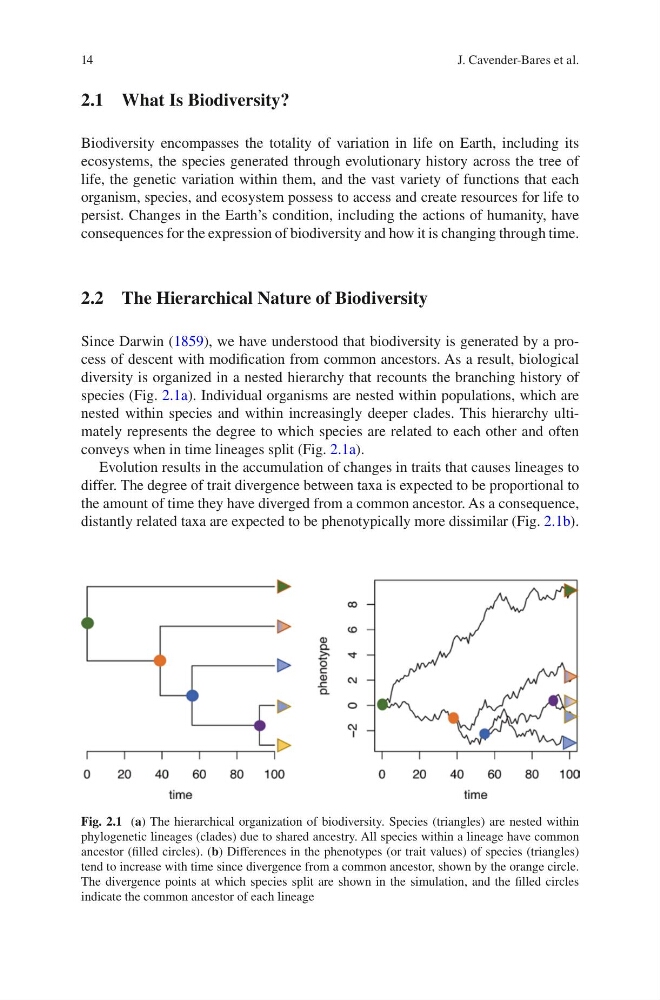
Since Darwin (1859), we have understood that biodiversity is generated by a process of descent with modification from common ancestors. As a result, biological
diversity is organized in a nested hierarchy that recounts the branching history of
species (Fig. 2.1a). Individual organisms are nested within populations, which are
nested within species and within increasingly deeper clades. This hierarchy ultimately represents the degree to which species are related to each other and often
conveys when in time lineages split (Fig. 2.1a).
Evolution results in the accumulation of changes in traits that causes lineages to
differ. The degree of trait divergence between taxa is expected to be proportional to
the amount of time they have diverged from a common ancestor. As a consequence,
distantly related taxa are expected to be phenotypically more dissimilar (Fig. 2.1b).
Fig. 2.1 (a) The hierarchical organization of biodiversity. Species (triangles) are nested within
phylogenetic lineages (clades) due to shared ancestry. All species within a lineage have common
ancestor (filled circles). (b) Differences in the phenotypes (or trait values) of species (triangles)
tend to increase with time since divergence from a common ancestor, shown by the orange circle.
The divergence points at which species split are shown in the simulation, and the filled circles
indicate the common ancestor of each lineage
J. Cavender-Bares et al.
2.1 What Is Biodiversity?
Biodiversity encompasses the totality of variation in life on Earth, including its
ecosystems, the species generated through evolutionary history across the tree of
life, the genetic variation within them, and the vast variety of functions that each
organism, species, and ecosystem possess to access and create resources for life to
persist. Changes in the Earth’s condition, including the actions of humanity, have
consequences for the expression of biodiversity and how it is changing through time.
2.2 The Hierarchical Nature of Biodiversity
Since Darwin (1859), we have understood that biodiversity is generated by a process of descent with modification from common ancestors. As a result, biological
diversity is organized in a nested hierarchy that recounts the branching history of
species (Fig. 2.1a). Individual organisms are nested within populations, which are
nested within species and within increasingly deeper clades. This hierarchy ultimately represents the degree to which species are related to each other and often
conveys when in time lineages split (Fig. 2.1a).
Evolution results in the accumulation of changes in traits that causes lineages to
differ. The degree of trait divergence between taxa is expected to be proportional to
the amount of time they have diverged from a common ancestor. As a consequence,
distantly related taxa are expected to be phenotypically more dissimilar (Fig. 2.1b).
Fig. 2.1 (a) The hierarchical organization of biodiversity. Species (triangles) are nested within
phylogenetic lineages (clades) due to shared ancestry. All species within a lineage have common
ancestor (filled circles). (b) Differences in the phenotypes (or trait values) of species (triangles)
tend to increase with time since divergence from a common ancestor, shown by the orange circle.
The divergence points at which species split are shown in the simulation, and the filled circles
indicate the common ancestor of each lineage
J. Cavender-Bares et al.