

316
water availability. The results showed that these plant species employ different strategies in the regulation of hydraulic and stomatal conductivity during drought stress
and thus substantiate the need for setting up WSN for different plant species and
communities (Teodoro et al. 2016).
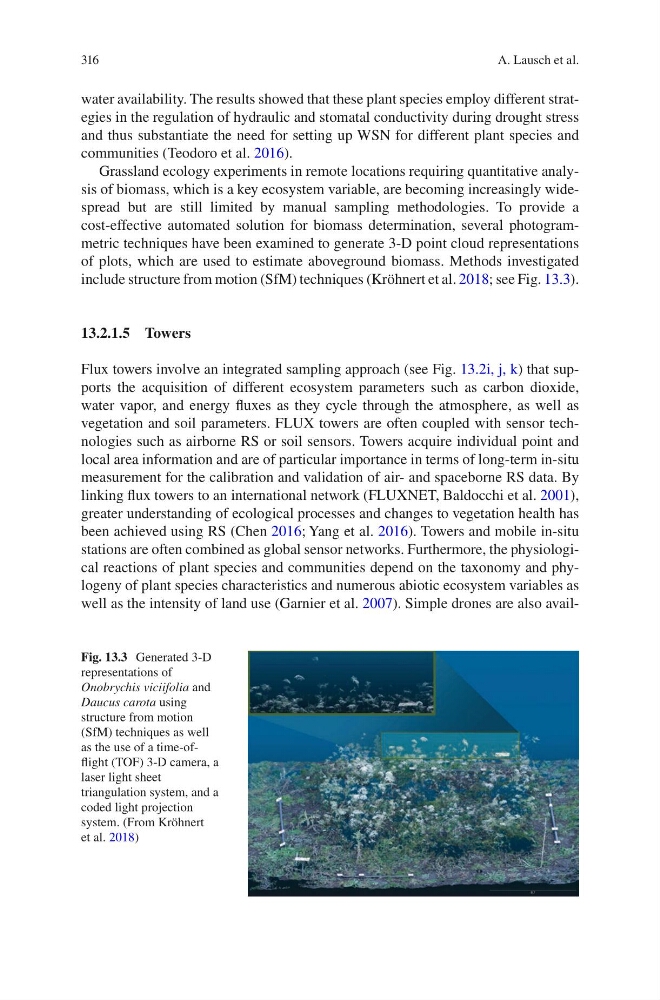
Grassland ecology experiments in remote locations requiring quantitative analysis of biomass, which is a key ecosystem variable, are becoming increasingly widespread but are still limited by manual sampling methodologies. To provide a
cost-effective automated solution for biomass determination, several photogrammetric techniques have been examined to generate 3-D point cloud representations
of plots, which are used to estimate aboveground biomass. Methods investigated
include structure from motion (SfM) techniques (Kröhnert et al. 2018; see Fig. 13.3).
13.2.1.5 Towers
Flux towers involve an integrated sampling approach (see Fig. 13.2i, j, k) that supports the acquisition of different ecosystem parameters such as carbon dioxide,
water vapor, and energy fluxes as they cycle through the atmosphere, as well as
vegetation and soil parameters. FLUX towers are often coupled with sensor technologies such as airborne RS or soil sensors. Towers acquire individual point and
local area information and are of particular importance in terms of long-term in-situ
measurement for the calibration and validation of air- and spaceborne RS data. By
linking flux towers to an international network (FLUXNET, Baldocchi et al. 2001),
greater understanding of ecological processes and changes to vegetation health has
been achieved using RS (Chen 2016; Yang et al. 2016). Towers and mobile in-situ
stations are often combined as global sensor networks. Furthermore, the physiological reactions of plant species and communities depend on the taxonomy and phylogeny of plant species characteristics and numerous abiotic ecosystem variables as
well as the intensity of land use (Garnier et al. 2007). Simple drones are also availFig. 13.3 Generated 3-D
representations of
Onobrychis viciifolia and
Daucus carota using
structure from motion
(SfM) techniques as well
as the use of a time-offlight (TOF) 3-D camera, a
laser light sheet
triangulation system, and a
coded light projection
system. (From Kröhnert
et al. 2018)
A. Lausch et al.
water availability. The results showed that these plant species employ different strategies in the regulation of hydraulic and stomatal conductivity during drought stress
and thus substantiate the need for setting up WSN for different plant species and
communities (Teodoro et al. 2016).
Grassland ecology experiments in remote locations requiring quantitative analysis of biomass, which is a key ecosystem variable, are becoming increasingly widespread but are still limited by manual sampling methodologies. To provide a
cost-effective automated solution for biomass determination, several photogrammetric techniques have been examined to generate 3-D point cloud representations
of plots, which are used to estimate aboveground biomass. Methods investigated
include structure from motion (SfM) techniques (Kröhnert et al. 2018; see Fig. 13.3).
13.2.1.5 Towers
Flux towers involve an integrated sampling approach (see Fig. 13.2i, j, k) that supports the acquisition of different ecosystem parameters such as carbon dioxide,
water vapor, and energy fluxes as they cycle through the atmosphere, as well as
vegetation and soil parameters. FLUX towers are often coupled with sensor technologies such as airborne RS or soil sensors. Towers acquire individual point and
local area information and are of particular importance in terms of long-term in-situ
measurement for the calibration and validation of air- and spaceborne RS data. By
linking flux towers to an international network (FLUXNET, Baldocchi et al. 2001),
greater understanding of ecological processes and changes to vegetation health has
been achieved using RS (Chen 2016; Yang et al. 2016). Towers and mobile in-situ
stations are often combined as global sensor networks. Furthermore, the physiological reactions of plant species and communities depend on the taxonomy and phylogeny of plant species characteristics and numerous abiotic ecosystem variables as
well as the intensity of land use (Garnier et al. 2007). Simple drones are also availFig. 13.3 Generated 3-D
representations of
Onobrychis viciifolia and
Daucus carota using
structure from motion
(SfM) techniques as well
as the use of a time-offlight (TOF) 3-D camera, a
laser light sheet
triangulation system, and a
coded light projection
system. (From Kröhnert
et al. 2018)
A. Lausch et al.