

291
One factor that aids in detection is that IAS tend to emerge in patches or patterns
associated with farm management practices. For example, plants growing outside of
the uniform row formations are often IAS and can be treated. Most studies typically
investigate a single IAS. However, IAS are often intermixed, making them hard to
distinguish from each other. Additionally, Basinger (2018) found that using field
spectroscopy, IAS detection is not uniform across cropping systems and suggested
that improved IAS detection may require crop-specific parameters for accurate IAS
detection and control.
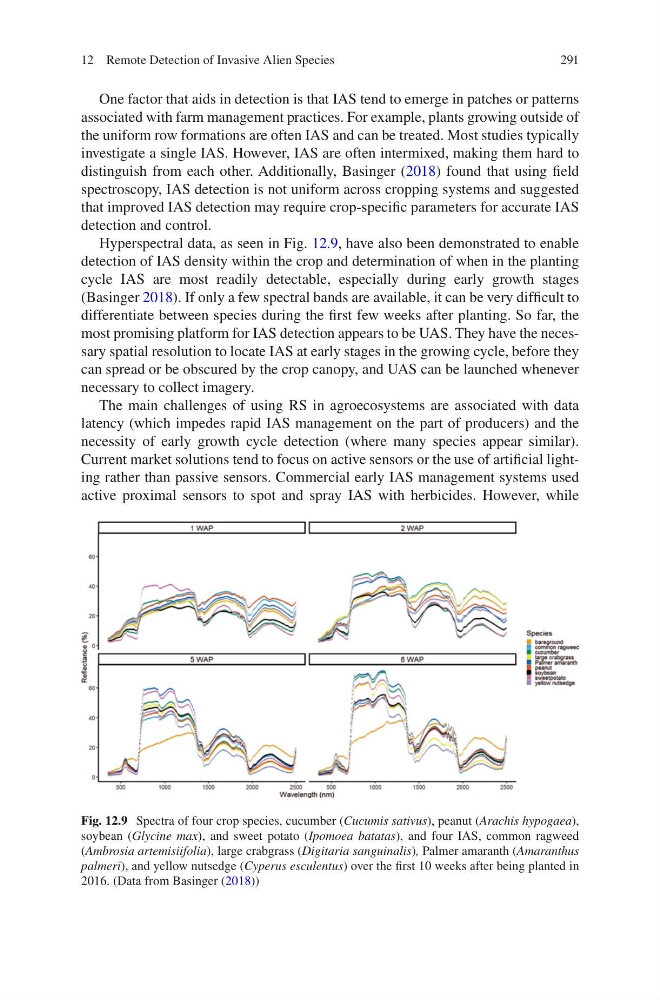
Hyperspectral data, as seen in Fig. 12.9, have also been demonstrated to enable
detection of IAS density within the crop and determination of when in the planting
cycle IAS are most readily detectable, especially during early growth stages
(Basinger 2018). If only a few spectral bands are available, it can be very difficult to
differentiate between species during the first few weeks after planting. So far, the
most promising platform for IAS detection appears to be UAS. They have the necessary spatial resolution to locate IAS at early stages in the growing cycle, before they
can spread or be obscured by the crop canopy, and UAS can be launched whenever
necessary to collect imagery.
The main challenges of using RS in agroecosystems are associated with data
latency (which impedes rapid IAS management on the part of producers) and the
necessity of early growth cycle detection (where many species appear similar).
Current market solutions tend to focus on active sensors or the use of artificial lighting rather than passive sensors. Commercial early IAS management systems used
active proximal sensors to spot and spray IAS with herbicides. However, while
Fig. 12.9 Spectra of four crop species, cucumber (Cucumis sativus), peanut (Arachis hypogaea),
soybean (Glycine max), and sweet potato (Ipomoea batatas), and four IAS, common ragweed
(Ambrosia artemisiifolia), large crabgrass (Digitaria sanguinalis), Palmer amaranth (Amaranthus
palmeri), and yellow nutsedge (Cyperus esculentus) over the first 10 weeks after being planted in
2016. (Data from Basinger (2018))
12 Remote Detection of Invasive Alien Species
One factor that aids in detection is that IAS tend to emerge in patches or patterns
associated with farm management practices. For example, plants growing outside of
the uniform row formations are often IAS and can be treated. Most studies typically
investigate a single IAS. However, IAS are often intermixed, making them hard to
distinguish from each other. Additionally, Basinger (2018) found that using field
spectroscopy, IAS detection is not uniform across cropping systems and suggested
that improved IAS detection may require crop-specific parameters for accurate IAS
detection and control.
Hyperspectral data, as seen in Fig. 12.9, have also been demonstrated to enable
detection of IAS density within the crop and determination of when in the planting
cycle IAS are most readily detectable, especially during early growth stages
(Basinger 2018). If only a few spectral bands are available, it can be very difficult to
differentiate between species during the first few weeks after planting. So far, the
most promising platform for IAS detection appears to be UAS. They have the necessary spatial resolution to locate IAS at early stages in the growing cycle, before they
can spread or be obscured by the crop canopy, and UAS can be launched whenever
necessary to collect imagery.
The main challenges of using RS in agroecosystems are associated with data
latency (which impedes rapid IAS management on the part of producers) and the
necessity of early growth cycle detection (where many species appear similar).
Current market solutions tend to focus on active sensors or the use of artificial lighting rather than passive sensors. Commercial early IAS management systems used
active proximal sensors to spot and spray IAS with herbicides. However, while
Fig. 12.9 Spectra of four crop species, cucumber (Cucumis sativus), peanut (Arachis hypogaea),
soybean (Glycine max), and sweet potato (Ipomoea batatas), and four IAS, common ragweed
(Ambrosia artemisiifolia), large crabgrass (Digitaria sanguinalis), Palmer amaranth (Amaranthus
palmeri), and yellow nutsedge (Cyperus esculentus) over the first 10 weeks after being planted in
2016. (Data from Basinger (2018))
12 Remote Detection of Invasive Alien Species