

289
documented similar rapid changes in cyanobacteria from hyperspectral measurements. Chen et al. (2010) observed phytoplankton blooms that evolve over 2–3 days
in Tampa Bay. After 13 years of observations in Long Island Sound, Dierssen et al.
(2015) concluded that monthly measurements are insufficient to quantify episodic
plankton blooms. While they documented a bloom of a ciliate that could only be
detected with hyperspectral measurements, of yellow fluorescence, only one such
image has ever been collected of this area and this was with the Hyperspectral
Imager for the Coastal Ocean (HICO) that ceased operations in 2014.
Mapping submerged phytoplankton, macrophytes, and macroalgae is one of the
most challenging aspects of IAS detection in aquatic systems. Well-calibrated
hyperspectral data with good radiometric quality is crucial when mapping submerged phytoplankton, macrophytes, and macroalgae to the species level. Due to
the low reflectance, noise can severely affect data. Because of signal attenuation
within the water column, typically less than 10% of the signal measured at the top
of the atmosphere comes from the water column and the submerged community.
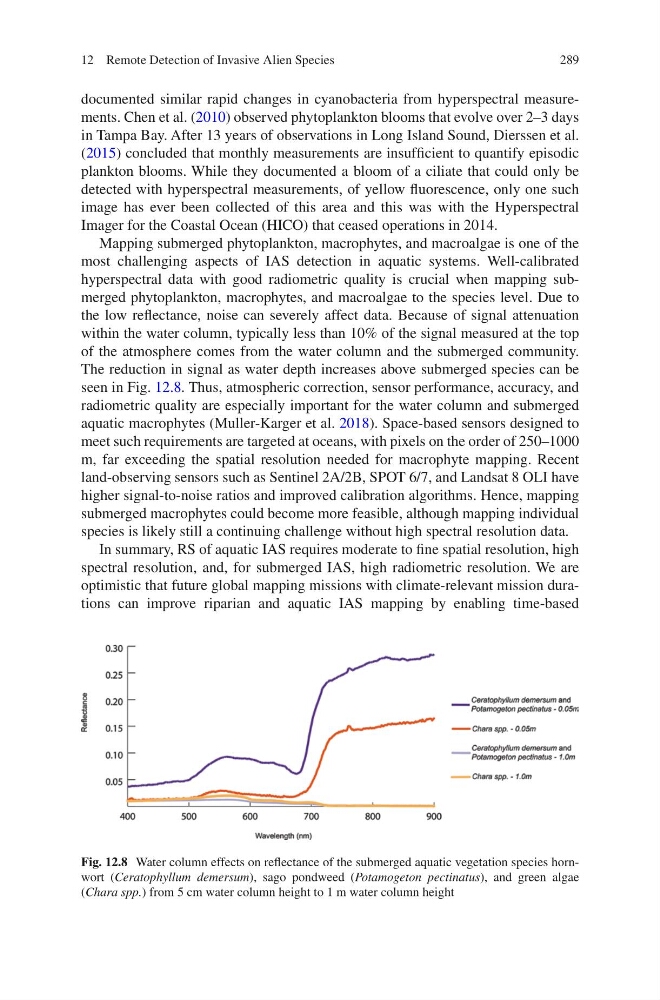
The reduction in signal as water depth increases above submerged species can be
seen in Fig. 12.8. Thus, atmospheric correction, sensor performance, accuracy, and
radiometric quality are especially important for the water column and submerged
aquatic macrophytes (Muller-Karger et al. 2018). Space-based sensors designed to
meet such requirements are targeted at oceans, with pixels on the order of 250–1000
m, far exceeding the spatial resolution needed for macrophyte mapping. Recent
land-observing sensors such as Sentinel 2A/2B, SPOT 6/7, and Landsat 8 OLI have
higher signal-to-noise ratios and improved calibration algorithms. Hence, mapping
submerged macrophytes could become more feasible, although mapping individual
species is likely still a continuing challenge without high spectral resolution data.
In summary, RS of aquatic IAS requires moderate to fine spatial resolution, high
spectral resolution, and, for submerged IAS, high radiometric resolution. We are
optimistic that future global mapping missions with climate-relevant mission durations can improve riparian and aquatic IAS mapping by enabling time-based
Fig. 12.8 Water column effects on reflectance of the submerged aquatic vegetation species hornwort (Ceratophyllum demersum), sago pondweed (Potamogeton pectinatus), and green algae
(Chara spp.) from 5 cm water column height to 1 m water column height
12 Remote Detection of Invasive Alien Species
documented similar rapid changes in cyanobacteria from hyperspectral measurements. Chen et al. (2010) observed phytoplankton blooms that evolve over 2–3 days
in Tampa Bay. After 13 years of observations in Long Island Sound, Dierssen et al.
(2015) concluded that monthly measurements are insufficient to quantify episodic
plankton blooms. While they documented a bloom of a ciliate that could only be
detected with hyperspectral measurements, of yellow fluorescence, only one such
image has ever been collected of this area and this was with the Hyperspectral
Imager for the Coastal Ocean (HICO) that ceased operations in 2014.
Mapping submerged phytoplankton, macrophytes, and macroalgae is one of the
most challenging aspects of IAS detection in aquatic systems. Well-calibrated
hyperspectral data with good radiometric quality is crucial when mapping submerged phytoplankton, macrophytes, and macroalgae to the species level. Due to
the low reflectance, noise can severely affect data. Because of signal attenuation
within the water column, typically less than 10% of the signal measured at the top
of the atmosphere comes from the water column and the submerged community.
The reduction in signal as water depth increases above submerged species can be
seen in Fig. 12.8. Thus, atmospheric correction, sensor performance, accuracy, and
radiometric quality are especially important for the water column and submerged
aquatic macrophytes (Muller-Karger et al. 2018). Space-based sensors designed to
meet such requirements are targeted at oceans, with pixels on the order of 250–1000
m, far exceeding the spatial resolution needed for macrophyte mapping. Recent
land-observing sensors such as Sentinel 2A/2B, SPOT 6/7, and Landsat 8 OLI have
higher signal-to-noise ratios and improved calibration algorithms. Hence, mapping
submerged macrophytes could become more feasible, although mapping individual
species is likely still a continuing challenge without high spectral resolution data.
In summary, RS of aquatic IAS requires moderate to fine spatial resolution, high
spectral resolution, and, for submerged IAS, high radiometric resolution. We are
optimistic that future global mapping missions with climate-relevant mission durations can improve riparian and aquatic IAS mapping by enabling time-based
Fig. 12.8 Water column effects on reflectance of the submerged aquatic vegetation species hornwort (Ceratophyllum demersum), sago pondweed (Potamogeton pectinatus), and green algae
(Chara spp.) from 5 cm water column height to 1 m water column height
12 Remote Detection of Invasive Alien Species