

272
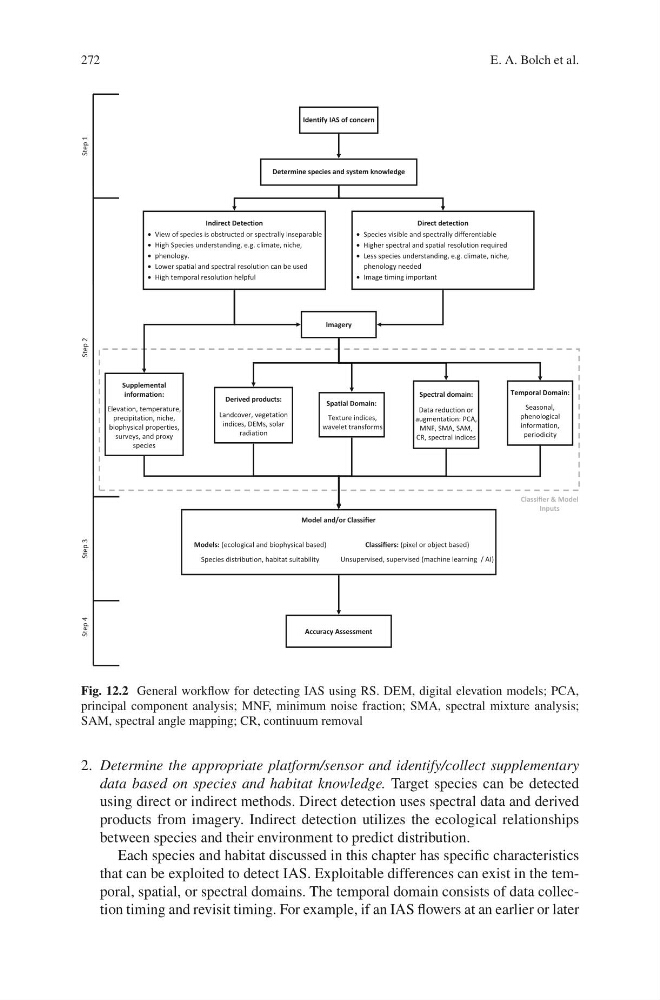
2. Determine the appropriate platform/sensor and identify/collect supplementary
data based on species and habitat knowledge. Target species can be detected
using direct or indirect methods. Direct detection uses spectral data and derived
products from imagery. Indirect detection utilizes the ecological relationships
between species and their environment to predict distribution.
Each species and habitat discussed in this chapter has specific characteristics
that can be exploited to detect IAS. Exploitable differences can exist in the temporal, spatial, or spectral domains. The temporal domain consists of data collection timing and revisit timing. For example, if an IAS flowers at an earlier or later
• View of species is obstructed or spectrally inseparable
Identify IAS of concern
Determine species and system knowledge
Indirect Detection
Direct detection
• High Species understanding, e.g. climate, niche,
• phenology.
Lower spatial and spectral resolution can be used
High temporal resolution helpful
•
•
•
•
• Less species understanding, e.g. climate, niche,
Higher spectral and spatial resolution required
Species visible and spectrally differentiable
phenology needed
Image timing important
•
Imagery
Texture indices,
wavelet transforms
Spectral domain:
Data reduction or
augmentation: PCA,
MNF, SMA, SAM,
CR, spectral indices
Temporal Domain:
Seasonal,
phenological
information,
periodicity
Accuracy Assessment
Classifier & Model
Inputs
Derived products:
Spatial Domain:
Supplemental
information:
Elevation, temperature,
precipitation, niche,
biophysical properties,
surveys, and proxy
species
Landcover, vegetation
indices, DEMs, solar
radiation
Classifiers: (pixel or object based)
Unsupervised, supervised (machine learning / AI)
Species distribution, habitat suitability
Models: (ecological and biophysical based)
Model and/or Classifier
Step 1
Step 2
Step 3
Step 4
Fig. 12.2 General workflow for detecting IAS using RS. DEM, digital elevation models; PCA,
principal component analysis; MNF, minimum noise fraction; SMA, spectral mixture analysis;
SAM, spectral angle mapping; CR, continuum removal
E. A. Bolch et al.
2. Determine the appropriate platform/sensor and identify/collect supplementary
data based on species and habitat knowledge. Target species can be detected
using direct or indirect methods. Direct detection uses spectral data and derived
products from imagery. Indirect detection utilizes the ecological relationships
between species and their environment to predict distribution.
Each species and habitat discussed in this chapter has specific characteristics
that can be exploited to detect IAS. Exploitable differences can exist in the temporal, spatial, or spectral domains. The temporal domain consists of data collection timing and revisit timing. For example, if an IAS flowers at an earlier or later
• View of species is obstructed or spectrally inseparable
Identify IAS of concern
Determine species and system knowledge
Indirect Detection
Direct detection
• High Species understanding, e.g. climate, niche,
• phenology.
Lower spatial and spectral resolution can be used
High temporal resolution helpful
•
•
•
•
• Less species understanding, e.g. climate, niche,
Higher spectral and spatial resolution required
Species visible and spectrally differentiable
phenology needed
Image timing important
•
Imagery
Texture indices,
wavelet transforms
Spectral domain:
Data reduction or
augmentation: PCA,
MNF, SMA, SAM,
CR, spectral indices
Temporal Domain:
Seasonal,
phenological
information,
periodicity
Accuracy Assessment
Classifier & Model
Inputs
Derived products:
Spatial Domain:
Supplemental
information:
Elevation, temperature,
precipitation, niche,
biophysical properties,
surveys, and proxy
species
Landcover, vegetation
indices, DEMs, solar
radiation
Classifiers: (pixel or object based)
Unsupervised, supervised (machine learning / AI)
Species distribution, habitat suitability
Models: (ecological and biophysical based)
Model and/or Classifier
Step 1
Step 2
Step 3
Step 4
Fig. 12.2 General workflow for detecting IAS using RS. DEM, digital elevation models; PCA,
principal component analysis; MNF, minimum noise fraction; SMA, spectral mixture analysis;
SAM, spectral angle mapping; CR, continuum removal
E. A. Bolch et al.