

263
spatial scale of the Atlantic Forest, the performance of RS-based climate descriptors
is comparable to, or slightly better than, that of weather station-based databases.
These results show promise for predicting different dimensions of diversity in the
tropics, based on RS data, especially for widely distributed groups. This approach
may be particularly relevant in groups or regions for which direct or indirect species
identification through RS (e.g., hyperspectral images) is feasible or available. It also
may be extended to other groups of plants, and to animals. Future directions of this
work include testing whether RS-based predictions of biodiversity work similarly
well in other biological groups, biomes, and geographical areas, while also potentially including additional variables of interest, such as topography and historical
climates.
References
Aguirre-Santoro J (2017) Taxonomy of the Ronnbergia Alliance (Bromeliaceae: Bromelioideae):
new combinations, synopsis, and new circumscriptions of Ronnbergia and the resurrected
genus Wittmackia. Plant Syst Evol 303:615–640
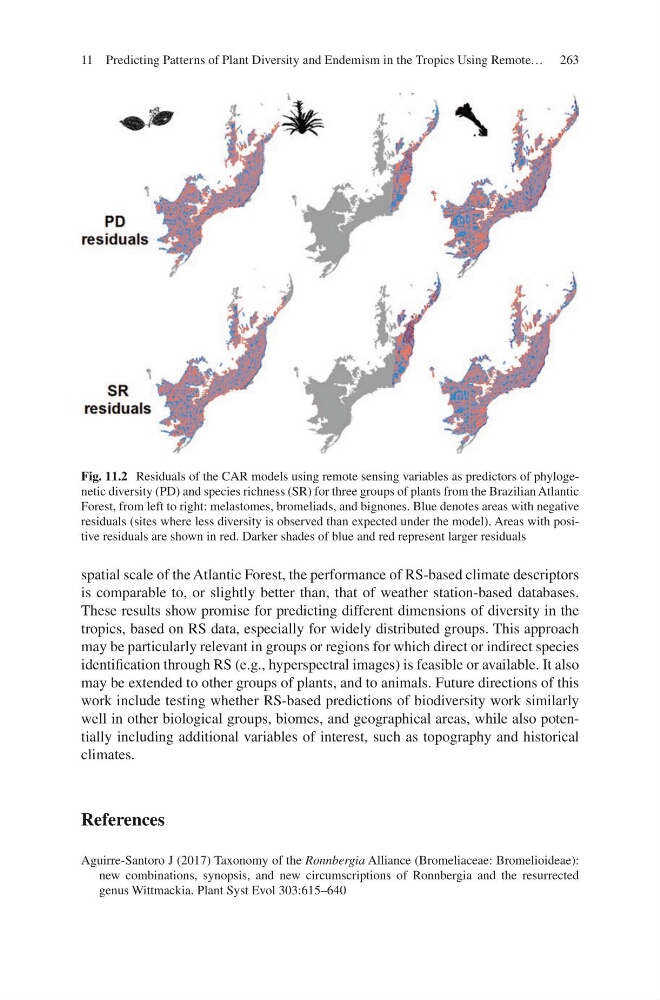
Fig. 11.2 Residuals of the CAR models using remote sensing variables as predictors of phylogenetic diversity (PD) and species richness (SR) for three groups of plants from the Brazilian Atlantic
Forest, from left to right: melastomes, bromeliads, and bignones. Blue denotes areas with negative
residuals (sites where less diversity is observed than expected under the model). Areas with positive residuals are shown in red. Darker shades of blue and red represent larger residuals
11 Predicting Patterns of Plant Diversity and Endemism in the Tropics Using Remote…
spatial scale of the Atlantic Forest, the performance of RS-based climate descriptors
is comparable to, or slightly better than, that of weather station-based databases.
These results show promise for predicting different dimensions of diversity in the
tropics, based on RS data, especially for widely distributed groups. This approach
may be particularly relevant in groups or regions for which direct or indirect species
identification through RS (e.g., hyperspectral images) is feasible or available. It also
may be extended to other groups of plants, and to animals. Future directions of this
work include testing whether RS-based predictions of biodiversity work similarly
well in other biological groups, biomes, and geographical areas, while also potentially including additional variables of interest, such as topography and historical
climates.
References
Aguirre-Santoro J (2017) Taxonomy of the Ronnbergia Alliance (Bromeliaceae: Bromelioideae):
new combinations, synopsis, and new circumscriptions of Ronnbergia and the resurrected
genus Wittmackia. Plant Syst Evol 303:615–640
Fig. 11.2 Residuals of the CAR models using remote sensing variables as predictors of phylogenetic diversity (PD) and species richness (SR) for three groups of plants from the Brazilian Atlantic
Forest, from left to right: melastomes, bromeliads, and bignones. Blue denotes areas with negative
residuals (sites where less diversity is observed than expected under the model). Areas with positive residuals are shown in red. Darker shades of blue and red represent larger residuals
11 Predicting Patterns of Plant Diversity and Endemism in the Tropics Using Remote…