

183
its native range (Lindroth and St. Clair 2013). Aspen is facing large and rapid
declines in intraspecific biodiversity because concentrated patches of aspen are currently experiencing high mortality rates in North America (Frey et al. 2004; Worrall
et al. 2008). This phenomenon, commonly referred to as sudden aspen decline
(SAD), leads to the death of apparently healthy aspen stands in 3–6 years (Shields
and Bockheim 1981; Frey et al. 2004). These natural history traits, combined with
the ecological and economic significance of the species, make trembling aspen an
ideal system to employ RS techniques to estimate genetic diversity and the consequences thereof for belowground processes.
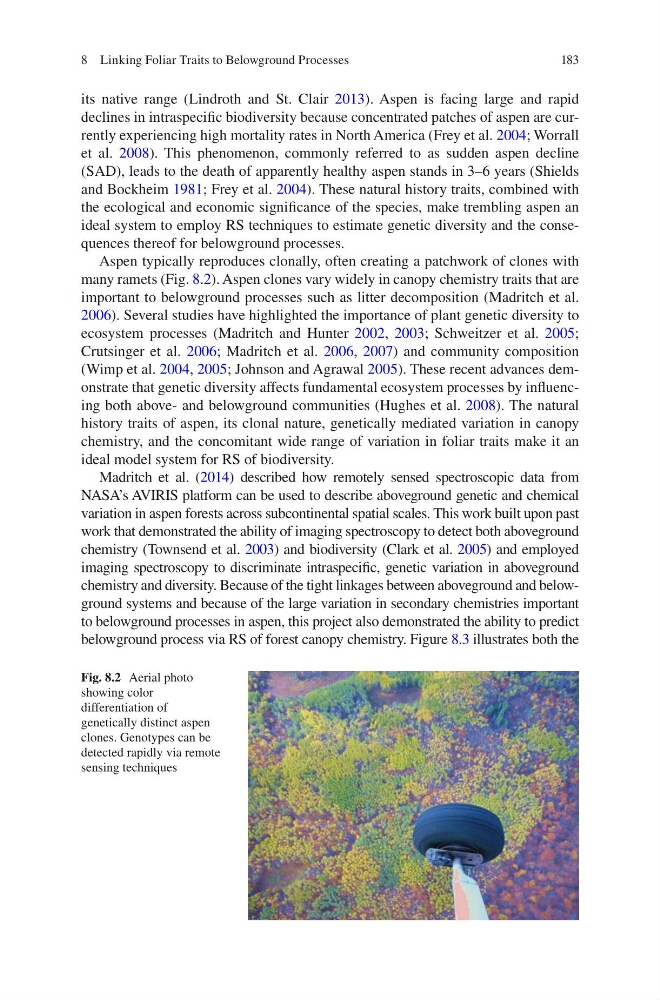
Aspen typically reproduces clonally, often creating a patchwork of clones with
many ramets (Fig. 8.2). Aspen clones vary widely in canopy chemistry traits that are
important to belowground processes such as litter decomposition (Madritch et al.
2006). Several studies have highlighted the importance of plant genetic diversity to
ecosystem processes (Madritch and Hunter 2002, 2003; Schweitzer et al. 2005;
Crutsinger et al. 2006; Madritch et al. 2006, 2007) and community composition
(Wimp et al. 2004, 2005; Johnson and Agrawal 2005). These recent advances demonstrate that genetic diversity affects fundamental ecosystem processes by influencing both above- and belowground communities (Hughes et al. 2008). The natural
history traits of aspen, its clonal nature, genetically mediated variation in canopy
chemistry, and the concomitant wide range of variation in foliar traits make it an
ideal model system for RS of biodiversity.
Madritch et al. (2014) described how remotely sensed spectroscopic data from
NASA’s AVIRIS platform can be used to describe aboveground genetic and chemical
variation in aspen forests across subcontinental spatial scales. This work built upon past
work that demonstrated the ability of imaging spectroscopy to detect both aboveground
chemistry (Townsend et al. 2003) and biodiversity (Clark et al. 2005) and employed
imaging spectroscopy to discriminate intraspecific, genetic variation in aboveground
chemistry and diversity. Because of the tight linkages between aboveground and belowground systems and because of the large variation in secondary chemistries important
to belowground processes in aspen, this project also demonstrated the ability to predict
belowground process via RS of forest canopy chemistry. Figure 8.3 illustrates both the
Fig. 8.2 Aerial photo
showing color
differentiation of
genetically distinct aspen
clones. Genotypes can be
detected rapidly via remote
sensing techniques
8 Linking Foliar Traits to Belowground Processes
its native range (Lindroth and St. Clair 2013). Aspen is facing large and rapid
declines in intraspecific biodiversity because concentrated patches of aspen are currently experiencing high mortality rates in North America (Frey et al. 2004; Worrall
et al. 2008). This phenomenon, commonly referred to as sudden aspen decline
(SAD), leads to the death of apparently healthy aspen stands in 3–6 years (Shields
and Bockheim 1981; Frey et al. 2004). These natural history traits, combined with
the ecological and economic significance of the species, make trembling aspen an
ideal system to employ RS techniques to estimate genetic diversity and the consequences thereof for belowground processes.
Aspen typically reproduces clonally, often creating a patchwork of clones with
many ramets (Fig. 8.2). Aspen clones vary widely in canopy chemistry traits that are
important to belowground processes such as litter decomposition (Madritch et al.
2006). Several studies have highlighted the importance of plant genetic diversity to
ecosystem processes (Madritch and Hunter 2002, 2003; Schweitzer et al. 2005;
Crutsinger et al. 2006; Madritch et al. 2006, 2007) and community composition
(Wimp et al. 2004, 2005; Johnson and Agrawal 2005). These recent advances demonstrate that genetic diversity affects fundamental ecosystem processes by influencing both above- and belowground communities (Hughes et al. 2008). The natural
history traits of aspen, its clonal nature, genetically mediated variation in canopy
chemistry, and the concomitant wide range of variation in foliar traits make it an
ideal model system for RS of biodiversity.
Madritch et al. (2014) described how remotely sensed spectroscopic data from
NASA’s AVIRIS platform can be used to describe aboveground genetic and chemical
variation in aspen forests across subcontinental spatial scales. This work built upon past
work that demonstrated the ability of imaging spectroscopy to detect both aboveground
chemistry (Townsend et al. 2003) and biodiversity (Clark et al. 2005) and employed
imaging spectroscopy to discriminate intraspecific, genetic variation in aboveground
chemistry and diversity. Because of the tight linkages between aboveground and belowground systems and because of the large variation in secondary chemistries important
to belowground processes in aspen, this project also demonstrated the ability to predict
belowground process via RS of forest canopy chemistry. Figure 8.3 illustrates both the
Fig. 8.2 Aerial photo
showing color
differentiation of
genetically distinct aspen
clones. Genotypes can be
detected rapidly via remote
sensing techniques
8 Linking Foliar Traits to Belowground Processes