

122
profound impacts on the biodiversity of rural landscapes (Harwood et al. 2011). The
mountain pine beetle has impacted large swaths of coniferous and mixed forests in
British Columbia, with severe impacts to avian biodiversity (Martin et al. 2006).
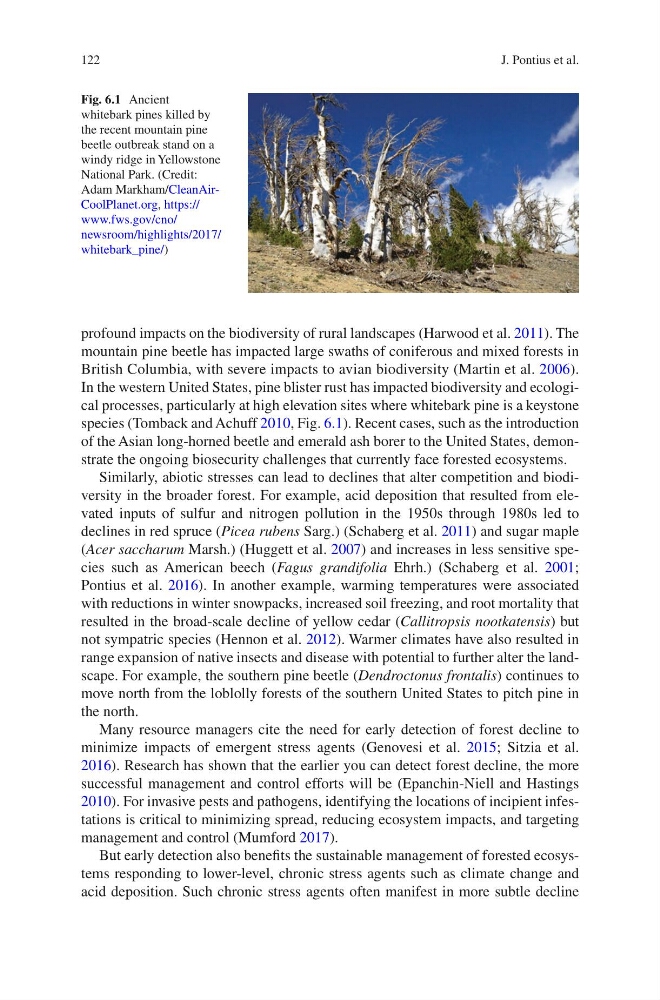
In the western United States, pine blister rust has impacted biodiversity and ecological processes, particularly at high elevation sites where whitebark pine is a keystone
species (Tomback and Achuff 2010, Fig. 6.1). Recent cases, such as the introduction
of the Asian long-horned beetle and emerald ash borer to the United States, demonstrate the ongoing biosecurity challenges that currently face forested ecosystems.
Similarly, abiotic stresses can lead to declines that alter competition and biodiversity in the broader forest. For example, acid deposition that resulted from elevated inputs of sulfur and nitrogen pollution in the 1950s through 1980s led to
declines in red spruce (Picea rubens Sarg.) (Schaberg et al. 2011) and sugar maple
(Acer saccharum Marsh.) (Huggett et al. 2007) and increases in less sensitive species such as American beech (Fagus grandifolia Ehrh.) (Schaberg et al. 2001;
Pontius et al. 2016). In another example, warming temperatures were associated
with reductions in winter snowpacks, increased soil freezing, and root mortality that
resulted in the broad-scale decline of yellow cedar (Callitropsis nootkatensis) but
not sympatric species (Hennon et al. 2012). Warmer climates have also resulted in
range expansion of native insects and disease with potential to further alter the landscape. For example, the southern pine beetle (Dendroctonus frontalis) continues to
move north from the loblolly forests of the southern United States to pitch pine in
the north.
Many resource managers cite the need for early detection of forest decline to
minimize impacts of emergent stress agents (Genovesi et al. 2015; Sitzia et al.
2016). Research has shown that the earlier you can detect forest decline, the more
successful management and control efforts will be (Epanchin-Niell and Hastings
2010). For invasive pests and pathogens, identifying the locations of incipient infestations is critical to minimizing spread, reducing ecosystem impacts, and targeting
management and control (Mumford 2017).
But early detection also benefits the sustainable management of forested ecosystems responding to lower-level, chronic stress agents such as climate change and
acid deposition. Such chronic stress agents often manifest in more subtle decline
Fig. 6.1 Ancient
whitebark pines killed by
the recent mountain pine
beetle outbreak stand on a
windy ridge in Yellowstone
National Park. (Credit:
Adam Markham/CleanAirCoolPlanet.org, https://
www.fws.gov/cno/
newsroom/highlights/2017/
whitebark_pine/)
J. Pontius et al.
profound impacts on the biodiversity of rural landscapes (Harwood et al. 2011). The
mountain pine beetle has impacted large swaths of coniferous and mixed forests in
British Columbia, with severe impacts to avian biodiversity (Martin et al. 2006).
In the western United States, pine blister rust has impacted biodiversity and ecological processes, particularly at high elevation sites where whitebark pine is a keystone
species (Tomback and Achuff 2010, Fig. 6.1). Recent cases, such as the introduction
of the Asian long-horned beetle and emerald ash borer to the United States, demonstrate the ongoing biosecurity challenges that currently face forested ecosystems.
Similarly, abiotic stresses can lead to declines that alter competition and biodiversity in the broader forest. For example, acid deposition that resulted from elevated inputs of sulfur and nitrogen pollution in the 1950s through 1980s led to
declines in red spruce (Picea rubens Sarg.) (Schaberg et al. 2011) and sugar maple
(Acer saccharum Marsh.) (Huggett et al. 2007) and increases in less sensitive species such as American beech (Fagus grandifolia Ehrh.) (Schaberg et al. 2001;
Pontius et al. 2016). In another example, warming temperatures were associated
with reductions in winter snowpacks, increased soil freezing, and root mortality that
resulted in the broad-scale decline of yellow cedar (Callitropsis nootkatensis) but
not sympatric species (Hennon et al. 2012). Warmer climates have also resulted in
range expansion of native insects and disease with potential to further alter the landscape. For example, the southern pine beetle (Dendroctonus frontalis) continues to
move north from the loblolly forests of the southern United States to pitch pine in
the north.
Many resource managers cite the need for early detection of forest decline to
minimize impacts of emergent stress agents (Genovesi et al. 2015; Sitzia et al.
2016). Research has shown that the earlier you can detect forest decline, the more
successful management and control efforts will be (Epanchin-Niell and Hastings
2010). For invasive pests and pathogens, identifying the locations of incipient infestations is critical to minimizing spread, reducing ecosystem impacts, and targeting
management and control (Mumford 2017).
But early detection also benefits the sustainable management of forested ecosystems responding to lower-level, chronic stress agents such as climate change and
acid deposition. Such chronic stress agents often manifest in more subtle decline
Fig. 6.1 Ancient
whitebark pines killed by
the recent mountain pine
beetle outbreak stand on a
windy ridge in Yellowstone
National Park. (Credit:
Adam Markham/CleanAirCoolPlanet.org, https://
www.fws.gov/cno/
newsroom/highlights/2017/
whitebark_pine/)
J. Pontius et al.