

PE and PMMA were products of Polymer Standards GmbH (Mainz, Germany).
The PE-PMMA copolymer was prepared by the group of H. Ho ¨cker [52] at
RWTH (Aachen, Germany). The monomer composition measured by
1 H-NMR
was 87.6:12.4 mol% (E/MMA).
• Polymer blends. Blend A: PE (1,100 g/mol) + PMMA + PE-PMMA, Blend B: PE
(60,000 g/mol) + PMMA + PE-PMMA. The blend components were mixed in
ratios of 1:1:1 (2 mg/mL for each component) in both cases.
3.1.3.3 Equipment
• SEC. Waters 150C (Waters Inc., Milford, USA).
• NMR. 400 MHz spectrometer AVANCE (Bruker BioSpin GmbH, Rheinstetten,
Germany). The measurements were performed with a high-temperature flow
probe containing a 120 μL flow cell. The probe was an inverse detection probe
equipped with a shielded pulsed field-gradient coil. The gradient strength was
53 G/cm. The 90
1 H pulse was 6.7 μs. WET solvent suppression [53] was
applied to TCB. Three frequencies were suppressed. The SEC-NMR system was
controlled by Hystar software (Bruker Bio-Spin GmbH, Rheinstetten,
Germany).
• Columns. Styragel HT-2, HT-3, HT-4, HT-5 and HT-6, all of 10 μm average
particle size, and column sizes of 300 mm  8 mm i.d. (Waters Inc., Eschborn,
Germany).
• Solvent. TCB.
• Sample concentration. 2 mg/mL in TCB.
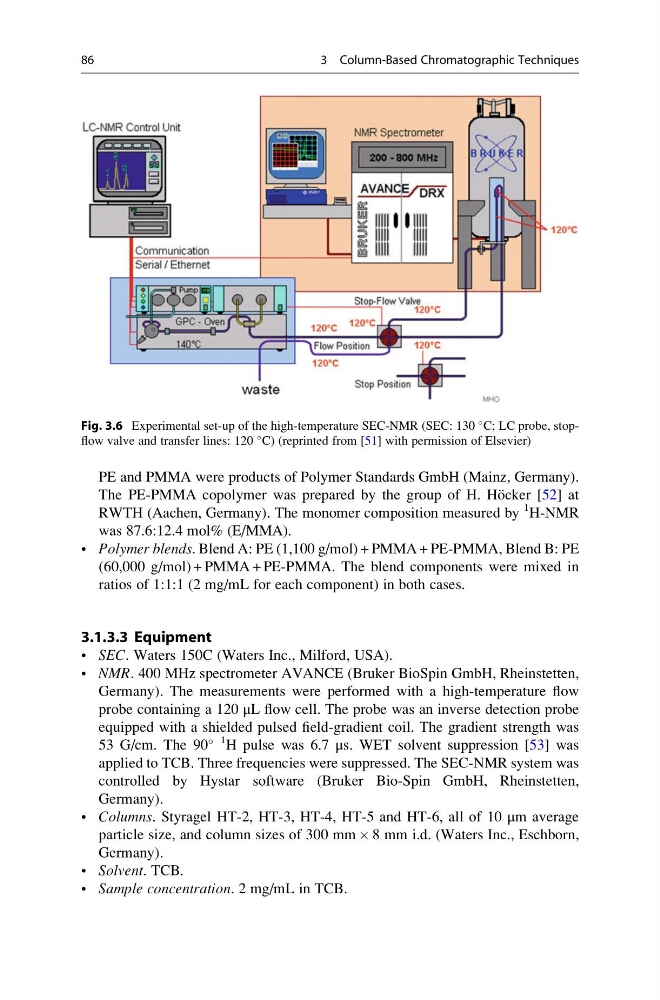
Fig. 3.6 Experimental set-up of the high-temperature SEC-NMR (SEC: 130
C; LC probe, stopflow valve and transfer lines: 120
C) (reprinted from [51] with permission of Elsevier)
86
3 Column-Based Chromatographic Techniques
The PE-PMMA copolymer was prepared by the group of H. Ho ¨cker [52] at
RWTH (Aachen, Germany). The monomer composition measured by
1 H-NMR
was 87.6:12.4 mol% (E/MMA).
• Polymer blends. Blend A: PE (1,100 g/mol) + PMMA + PE-PMMA, Blend B: PE
(60,000 g/mol) + PMMA + PE-PMMA. The blend components were mixed in
ratios of 1:1:1 (2 mg/mL for each component) in both cases.
3.1.3.3 Equipment
• SEC. Waters 150C (Waters Inc., Milford, USA).
• NMR. 400 MHz spectrometer AVANCE (Bruker BioSpin GmbH, Rheinstetten,
Germany). The measurements were performed with a high-temperature flow
probe containing a 120 μL flow cell. The probe was an inverse detection probe
equipped with a shielded pulsed field-gradient coil. The gradient strength was
53 G/cm. The 90
1 H pulse was 6.7 μs. WET solvent suppression [53] was
applied to TCB. Three frequencies were suppressed. The SEC-NMR system was
controlled by Hystar software (Bruker Bio-Spin GmbH, Rheinstetten,
Germany).
• Columns. Styragel HT-2, HT-3, HT-4, HT-5 and HT-6, all of 10 μm average
particle size, and column sizes of 300 mm  8 mm i.d. (Waters Inc., Eschborn,
Germany).
• Solvent. TCB.
• Sample concentration. 2 mg/mL in TCB.
Fig. 3.6 Experimental set-up of the high-temperature SEC-NMR (SEC: 130
C; LC probe, stopflow valve and transfer lines: 120
C) (reprinted from [51] with permission of Elsevier)
86
3 Column-Based Chromatographic Techniques