

2.2.3.4 CRYSTAF and DSC Measurements
The copolymers were prepared by solution polymerization using a single-site
catalyst. Conversions were kept to below 50 %. Comonomer contents were
restricted to an upper limit of 3.5 mol%.
13 C-NMR spectroscopy was used to
determine the amount of comonomer incorporated into the copolymer. All
copolymers had high molar masses and low molar mass dispersities. The analytical
data for the copolymers are summarized in Table 2.6.
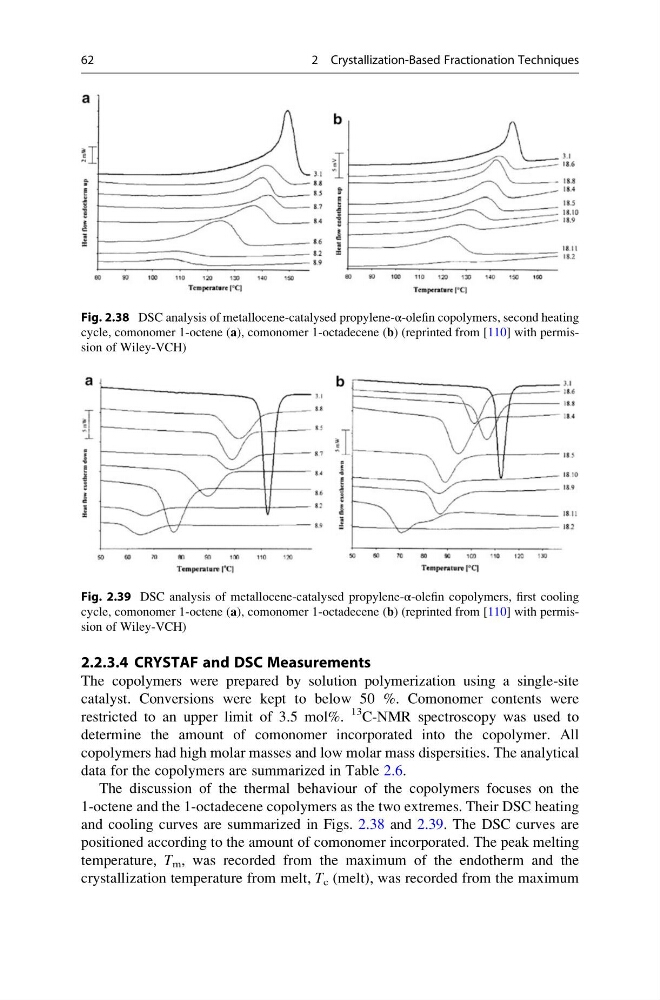
The discussion of the thermal behaviour of the copolymers focuses on the
1-octene and the 1-octadecene copolymers as the two extremes. Their DSC heating
and cooling curves are summarized in Figs. 2.38 and 2.39. The DSC curves are
positioned according to the amount of comonomer incorporated. The peak melting
temperature, T m , was recorded from the maximum of the endotherm and the
crystallization temperature from melt, T c (melt), was recorded from the maximum
Fig. 2.38 DSC analysis of metallocene-catalysed propylene-α-olefin copolymers, second heating
cycle, comonomer 1-octene (a), comonomer 1-octadecene (b) (reprinted from [110] with permission of Wiley-VCH)
Fig. 2.39 DSC analysis of metallocene-catalysed propylene-α-olefin copolymers, first cooling
cycle, comonomer 1-octene (a), comonomer 1-octadecene (b) (reprinted from [110] with permission of Wiley-VCH)
62
2 Crystallization-Based Fractionation Techniques
The copolymers were prepared by solution polymerization using a single-site
catalyst. Conversions were kept to below 50 %. Comonomer contents were
restricted to an upper limit of 3.5 mol%.
13 C-NMR spectroscopy was used to
determine the amount of comonomer incorporated into the copolymer. All
copolymers had high molar masses and low molar mass dispersities. The analytical
data for the copolymers are summarized in Table 2.6.
The discussion of the thermal behaviour of the copolymers focuses on the
1-octene and the 1-octadecene copolymers as the two extremes. Their DSC heating
and cooling curves are summarized in Figs. 2.38 and 2.39. The DSC curves are
positioned according to the amount of comonomer incorporated. The peak melting
temperature, T m , was recorded from the maximum of the endotherm and the
crystallization temperature from melt, T c (melt), was recorded from the maximum
Fig. 2.38 DSC analysis of metallocene-catalysed propylene-α-olefin copolymers, second heating
cycle, comonomer 1-octene (a), comonomer 1-octadecene (b) (reprinted from [110] with permission of Wiley-VCH)
Fig. 2.39 DSC analysis of metallocene-catalysed propylene-α-olefin copolymers, first cooling
cycle, comonomer 1-octene (a), comonomer 1-octadecene (b) (reprinted from [110] with permission of Wiley-VCH)
62
2 Crystallization-Based Fractionation Techniques