

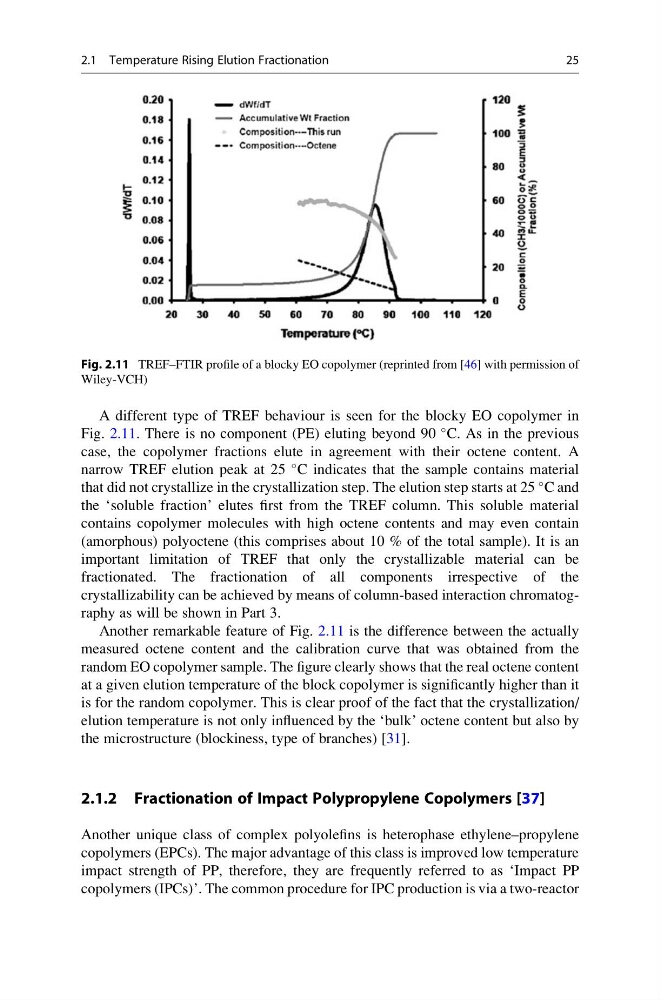
A different type of TREF behaviour is seen for the blocky EO copolymer in
Fig. 2.11. There is no component (PE) eluting beyond 90
C. As in the previous
case, the copolymer fractions elute in agreement with their octene content. A
narrow TREF elution peak at 25
C indicates that the sample contains material
that did not crystallize in the crystallization step. The elution step starts at 25
C and
the ‘soluble fraction’ elutes first from the TREF column. This soluble material
contains copolymer molecules with high octene contents and may even contain
(amorphous) polyoctene (this comprises about 10 % of the total sample). It is an
important limitation of TREF that only the crystallizable material can be
fractionated. The fractionation of all components irrespective of the
crystallizability can be achieved by means of column-based interaction chromatography as will be shown in Part 3.
Another remarkable feature of Fig. 2.11 is the difference between the actually
measured octene content and the calibration curve that was obtained from the
random EO copolymer sample. The figure clearly shows that the real octene content
at a given elution temperature of the block copolymer is significantly higher than it
is for the random copolymer. This is clear proof of the fact that the crystallization/
elution temperature is not only influenced by the ‘bulk’ octene content but also by
the microstructure (blockiness, type of branches) [31].
2.1.2 Fractionation of Impact Polypropylene Copolymers [37]
Another unique class of complex polyolefins is heterophase ethylene–propylene
copolymers (EPCs). The major advantage of this class is improved low temperature
impact strength of PP, therefore, they are frequently referred to as ‘Impact PP
copolymers (IPCs)’. The common procedure for IPC production is via a two-reactor
Fig. 2.11 TREF–FTIR profile of a blocky EO copolymer (reprinted from [46] with permission of
Wiley-VCH)
2.1 Temperature Rising Elution Fractionation
25
Fig. 2.11. There is no component (PE) eluting beyond 90
C. As in the previous
case, the copolymer fractions elute in agreement with their octene content. A
narrow TREF elution peak at 25
C indicates that the sample contains material
that did not crystallize in the crystallization step. The elution step starts at 25
C and
the ‘soluble fraction’ elutes first from the TREF column. This soluble material
contains copolymer molecules with high octene contents and may even contain
(amorphous) polyoctene (this comprises about 10 % of the total sample). It is an
important limitation of TREF that only the crystallizable material can be
fractionated. The fractionation of all components irrespective of the
crystallizability can be achieved by means of column-based interaction chromatography as will be shown in Part 3.
Another remarkable feature of Fig. 2.11 is the difference between the actually
measured octene content and the calibration curve that was obtained from the
random EO copolymer sample. The figure clearly shows that the real octene content
at a given elution temperature of the block copolymer is significantly higher than it
is for the random copolymer. This is clear proof of the fact that the crystallization/
elution temperature is not only influenced by the ‘bulk’ octene content but also by
the microstructure (blockiness, type of branches) [31].
2.1.2 Fractionation of Impact Polypropylene Copolymers [37]
Another unique class of complex polyolefins is heterophase ethylene–propylene
copolymers (EPCs). The major advantage of this class is improved low temperature
impact strength of PP, therefore, they are frequently referred to as ‘Impact PP
copolymers (IPCs)’. The common procedure for IPC production is via a two-reactor
Fig. 2.11 TREF–FTIR profile of a blocky EO copolymer (reprinted from [46] with permission of
Wiley-VCH)
2.1 Temperature Rising Elution Fractionation
25