

In the TREF fractionation part, there are five stainless steel vessels equipped
with internal filters and magnetic stir bars for dissolution and the subsequent
sequential analysis. Dissolution of the sample is achieved by heating the TREF
oven to 150
C. The injection valve is moved to the ‘load’ position in order to load
typically 1–3 mg of the sample into the TREF column through an internal filter. The
injection valve is kept at the load position in the next step when crystallization of
the sample is carried out. After complete crystallization and segregation of the
polymer in the TREF column, a discontinuous elution at increasing temperature
steps is carried out. A predefined dissolution time at each temperature is given for
different fractions. The injection valve is then switched to the ‘inject’ position to
elute the dissolved polymer fractions from the TREF column into the SEC column
set. The flow through the TREF column is stopped again after elution of the given
fraction by switching the injection valve to the ‘load’ position. The oven temperature is increased for dissolution of the next fraction. This process allows molar mass
analysis of the TREF fractions that are collected with respect to increasing crystallinity. The final chromatogram is recorded by an IR4 infrared detector and the oven
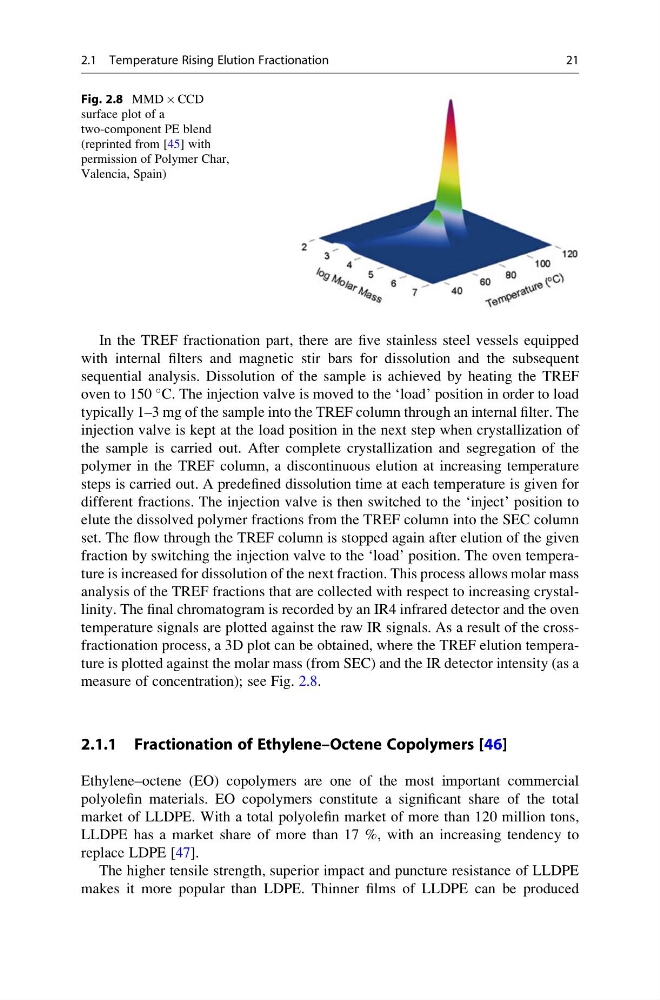
temperature signals are plotted against the raw IR signals. As a result of the crossfractionation process, a 3D plot can be obtained, where the TREF elution temperature is plotted against the molar mass (from SEC) and the IR detector intensity (as a
measure of concentration); see Fig. 2.8.
2.1.1 Fractionation of Ethylene–Octene Copolymers [46]
Ethylene–octene (EO) copolymers are one of the most important commercial
polyolefin materials. EO copolymers constitute a significant share of the total
market of LLDPE. With a total polyolefin market of more than 120 million tons,
LLDPE has a market share of more than 17 %, with an increasing tendency to
replace LDPE [47].
The higher tensile strength, superior impact and puncture resistance of LLDPE
makes it more popular than LDPE. Thinner films of LLDPE can be produced
Fig. 2.8 MMD Â CCD
surface plot of a
two-component PE blend
(reprinted from [45] with
permission of Polymer Char,
Valencia, Spain)
2.1 Temperature Rising Elution Fractionation
21
with internal filters and magnetic stir bars for dissolution and the subsequent
sequential analysis. Dissolution of the sample is achieved by heating the TREF
oven to 150
C. The injection valve is moved to the ‘load’ position in order to load
typically 1–3 mg of the sample into the TREF column through an internal filter. The
injection valve is kept at the load position in the next step when crystallization of
the sample is carried out. After complete crystallization and segregation of the
polymer in the TREF column, a discontinuous elution at increasing temperature
steps is carried out. A predefined dissolution time at each temperature is given for
different fractions. The injection valve is then switched to the ‘inject’ position to
elute the dissolved polymer fractions from the TREF column into the SEC column
set. The flow through the TREF column is stopped again after elution of the given
fraction by switching the injection valve to the ‘load’ position. The oven temperature is increased for dissolution of the next fraction. This process allows molar mass
analysis of the TREF fractions that are collected with respect to increasing crystallinity. The final chromatogram is recorded by an IR4 infrared detector and the oven
temperature signals are plotted against the raw IR signals. As a result of the crossfractionation process, a 3D plot can be obtained, where the TREF elution temperature is plotted against the molar mass (from SEC) and the IR detector intensity (as a
measure of concentration); see Fig. 2.8.
2.1.1 Fractionation of Ethylene–Octene Copolymers [46]
Ethylene–octene (EO) copolymers are one of the most important commercial
polyolefin materials. EO copolymers constitute a significant share of the total
market of LLDPE. With a total polyolefin market of more than 120 million tons,
LLDPE has a market share of more than 17 %, with an increasing tendency to
replace LDPE [47].
The higher tensile strength, superior impact and puncture resistance of LLDPE
makes it more popular than LDPE. Thinner films of LLDPE can be produced
Fig. 2.8 MMD Â CCD
surface plot of a
two-component PE blend
(reprinted from [45] with
permission of Polymer Char,
Valencia, Spain)
2.1 Temperature Rising Elution Fractionation
21