

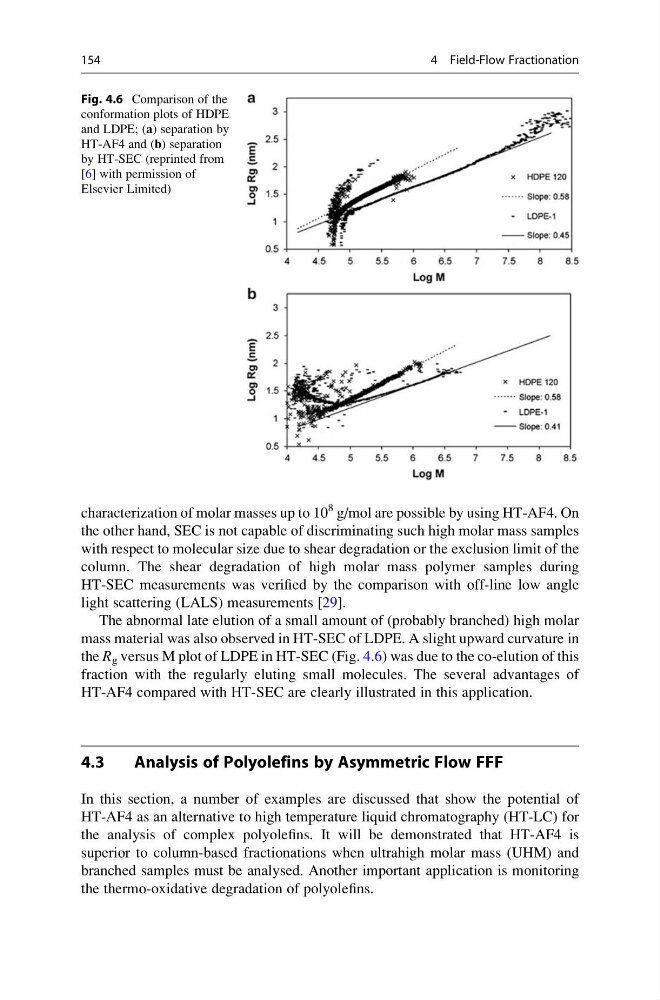
characterization of molar masses up to 10
8 g/mol are possible by using HT-AF4. On
the other hand, SEC is not capable of discriminating such high molar mass samples
with respect to molecular size due to shear degradation or the exclusion limit of the
column. The shear degradation of high molar mass polymer samples during
HT-SEC measurements was verified by the comparison with off-line low angle
light scattering (LALS) measurements [29].
The abnormal late elution of a small amount of (probably branched) high molar
mass material was also observed in HT-SEC of LDPE. A slight upward curvature in
the R g versus M plot of LDPE in HT-SEC (Fig. 4.6) was due to the co-elution of this
fraction with the regularly eluting small molecules. The several advantages of
HT-AF4 compared with HT-SEC are clearly illustrated in this application.
4.3
Analysis of Polyolefins by Asymmetric Flow FFF
In this section, a number of examples are discussed that show the potential of
HT-AF4 as an alternative to high temperature liquid chromatography (HT-LC) for
the analysis of complex polyolefins. It will be demonstrated that HT-AF4 is
superior to column-based fractionations when ultrahigh molar mass (UHM) and
branched samples must be analysed. Another important application is monitoring
the thermo-oxidative degradation of polyolefins.
Fig. 4.6 Comparison of the
conformation plots of HDPE
and LDPE; (a) separation by
HT-AF4 and (b) separation
by HT-SEC (reprinted from
[6] with permission of
Elsevier Limited)
154
4 Field-Flow Fractionation
8 g/mol are possible by using HT-AF4. On
the other hand, SEC is not capable of discriminating such high molar mass samples
with respect to molecular size due to shear degradation or the exclusion limit of the
column. The shear degradation of high molar mass polymer samples during
HT-SEC measurements was verified by the comparison with off-line low angle
light scattering (LALS) measurements [29].
The abnormal late elution of a small amount of (probably branched) high molar
mass material was also observed in HT-SEC of LDPE. A slight upward curvature in
the R g versus M plot of LDPE in HT-SEC (Fig. 4.6) was due to the co-elution of this
fraction with the regularly eluting small molecules. The several advantages of
HT-AF4 compared with HT-SEC are clearly illustrated in this application.
4.3
Analysis of Polyolefins by Asymmetric Flow FFF
In this section, a number of examples are discussed that show the potential of
HT-AF4 as an alternative to high temperature liquid chromatography (HT-LC) for
the analysis of complex polyolefins. It will be demonstrated that HT-AF4 is
superior to column-based fractionations when ultrahigh molar mass (UHM) and
branched samples must be analysed. Another important application is monitoring
the thermo-oxidative degradation of polyolefins.
Fig. 4.6 Comparison of the
conformation plots of HDPE
and LDPE; (a) separation by
HT-AF4 and (b) separation
by HT-SEC (reprinted from
[6] with permission of
Elsevier Limited)
154
4 Field-Flow Fractionation