

A special focusing flow is implemented to enhance the performance of the
polymer separation. The focusing flow enters the channel close to the center as a
second input flow and divides itself into two sub-streams, as depicted in Fig. 4.4.
The injection flow meets the one part of the second input flow near the beginning
of the channel. A sharp barrier is formed by the two flows. The sample transported
by the injection flow is focused laterally in the region where both flows come into
contact. The sample will rest at the same position until the focus flow stops. During
the focusing step, a constant detector flow is provided by the second focus flow
sub-stream. This focusing of the polymer molecules ensures the retention of the
analytes at the beginning of the channel after the injection. The focusing step
consequently provides separation of the polymer molecules with minimal longitudinal diffusion, which in turn results in less band broadening.
Giddings et al. [30] reported on the first AF4 separation at high temperature for
polystyrene (PS). The possibility of separation of polyethylene (PE) by HT-AF4
was mentioned in the same article, but no results were included. Later, Mes et al. [6]
reported on the successful separation of polyolefins with HT-AF4. Postnova Analytics (Landsberg, Germany) and Polymer Laboratories (Church Stretton, England)
joined their efforts to develop the first commercial instrument for HT-AF4. Several
different samples of high molar mass high density polyethylene (HDPE) and low
density polyethylene (LDPE) were analysed by Mes et al. using a combination of
HT-AF4 and IR, MALS and viscosity detectors. A comparison of the HT-AF4
results with the corresponding HT-SEC results has been presented [6]. A high molar
mass shoulder was observed in the SEC chromatograms for the LDPE samples that
was not noticed in the fractograms (Fig. 4.5) of the same samples. This shoulder
was the consequence of lack of size separation at the exclusion limit of the SEC
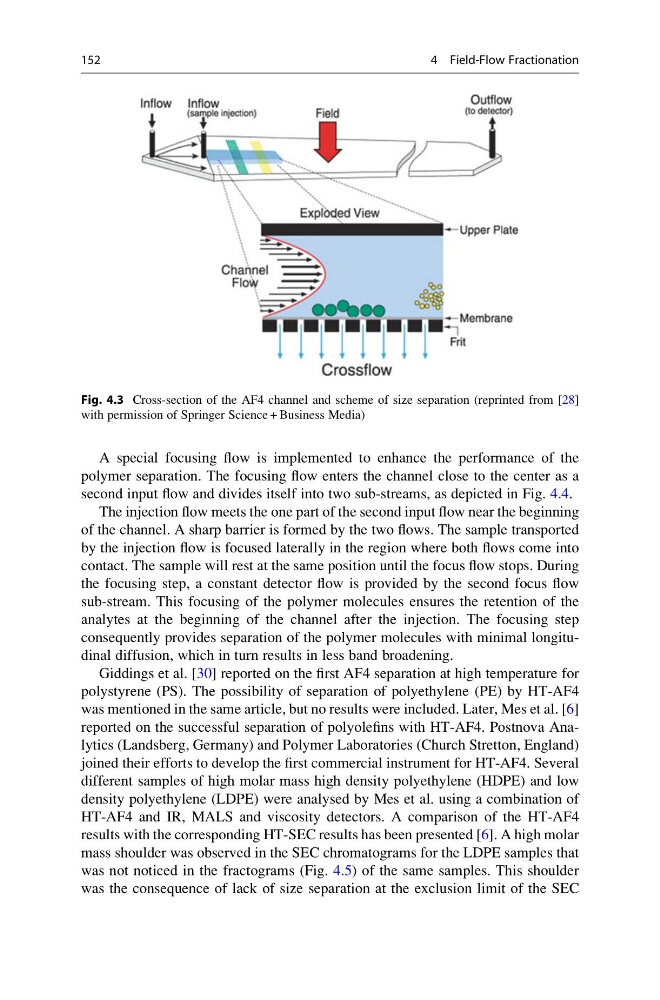
Fig. 4.3 Cross-section of the AF4 channel and scheme of size separation (reprinted from [28]
with permission of Springer Science + Business Media)
152
4 Field-Flow Fractionation
polymer separation. The focusing flow enters the channel close to the center as a
second input flow and divides itself into two sub-streams, as depicted in Fig. 4.4.
The injection flow meets the one part of the second input flow near the beginning
of the channel. A sharp barrier is formed by the two flows. The sample transported
by the injection flow is focused laterally in the region where both flows come into
contact. The sample will rest at the same position until the focus flow stops. During
the focusing step, a constant detector flow is provided by the second focus flow
sub-stream. This focusing of the polymer molecules ensures the retention of the
analytes at the beginning of the channel after the injection. The focusing step
consequently provides separation of the polymer molecules with minimal longitudinal diffusion, which in turn results in less band broadening.
Giddings et al. [30] reported on the first AF4 separation at high temperature for
polystyrene (PS). The possibility of separation of polyethylene (PE) by HT-AF4
was mentioned in the same article, but no results were included. Later, Mes et al. [6]
reported on the successful separation of polyolefins with HT-AF4. Postnova Analytics (Landsberg, Germany) and Polymer Laboratories (Church Stretton, England)
joined their efforts to develop the first commercial instrument for HT-AF4. Several
different samples of high molar mass high density polyethylene (HDPE) and low
density polyethylene (LDPE) were analysed by Mes et al. using a combination of
HT-AF4 and IR, MALS and viscosity detectors. A comparison of the HT-AF4
results with the corresponding HT-SEC results has been presented [6]. A high molar
mass shoulder was observed in the SEC chromatograms for the LDPE samples that
was not noticed in the fractograms (Fig. 4.5) of the same samples. This shoulder
was the consequence of lack of size separation at the exclusion limit of the SEC
Fig. 4.3 Cross-section of the AF4 channel and scheme of size separation (reprinted from [28]
with permission of Springer Science + Business Media)
152
4 Field-Flow Fractionation