

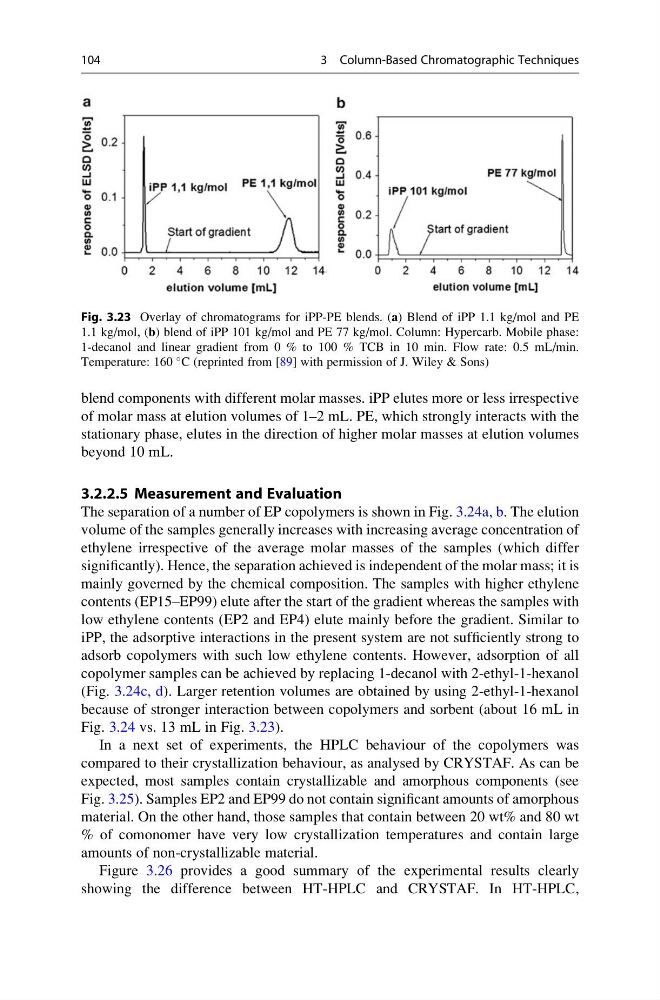
blend components with different molar masses. iPP elutes more or less irrespective
of molar mass at elution volumes of 1–2 mL. PE, which strongly interacts with the
stationary phase, elutes in the direction of higher molar masses at elution volumes
beyond 10 mL.
3.2.2.5 Measurement and Evaluation
The separation of a number of EP copolymers is shown in Fig. 3.24a, b. The elution
volume of the samples generally increases with increasing average concentration of
ethylene irrespective of the average molar masses of the samples (which differ
significantly). Hence, the separation achieved is independent of the molar mass; it is
mainly governed by the chemical composition. The samples with higher ethylene
contents (EP15–EP99) elute after the start of the gradient whereas the samples with
low ethylene contents (EP2 and EP4) elute mainly before the gradient. Similar to
iPP, the adsorptive interactions in the present system are not sufficiently strong to
adsorb copolymers with such low ethylene contents. However, adsorption of all
copolymer samples can be achieved by replacing 1-decanol with 2-ethyl-1-hexanol
(Fig. 3.24c, d). Larger retention volumes are obtained by using 2-ethyl-1-hexanol
because of stronger interaction between copolymers and sorbent (about 16 mL in
Fig. 3.24 vs. 13 mL in Fig. 3.23).
In a next set of experiments, the HPLC behaviour of the copolymers was
compared to their crystallization behaviour, as analysed by CRYSTAF. As can be
expected, most samples contain crystallizable and amorphous components (see
Fig. 3.25). Samples EP2 and EP99 do not contain significant amounts of amorphous
material. On the other hand, those samples that contain between 20 wt% and 80 wt
% of comonomer have very low crystallization temperatures and contain large
amounts of non-crystallizable material.
Figure 3.26 provides a good summary of the experimental results clearly
showing the difference between HT-HPLC and CRYSTAF. In HT-HPLC,
Fig. 3.23 Overlay of chromatograms for iPP-PE blends. (a) Blend of iPP 1.1 kg/mol and PE
1.1 kg/mol, (b) blend of iPP 101 kg/mol and PE 77 kg/mol. Column: Hypercarb. Mobile phase:
1-decanol and linear gradient from 0 % to 100 % TCB in 10 min. Flow rate: 0.5 mL/min.
Temperature: 160
C (reprinted from [89] with permission of J. Wiley & Sons)
104
3 Column-Based Chromatographic Techniques
of molar mass at elution volumes of 1–2 mL. PE, which strongly interacts with the
stationary phase, elutes in the direction of higher molar masses at elution volumes
beyond 10 mL.
3.2.2.5 Measurement and Evaluation
The separation of a number of EP copolymers is shown in Fig. 3.24a, b. The elution
volume of the samples generally increases with increasing average concentration of
ethylene irrespective of the average molar masses of the samples (which differ
significantly). Hence, the separation achieved is independent of the molar mass; it is
mainly governed by the chemical composition. The samples with higher ethylene
contents (EP15–EP99) elute after the start of the gradient whereas the samples with
low ethylene contents (EP2 and EP4) elute mainly before the gradient. Similar to
iPP, the adsorptive interactions in the present system are not sufficiently strong to
adsorb copolymers with such low ethylene contents. However, adsorption of all
copolymer samples can be achieved by replacing 1-decanol with 2-ethyl-1-hexanol
(Fig. 3.24c, d). Larger retention volumes are obtained by using 2-ethyl-1-hexanol
because of stronger interaction between copolymers and sorbent (about 16 mL in
Fig. 3.24 vs. 13 mL in Fig. 3.23).
In a next set of experiments, the HPLC behaviour of the copolymers was
compared to their crystallization behaviour, as analysed by CRYSTAF. As can be
expected, most samples contain crystallizable and amorphous components (see
Fig. 3.25). Samples EP2 and EP99 do not contain significant amounts of amorphous
material. On the other hand, those samples that contain between 20 wt% and 80 wt
% of comonomer have very low crystallization temperatures and contain large
amounts of non-crystallizable material.
Figure 3.26 provides a good summary of the experimental results clearly
showing the difference between HT-HPLC and CRYSTAF. In HT-HPLC,
Fig. 3.23 Overlay of chromatograms for iPP-PE blends. (a) Blend of iPP 1.1 kg/mol and PE
1.1 kg/mol, (b) blend of iPP 101 kg/mol and PE 77 kg/mol. Column: Hypercarb. Mobile phase:
1-decanol and linear gradient from 0 % to 100 % TCB in 10 min. Flow rate: 0.5 mL/min.
Temperature: 160
C (reprinted from [89] with permission of J. Wiley & Sons)
104
3 Column-Based Chromatographic Techniques